
What Is Agave Used For? Syrup, Fibre, Tequila and Hedging
One genus supplies sweetener, rope, mezcal and tequila, and architectural planting. Here is what each use takes, and the honest line on agave syrup.
 By
On this page
One genus produces a sweetener, industrial rope fibre, tequila, and some of the best architectural garden plants there are. The commercial uses are mostly destructive to the individual plant.
The four uses
| Use | Species | Cost to the plant |
|---|---|---|
| Syrup | A. salmiana, A. tequilana | Sap extracted; plant usually sacrificed |
| Sisal fibre | A. sisalana | Leaves cut repeatedly over years |
| Tequila | A. tequilana (blue agave) | The whole plant, at 6–8 years |
| Mezcal | Various, incl. A. angustifolia | The whole plant |
| Ornamental | Many | None — it just grows |
Agave syrup, honestly
The health positioning rests on one real fact and omits its context.
The fact: agave syrup has a low glycaemic index, because it is mostly fructose, and fructose does not raise blood glucose the way glucose does.
The context: it is mostly fructose because it is mostly fructose — typically a higher proportion than high-fructose corn syrup. Fructose is metabolised in the liver, and high intakes carry their own metabolic concerns that the GI figure does not capture.
Low GI is not the same as healthy
Agave syrup is a concentrated sugar with a particular flavour and a lower glycaemic index. That is a reasonable description and a reasonable reason to choose it for a recipe.
“Healthier than sugar” is a marketing claim the composition does not support.
It is also worth knowing that the syrup is a processed product, not a raw sap — the plant’s carbohydrates are largely inulin, which is hydrolysed into fructose during manufacture.
Sisal, which quietly built a lot of the world
Agave sisalana leaves are crushed and the long fibres extracted, dried and spun. Sisal makes rope, twine, matting, carpet backing, dartboards and reinforcement for plaster, and it was one of the major agricultural exports of East Africa and Brazil for much of the twentieth century.
Synthetic fibres took most of the market, and sisal has recovered ground where biodegradability matters — agricultural twine, geotextiles, composite reinforcement.
Tequila and mezcal
The leaves are stripped from a mature plant to expose the piña, the dense core that looks like a giant pineapple. It is cooked to convert complex carbohydrates into fermentable sugars, crushed, fermented and distilled.
Two consequences follow from the biology:
- The plant must be mature — six to eight years for blue agave
- Harvesting kills it
So every bottle represents an individual plant’s entire life, which is why agave supply has historically swung between gluts and shortages on something close to a decade-long cycle.
Mezcal is made the same way from a wider range of species, traditionally cooked in earth pits, which is where the smoky character comes from. All tequila is a mezcal by the broad definition; not all mezcal is tequila.
In the garden
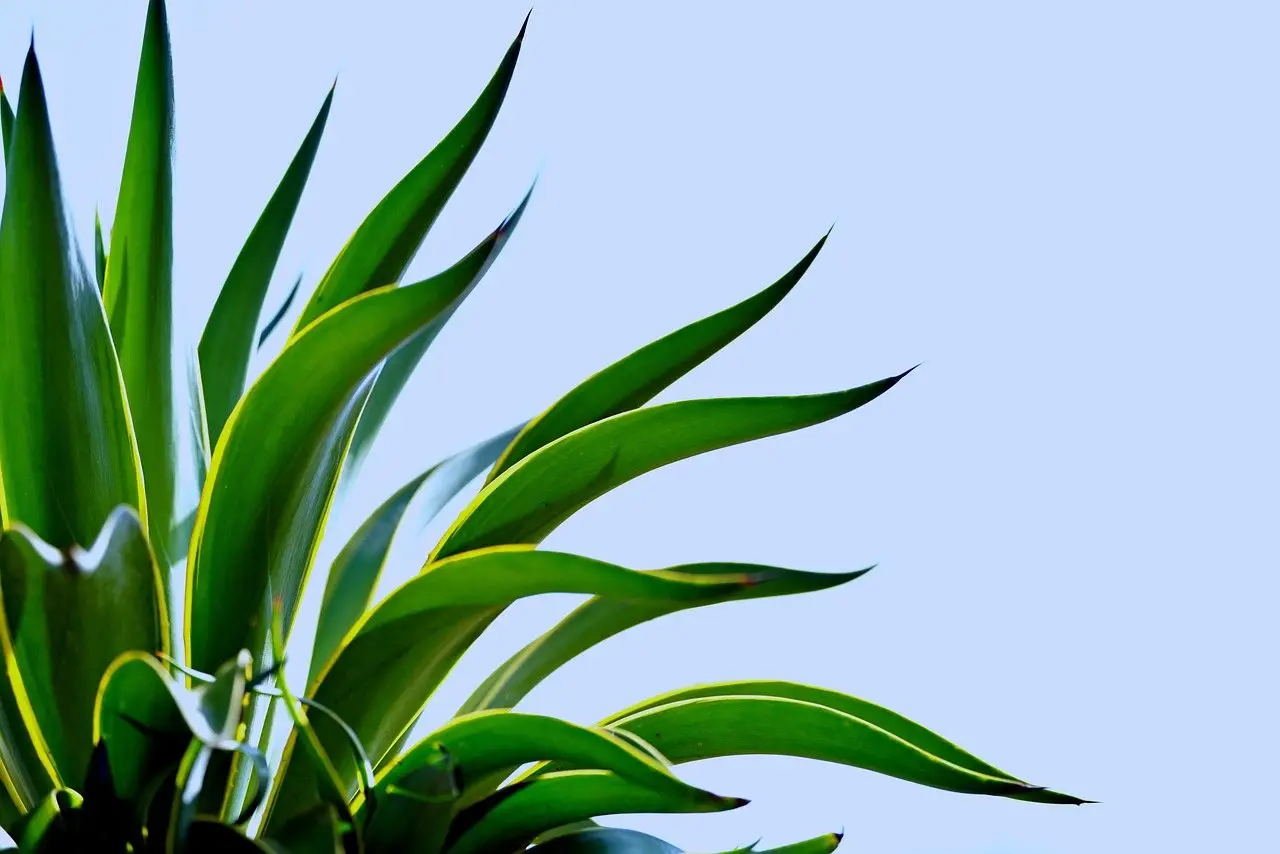
This is the use most readers will actually have.
- Full sun, as much as you can give
- Sharp drainage above everything. Gritty mix, raised bed, slope or container
- Water thoroughly, then let it dry completely. Very little in winter
- Dry winter matters more than warm winter — cold wet soil kills far more agaves than cold does
- Heavy pot, since mature plants are top-heavy
- Mind the spines. Many species have needle-sharp terminal spines at eye height on a mature plant, which is a genuine consideration near paths and children. Some growers trim the tips
They flower once and die. Most produce offsets around the base first, so the clump continues even though the flowering rosette is finished — detach and pot those on as replacements.
The flower spike itself is remarkable: several metres in a few weeks, from a plant that has done almost nothing visible for twenty years. It is worth leaving to run its course, even knowing how it ends.
Common questions
What is agave used for?
Is agave syrup healthier than sugar?
How is tequila made from agave?
Do agave plants die after flowering?
Can you grow agave in a pot?
Backyard Weekly
Know what to plant, week by week
Join the weekly email for seasonal jobs, fixes for what is going wrong, and gear worth buying.
Not ready to subscribe? The planting calendar is free and needs no email.
By subscribing you agree to our privacy policy. Grow In Backyard will never sell your address.
Keep reading
How to Grow Cacti: Light, Grit and a Dry Winter Rest
Most cacti die from winter watering, not neglect. Gritty mix, the brightest window, a soak in summer and almost nothing from October to March.
Prickly Pear Cactus Propagation: Pads, Callus, Patience
A pad twisted off at the joint and left to callus for two weeks roots easily. Rushing the callus, or burying the pad deep, is what kills them.
Zebra Plant Succulent: Haworthia Care, and Two Plants
Two very different plants share this name. The succulent Haworthiopsis is near-indestructible; the tropical Aphelandra is not. Here is how to tell.
When to Plant Hollyhock Seeds: Autumn Beats Spring
Hollyhocks are biennial, so autumn-sown seed flowers the following summer while spring sowing waits a year. Surface sow — the seed needs light.