
Zebra Plant Succulent: Haworthia Care, and Two Plants
Two very different plants share this name. The succulent Haworthiopsis is near-indestructible; the tropical Aphelandra is not. Here is how to tell.
 By
On this page
Two completely different plants are sold as “zebra plant”, and the care advice for one kills the other. Sort that out first.
Which plant do you have
| Zebra succulent (Haworthiopsis) | Zebra plant (Aphelandra) | |
|---|---|---|
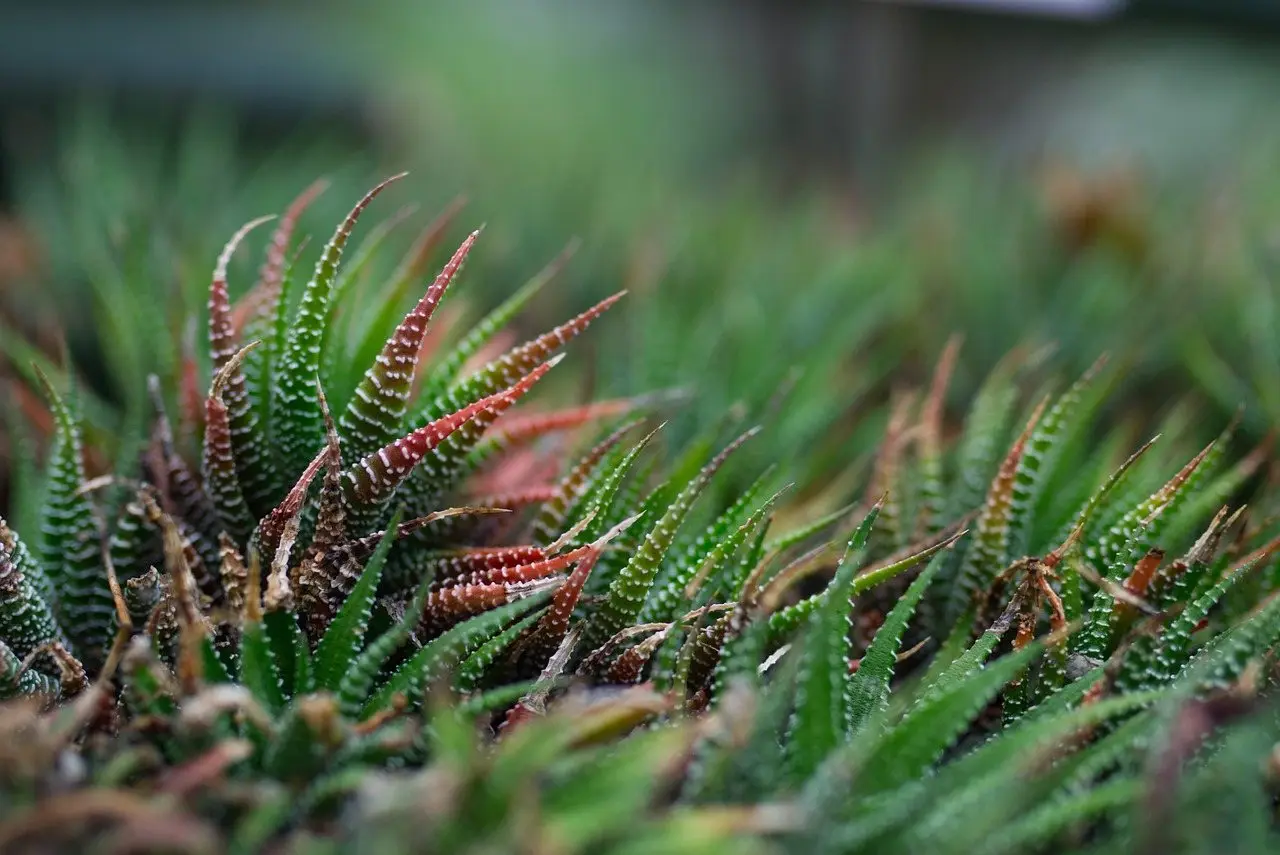
| Leaves | Stiff, dark, 5–8 cm, raised white dots | Large, glossy, white veins |
| Size | 10–15 cm rosette | Up to 60 cm shrub |
| Water | Soak and dry out fully | Constantly moist |
| Humidity | Irrelevant | High — the main difficulty |
| Light | Bright indirect; tolerates low | Bright indirect |
| Flowers | Small white, on a long thin stalk | Large yellow bracts |
| Difficulty | Very easy | Difficult |
If the leaves are thick, stiff and covered in little raised white bumps, you have the succulent and everything below applies. If they are broad, soft and glossy with white veins, you have the tropical shrub — it wants constant moisture and humidity, and it will drop its leaves if either lapses.
Caring for the succulent
Light. Bright indirect is ideal. It tolerates lower light better than almost any other succulent, which is why it thrives on desks and shelves where an echeveria would stretch and collapse. Strong direct sun turns it reddish-bronze.
Water. Soak thoroughly, then wait until the compost is completely dry.
- Summer: every two to three weeks
- Winter: every four to six
- Never leave it in a saucer
- Water the compost, not the rosette — water sitting in the crown rots it
Compost. Gritty and free-draining: cactus mix with added perlite or grit. Standard houseplant compost holds far too much water.
Pot. Small, terracotta, with drainage. Haworthia is quite happy pot-bound and an oversized pot full of damp compost is the usual route to rot.
Temperature. Ordinary room temperature. Keep it above about 10°C and away from cold glass in winter.
Feed. A dilute cactus feed once or twice in summer. Nothing in winter.
Read the leaves
This plant tells you what it needs more clearly than most.
Plump and firm — correct. Slightly wrinkled and thin — it genuinely wants water. Soft, translucent, yellowing — too much water, stop immediately.
Colour changes are usually not a problem
A Haworthia in strong light turns reddish-brown, bronze or purple. This is a stress response — the plant producing protective pigments — and it is not damage.
Whether to correct it is aesthetic. Bright indirect light restores deep green in new growth, but the leaves already coloured will stay as they are.
What are problems:
- Brown dry tips → underwatering, or very dry air
- Brown mushy base → rot. Overwatering
- White crusty marks → mineral deposits from hard water
- Stretched, pale, loose rosette → not enough light
- Grey-white cottony patches in the crevices → mealybugs
Propagation
Easier than almost any other houseplant, because the plant does the work:
- Tip it out and look for small rosettes attached at the base
- Separate an offset with its own roots where possible
- Pot into dry gritty compost, in a small pot
- Wait a week before watering
- Treat as an adult thereafter
Offsets without roots can be left to callus for a few days and then set on the compost surface, where they root in their own time.
Leaf cuttings work in theory and are slow and unreliable in this genus — unlike echeverias, where they are the standard method.
Flowering
Small white or pale pink tubular flowers on a thin stalk up to 40 cm long, far taller than the plant itself. They are unremarkable and the plant puts real energy into them.
If you are not saving seed, cut the stalk off once it appears and let the plant put that energy into offsets instead.
Common questions
What is a zebra plant succulent?
How often should you water a zebra succulent?
Why is my zebra succulent turning brown or red?
How do you propagate a zebra plant succulent?
Is the zebra succulent the same as an aloe?
Backyard Weekly
Know what to plant, week by week
Join the weekly email for seasonal jobs, fixes for what is going wrong, and gear worth buying.
Not ready to subscribe? The planting calendar is free and needs no email.
By subscribing you agree to our privacy policy. Grow In Backyard will never sell your address.
Keep reading
How to Repot a Snake Plant: Only When It Has To Be Done
Snake plants flower better and rot less when slightly pot-bound. Repot every 3–5 years, one size up, into gritty mix — and keep it dry afterwards.
How to Grow Cacti: Light, Grit and a Dry Winter Rest
Most cacti die from winter watering, not neglect. Gritty mix, the brightest window, a soak in summer and almost nothing from October to March.
How to Plant Cactus Cuttings: Callus First, Water Last
A fresh cut planted straight into damp compost rots. Let the wound callus for days or weeks, pot dry, and wait before the first watering.
Best Time to Repot Indoor Plants: Early Spring
Repot as growth resumes, not on a schedule. Most houseplants need it every two to three years — and several are better off left pot-bound.