
Do Chipmunks Have Tails? Yes — and It Tells You a Lot
Chipmunks have flat, thin, dark-edged tails they carry upright when running. How the tail differs from a squirrel's, and what it does for the animal.
 By
On this page
Yes — and it is the opposite of a squirrel’s tail in almost every respect, which is the useful part of the answer.
The comparison that actually answers the question
| Chipmunk | Grey squirrel | |
|---|---|---|
| Tail length | 3–4 in | 8–10 in, near body length |
| Shape | Flat, thin, sparse | Plumed, thick, bushy |
| Carried | Straight up when running | Arched over the back |
| Main job | Signalling, some balance | Balance, braking, warmth |
| Lives | Underground burrows | Trees |
| Face stripes | Yes | No |
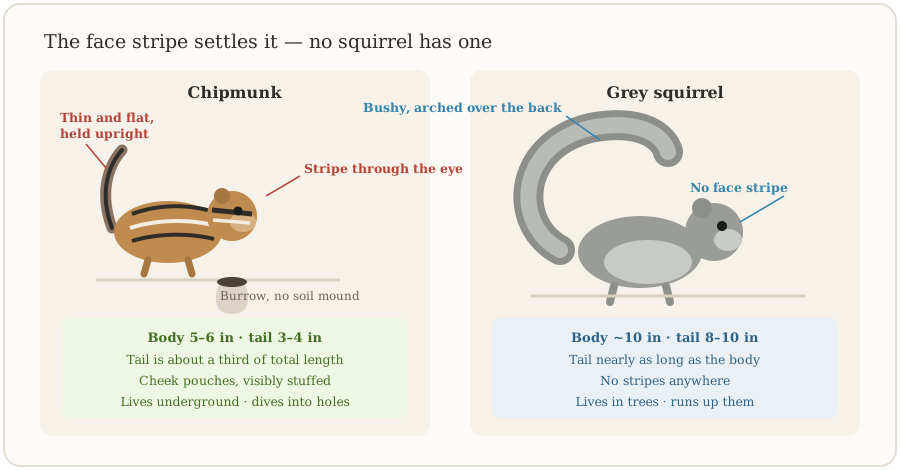
The tail follows the lifestyle. A grey squirrel spends its life in the canopy, where a long plumed tail is a rudder, an air brake and a blanket. A chipmunk spends most of its life in a burrow system that can run thirty feet with chambers barely wider than the animal — and a bushy tail in that setting is nothing but an obstruction.
What the tail does
- Signals. Held vertical on open ground, it flags position to other chipmunks the way a cottontail’s white scut does
- Flicks with the alarm call. The sharp chipping and the tail jerk are one display, not two
- Balances, modestly, when climbing — and chipmunks climb far more than people expect
- Comes off if grabbed. The tail skin can deglove, letting the animal escape a predator’s grip
A stub-tailed chipmunk is a survivor, not a sick one
Losing part of the tail to a near miss is common, the wound dries and drops away, and it does not grow back. Garden chipmunks with short stubs are ordinary and generally in fine health.
Telling them apart in the garden
If you are trying to work out what is on the patio:
- Stripes through the face — chipmunk. No North American squirrel has them
- Size — a chipmunk’s body is 5 to 6 inches; a grey squirrel’s is nearer 10
- Cheek pouches, visibly bulging with seed — chipmunk
- On the ground, diving into a hole — chipmunk. Squirrels go up
Ground squirrels are the one genuine confusion: some have body stripes too, but none has the facial stripe, and they are bigger and heavier-set.
Common questions
Do chipmunks have tails?
How is a chipmunk's tail different from a squirrel's?
Why do chipmunks hold their tails up?
Can a chipmunk lose its tail?
Do chipmunks use their tails for balance?
How do I tell a chipmunk from a squirrel at a glance?
Backyard Weekly
Know what to plant, week by week
Join the weekly email for seasonal jobs, fixes for what is going wrong, and gear worth buying.
Not ready to subscribe? The planting calendar is free and needs no email.
By subscribing you agree to our privacy policy. Grow In Backyard will never sell your address.
Keep reading
How Big Is a Chipmunk? Size, Weight and Burrow Depth
An eastern chipmunk is 8–11 inches including tail and weighs about 3 ounces — but its burrow runs 10 to 30 feet. Sizes, and when they reappear in spring.
What Do Chipmunks Eat? Seeds, Nuts, and a Lot Else
Chipmunks are omnivores hoarding seeds and nuts in cheek pouches — plus insects, eggs and fungi. What to feed them, what harms them, and why they dig your pots.
How Long Do Chipmunks Live? And Why They Dig Up Pots
Wild chipmunks rarely see three years — predators and winter mortality see to that. Realistic lifespan, what they eat, and why flower pots are such an easy target.
Do Chipmunks Live Underground? Yes, in 30 ft Burrows
Do chipmunks live underground: yes, in burrow systems up to 30 ft long with separate chambers. What that means for your lawn, and why the entrance has no soil pile.