Are Corn Snakes Poisonous? No, and Not Venomous Either
Corn snakes are harmless constrictors often killed on sight because they mimic copperheads. How to tell them apart, and why one is worth keeping around.

On this page
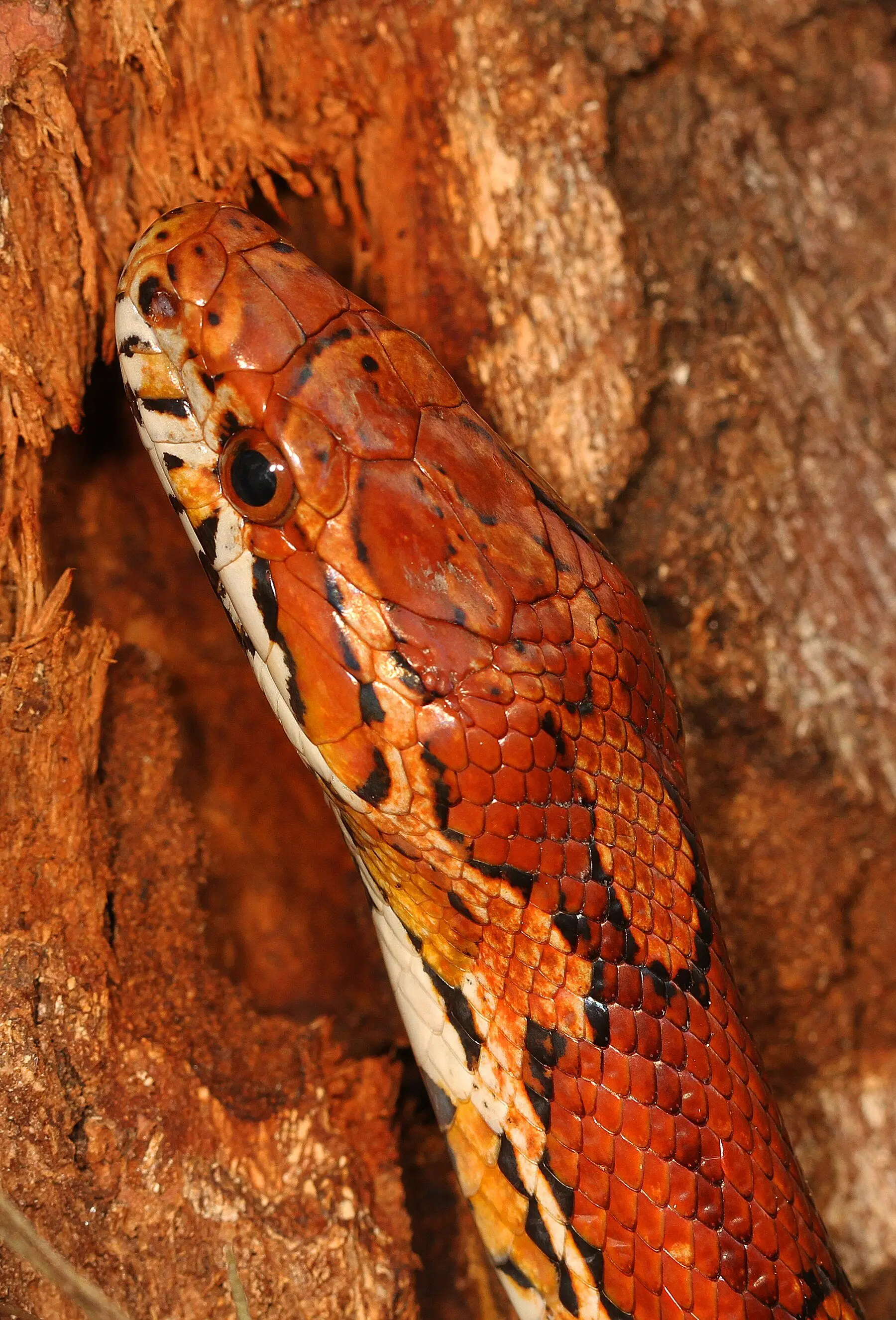
No. Corn snakes have no venom, no fangs, and no toxicity of any kind. They are constrictors, and they are one of the most harmless snakes in North America.
The reason the question gets asked so often is that corn snakes are killed on sight constantly — mistaken for copperheads, which they superficially resemble and which are genuinely venomous.
Poisonous and venomous are not the same word
Worth settling, because it is the actual question underneath.
- Venomous — injects a toxin, through fangs, a sting or a spine.
- Poisonous — harms you if you touch or eat it.
Almost no snake is poisonous. Some are venomous. Corn snakes are neither.
Telling a corn snake from a copperhead
Check from a safe distance and never handle a snake to identify it.
| Feature | Corn snake (harmless) | Copperhead (venomous) |
|---|---|---|
| Head shape | Rounded, barely wider than the neck | Broad, triangular, distinctly wider |
| Pupils | Round | Vertical, cat-like |
| Facial pit | None | Heat-sensing pit between eye and nostril |
| Belly | Black-and-white chequerboard | Plain, pale, unmarked |
| Pattern | Blotches with black borders, roughly square | Hourglass crossbands — wide at the sides, narrow over the spine |
| Colour | Orange, red, rust on tan or grey | Copper, tan, pinkish |
| Build | Slender | Thick and heavy-bodied |
| Behaviour | Flees quickly | Often freezes and relies on camouflage |
The belly is the single clearest tell if you can see it — that black-and-white chequerboard is unmistakable and copperheads have nothing like it.
The pattern shape is the best one from a distance. A copperhead’s crossbands are wide along the flanks and pinch narrow across the back, like a row of hourglasses seen from above. A corn snake’s blotches are roughly square and evenly bordered.
If you are not certain, just leave it
No identification guide is worth a bite, and the practical answer to any unidentified snake is the same as the answer to a corn snake: step back and leave it alone. Snakes bite defensively, and almost every snakebite in a garden happens because someone tried to kill, catch or move the animal. Give it room and it leaves on its own.
What they do in a garden
Corn snakes are excellent rodent control. An adult eats mice, rats, voles and the occasional bird egg, and it hunts in exactly the places rodents live — under sheds, in compost heaps, along walls, inside outbuildings.
They also occupy territory and prey that venomous species would otherwise use, so a resident corn snake makes a copperhead less likely rather than more.
They are shy, mostly active at dawn and dusk, and generally seen only when disturbed or when crossing open ground. A corn snake in a garden is a sign of a healthy rodent population, which is worth noticing separately — see can rats climb walls if you would rather address the food source.
If one turns up somewhere inconvenient
In the garden: leave it. It will move on.
In a shed, garage or outbuilding: open a door, leave the room, and give it a few hours. If it stays, a gentle nudge with a soft broom in the direction of the exit works, or a hose on a light spray.
Indoors: contact a local reptile rescue or wildlife service. Do not try to catch it, and do not use glue traps — they cause a slow death and are inhumane for any animal.
Prevention is the same as for rodents: seal gaps at ground level, keep grass short near the house, move woodpiles and debris away from walls, and reduce the rodent population that drew the snake in.
Do they bite?
Rarely. A frightened corn snake will try to flee first, then vibrate its tail against dry leaves — a convincing rattlesnake impression that is pure bluff — then release a foul-smelling musk.
If one does bite, the teeth are small, backward-curving and designed for gripping mice. The result is a few pinprick scratches. Wash it like any minor graze.
Their temperament is exactly why they are among the most commonly kept pet snakes in the world.
Common questions
Are corn snakes poisonous or venomous?
Do corn snakes bite?
How do you tell a corn snake from a copperhead?
Should you remove a corn snake from your garden?
What is the difference between poisonous and venomous?
Where do corn snakes live?
Backyard Weekly
Know what to plant, week by week
Free planting calendar. Join the weekly email for seasonal jobs, fixes for what is going wrong, and gear worth buying.
Set MONETIZATION.email.endpoint in src/config/site.ts to enable this form.
By subscribing you agree to our privacy policy. Grow In Backyard will never sell your address.
Keep reading
What Do Backyard Lizards Actually Eat?
Wild lizards in a garden are almost entirely insect-eaters, not the varied diet pet-care sites describe. What they hunt, and what draws more of them to your yard.
Can Rats Climb Walls? Brick and Pipes, Yes. Glass, No.
Rats climb rough vertical surfaces easily, jump three feet up and squeeze through a 20mm gap. What that means for sealing a house, and what actually stops them.
How Long Do Lizards Live? By Species, Wild vs. Kept
Backyard lizard lifespan runs from 1 year to over 20, depending entirely on species and whether it is wild or kept as a pet. The real numbers, by common type.

How Long Do Koi Live? 25 to 35 Years, With Caveats
Koi routinely outlive the pond they were bought for. What actually sets lifespan, the volume they need, and why the famous 226-year fish is not the benchmark.