Why Are My Tomatoes Splitting? Water, Almost Always
Tomatoes split when a dry spell is followed by heavy water — the inside grows faster than the skin. How to read the crack, and how to stop it happening.

On this page
A tomato splits for a mechanical reason, not a medical one. The flesh inside takes up water faster than the skin around it can stretch, and the skin gives way. Everything else about the problem — which variety, which week, which crack pattern — follows from that.
Almost always the trigger is a swing: a dry stretch, then a downpour or a thorough watering.
What is physically happening
A ripening tomato is mostly water held inside a skin that has largely stopped growing. During a dry spell that skin toughens and loses elasticity while the fruit sits more or less still.
Then the water arrives. Roots take it up, the plant moves it into the fruit — ripening fruit is a strong sink for water — and the flesh expands quickly. The skin, now less elastic than the flesh it contains, reaches its limit and tears.
Heat makes it worse in two ways: it dries the soil faster before the event, and hot fruit skins are already under more strain.
Why it so often happens overnight
Fruit takes up most of its water at night, when the leaves are not transpiring and the plant’s internal water pressure is highest. That is why tomatoes that looked perfect at dusk are split by morning after an evening downpour.
Reading the crack
| Pattern | Looks like | Usual cause | Serious? |
|---|---|---|---|
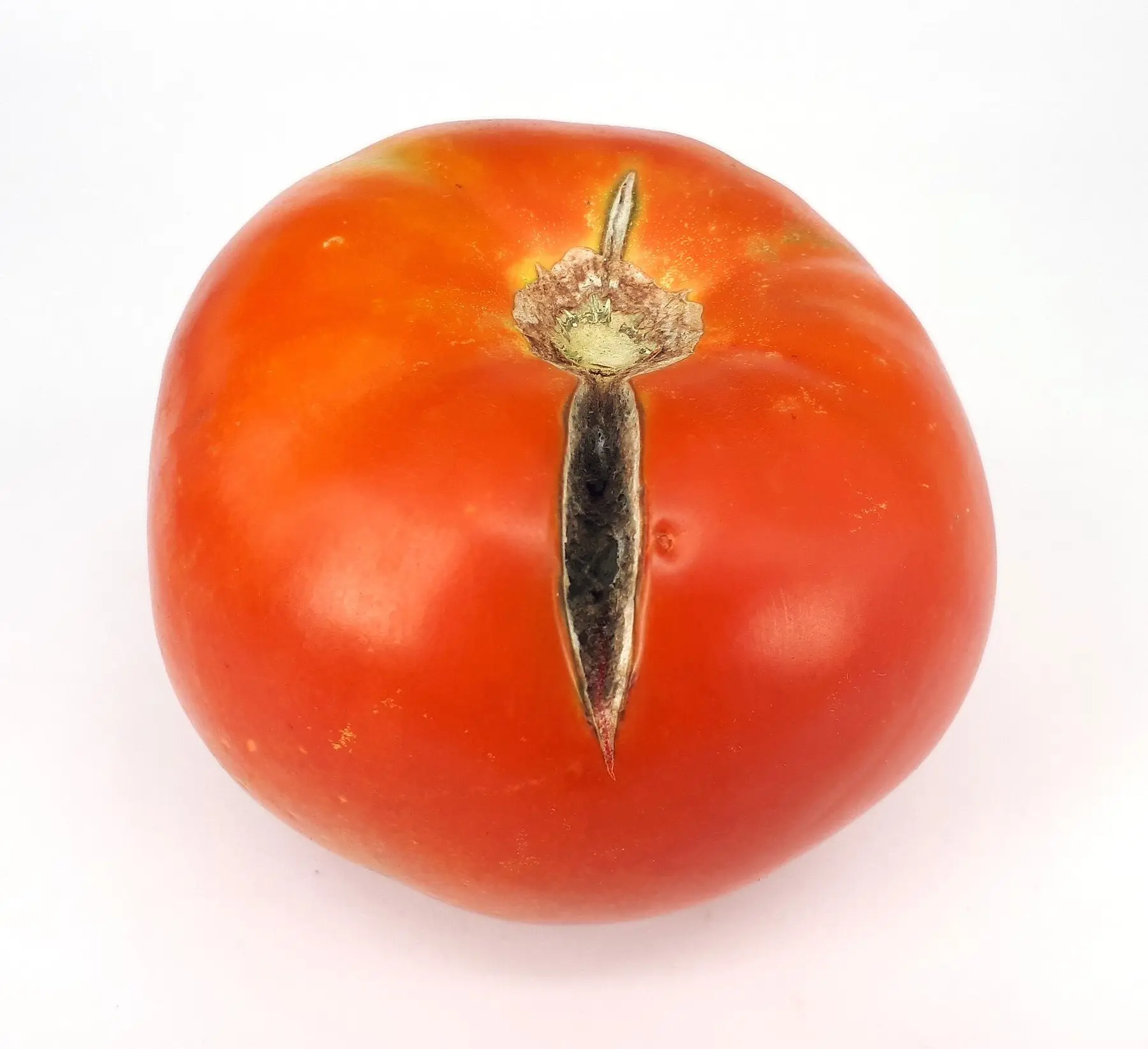
| Radial | Splits running from the stem down the shoulder | Sharp dry-to-wet swing | Yes — deep, lets rot in |
| Concentric | Fine rings circling the stem end | Variety, plus mild swings | Usually not |
| Both together | Rings plus deep splits | Heavy rain after drought | Yes |
| Split at the base | Not cracking at all | Blossom end rot — dark, sunken | Different problem |
Radial cracks are the ones to act on. They run deep, open a path into the fruit, and colonise with mould or fruit flies within a day or two in warm weather.
Concentric rings are largely cosmetic. Many older and larger varieties do it as a matter of course, and the fruit is perfectly good.
The varieties that crack
Susceptibility varies enormously, and no amount of watering discipline makes a crack-prone heirloom behave like a modern crack-resistant hybrid.
Large beefsteaks and heirlooms tend to be worst — thin skins bred for eating quality rather than resilience. Cherry tomatoes crack readily too, because their skin-to-volume ratio leaves little room for expansion, which is why a whole truss can split after one wet night.
If splitting is a recurring annoyance rather than an occasional one, changing variety does more than any cultural fix. Seed catalogues list crack resistance, and it is worth reading.
Preventing it
Water consistently. This is the whole game. A deep soak twice a week beats a light daily sprinkle and beats an occasional flood far more. What you are trying to eliminate is the swing, not the quantity.
Mulch two to three inches deep. Straw, compost, or bark on the soil surface slows evaporation and buffers the soil against exactly the rapid changes that cause cracking. It is the single most effective thing you can do, and it helps with blossom end rot at the same time.
Watch the forecast and pick early. A tomato at the blush stage — just turning, still firm — will ripen perfectly well on a windowsill. Picking the nearly-ripe fruit ahead of forecast heavy rain saves the crop that would otherwise split that night.
Mind containers especially. Pots swing between wet and dry far faster than open ground, which is why container tomatoes split more. A bigger pot and a surface mulch both flatten the curve.
Do not chase it with calcium or feed
Splitting is mechanical. Calcium sprays, epsom salts, and extra fertiliser do nothing for it, and high-nitrogen feed arguably makes it slightly worse by pushing soft, fast growth. The confusion is with blossom end rot — the dark, sunken, leathery patch on the bottom of the fruit — which is a calcium-availability problem. Even that is usually solved by watering consistently rather than by adding calcium, because erratic water is what stops the plant moving the calcium it already has.
What to do with the split ones
Pick them straight away rather than leaving them on the plant. A crack is an open wound, and in warm weather it attracts fruit flies and goes mouldy quickly — and a rotting fruit left on the truss spreads to its neighbours.
A fresh, clean split is fine to eat: cut the damaged section out and use the rest that day. They do not keep, and they are not worth storing, but they are perfectly good in a sauce, a salad, or on toast. Anything soft, dark, weeping, or mouldy at the crack goes in the compost.
Common questions
Why do tomatoes split on the vine?
Can you eat tomatoes that have split?
What is the difference between radial and concentric cracking?
How do I stop my tomatoes from splitting?
Does calcium or fertiliser fix splitting?
Backyard Weekly
Know what to plant, week by week
Free planting calendar. Join the weekly email for seasonal jobs, fixes for what is going wrong, and gear worth buying.
Set MONETIZATION.email.endpoint in src/config/site.ts to enable this form.
By subscribing you agree to our privacy policy. Grow In Backyard will never sell your address.
Keep reading
Tomato Plant Leaves Curling: 7 Causes, and Which Matter
Most curling tomato leaves are harmless leaf roll from heat or water stress. A few causes are serious. Here is how to tell them apart in under a minute.
Companion Plants for Tomatoes (And 5 to Keep Away)
Basil, marigolds, and borage earn their place next to tomatoes. Fennel, potatoes, and brassicas do not. What to plant together, and why each pairing works.
What Smells Do Mosquitoes Hate? What Works and What Does Not
Citronella, lavender and peppermint all repel mosquitoes in a lab. Almost none of it survives contact with a real backyard — here is what actually reduces bites.
How to Use Neem Oil on Plants Without Burning Them
The right dilution, why it needs soap to mix, when to spray, and which pests it works on. Neem is slow and specific — treat it as a knockdown and it fails.