
Tiny White Bugs on Plants: Identifying What You Have
Five different pests look like white specks. How to tell mealybugs, whitefly, thrips, mites and springtails apart — and which one is harmless.
 By
On this page
Five different things look like white specks on a plant, and they need four different responses. One of them is harmless and needs none.
Work out which one you have
| What you see | What it is | Harmful? |
|---|---|---|
| White cottony blobs, still, in leaf joints and stem crotches | Mealybugs | Yes |
| Tiny white moths that fly up in a cloud when disturbed | Whitefly | Yes |
| Specks that hop on the compost surface when watered | Springtails | No |
| Fine webbing, minute dots, stippled pale leaves | Spider mites | Yes |
| Slender specks, silvery scarred leaves, black dots of frass | Thrips | Yes |
| White fuzzy patches on the compost surface | Saprophytic mould | No |
| White crust on the pot rim or soil | Mineral salts | No |
The quickest test: disturb the plant
A cloud rises → whitefly.
Nothing moves → mealybugs, scale, or something that is not an insect at all.
Movement on the soil, not the plant → springtails or fungus gnat larvae, not a foliage pest.
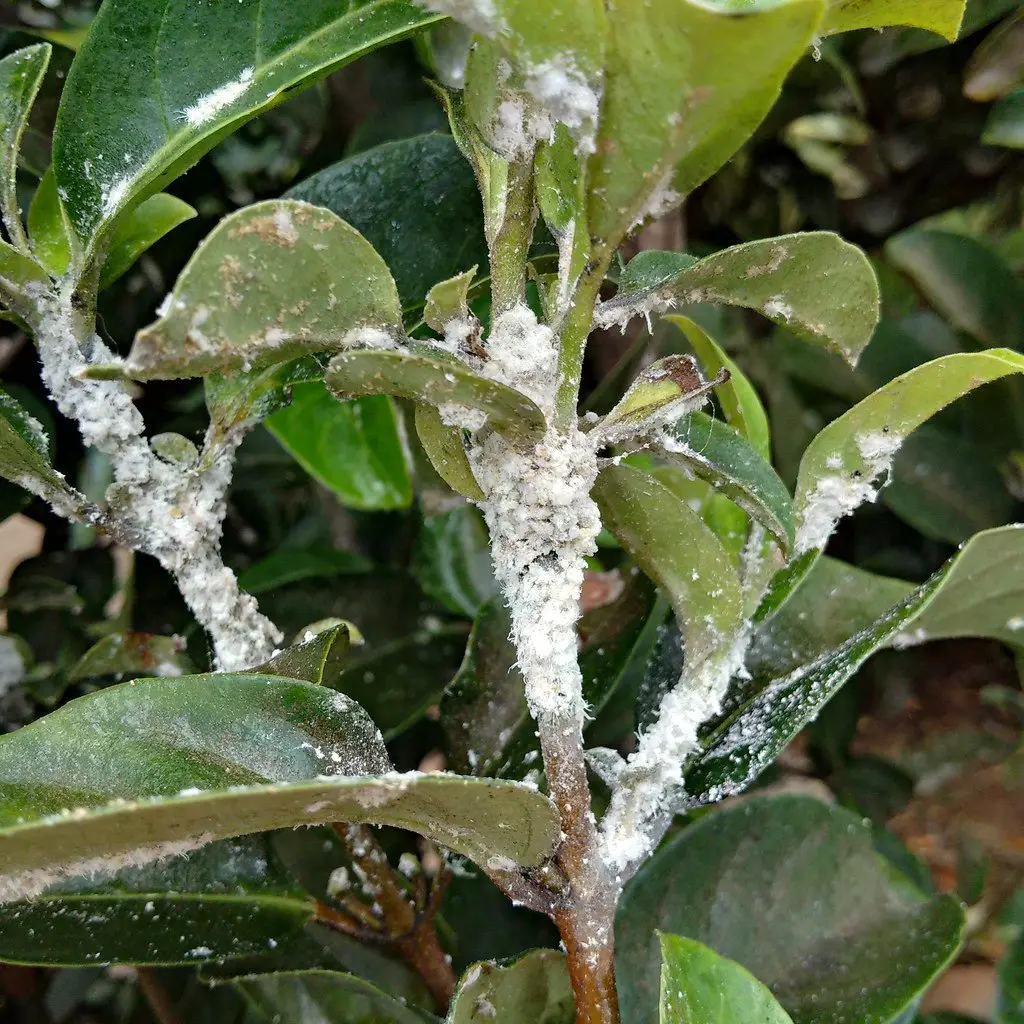
Mealybugs
White, oval, slow, covered in a waxy cotton-like coat that repels water — and therefore repels most sprays. They wedge into leaf joints, stem crotches and under leaf edges.
Treatment:
- Isolate the plant immediately. They crawl to neighbours
- Rubbing alcohol on a cotton bud, touched to each insect. The alcohol dissolves the wax and kills on contact — this is the most reliable method for anything you can see
- Follow up weekly for a month. Eggs hatch in batches, so one pass never finishes it
- Spray insecticidal soap or neem for heavy infestations, covering undersides, joints and the compost surface
- Check the roots when repotting. Root mealybugs look like white powder on the root ball and survive every foliar treatment
A plant that keeps reinfesting probably has them on the roots
If foliar treatment works and the problem returns weeks later, unpot the plant and look. White waxy deposits among the roots are root mealybugs, and they need the root ball washed clean and the plant repotted into fresh compost in a clean pot — or, often, the plant discarded.
Whitefly
Tiny white winged insects on leaf undersides, rising in a cloud when disturbed. They breed fast and spread between plants by flying, so they are the most contagious of the group.
- Yellow sticky traps — genuinely effective, and they tell you the population trend
- Spray undersides with insecticidal soap or neem, every 5 to 7 days for several weeks
- Vacuum the adults off in the morning while they are sluggish
- Remove the worst leaves rather than trying to save them
- Outdoors they are mostly cosmetic on a large plant; indoors and in greenhouses they build without limit
They lay on the undersides, so a spray that only hits the tops of leaves does nothing.
Springtails — leave them alone
Minute, white or grey, and they jump when the soil is disturbed. They eat decaying matter and fungi, not roots.
They indicate compost kept too wet, nothing more. Let the top inch or two dry properly between waterings and they disappear on their own. No treatment is warranted, and insecticide applied to soil for springtails is wasted.
Fungus gnat larvae live in the same conditions and do damage fine roots — small black flies rather than jumping specks. Those are worth acting on.
Spider mites
Barely visible dots, usually with fine webbing between leaves and stems, and a stippled, dusty, pale look to the foliage. They thrive in dry heated air, which is why they are a winter houseplant problem.
- Shower the plant thoroughly, undersides especially
- Raise humidity — this alone suppresses them substantially
- Neem or insecticidal soap, every 5 to 7 days for three weeks
- Isolate, because they spread on air currents and contact
- Badly infested plants are often better discarded than treated
Thrips
Slender, fast, and they leave a distinctive trace: silvery scarred patches on leaves, often with tiny black dots of excrement, and distorted new growth.
- Blue sticky traps catch and monitor them
- Neem, weekly, several times
- Remove damaged growth, which does not recover
- Check flowers, where they concentrate
Preventing all of them
- Quarantine new plants for two to three weeks. This prevents most introductions outright
- Look at leaf undersides when you water. Ten insects is a five-minute job; a thousand is a lost plant
- Do not over-water or over-feed. Soft sappy growth from heavy nitrogen is what sap-suckers prefer
- Raise humidity indoors in winter — specifically against spider mites
- Wash your hands and tools between plants when treating an infestation
Common questions
What are the tiny white bugs on my plants?
Are the white bugs in my houseplant soil harmful?
How do I get rid of mealybugs?
What is the difference between whitefly and mealybugs?
Will neem oil kill white bugs on plants?
How do I stop white bugs coming back?
Backyard Weekly
Know what to plant, week by week
Join the weekly email for seasonal jobs, fixes for what is going wrong, and gear worth buying.
Not ready to subscribe? The planting calendar is free and needs no email.
By subscribing you agree to our privacy policy. Grow In Backyard will never sell your address.
Keep reading
Fungus Gnats: Kill the Larvae, Not the Flies You See
The adults are harmless; the larvae in the top inch of compost are what damage roots. Why letting the surface dry works, and what actually breaks the cycle.
How to Use Neem Oil on Plants Without Burning Them
The right dilution, why it needs soap to mix, when to spray, and which pests it works on. Neem is slow and specific — treat it as a knockdown and it fails.
Spider Plant Care: Brown Tips, Babies and Why It Stops
Spider plants are nearly unkillable but tell you everything through their tips. Water, light, why yours has no babies, and propagating the ones it has.
Types of Stink Bugs: Which Are Pests and Which Help
Not every shield bug is a problem — some eat the ones that are. How to tell the invasive brown marmorated from natives, and what to do about each.