
Mulberry Tree: Which to Plant, and the Staining Problem
Mulberries crop heavily within a few years and stain everything under them. Choosing a species, siting it away from paths, and the fruitless myth.
 By
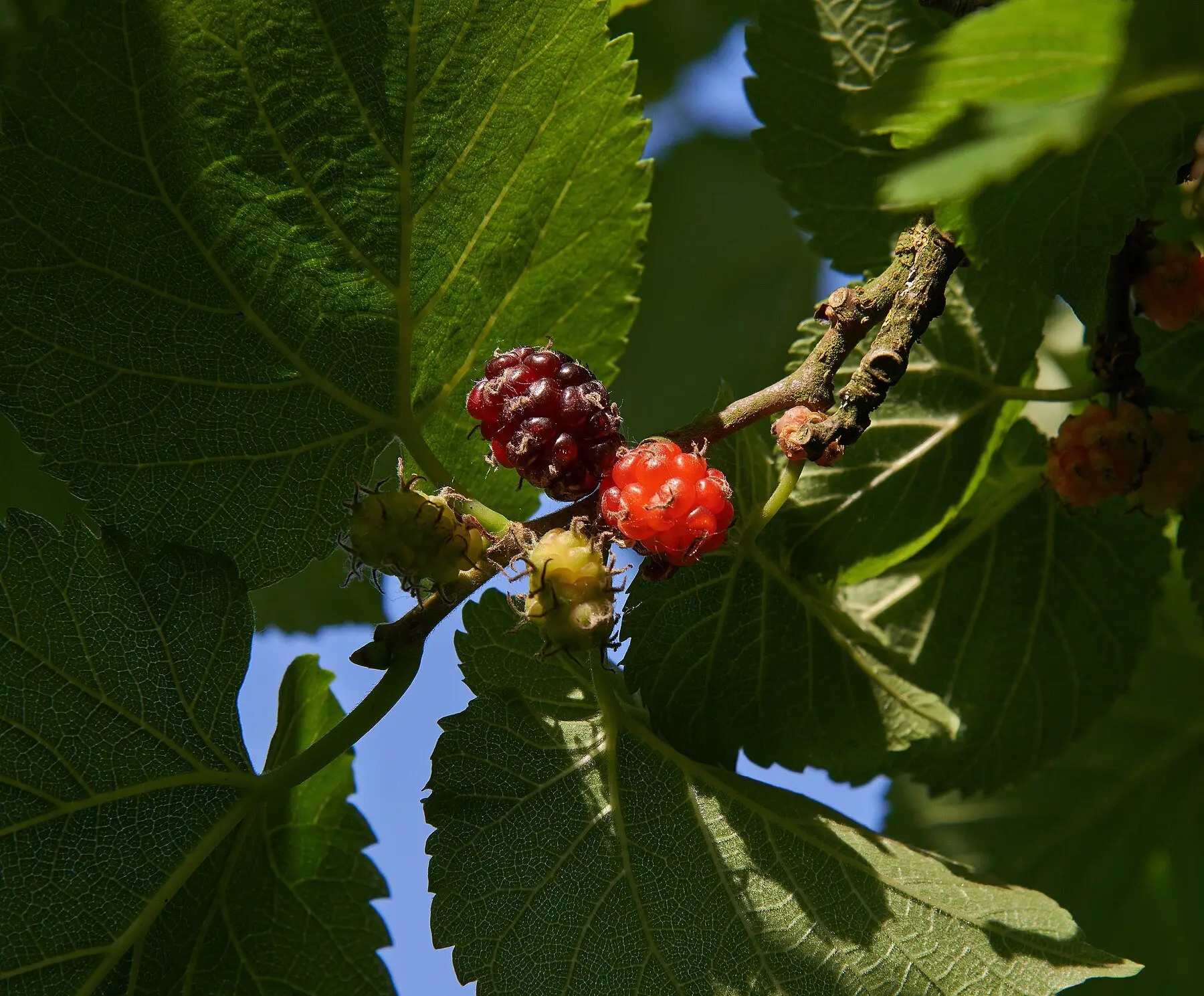

On this page
Mulberries are among the fastest trees to reward you with fruit — and among the messiest things you can plant near a patio. Both facts matter equally when choosing where to put one.
The three species
| Black (M. nigra) | Red (M. rubra) | White (M. alba) | |
|---|---|---|---|
| Flavour | The best — rich, tart, complex | Good, sweet | Mild, often insipid |
| Hardiness | Zone 7+ | Zone 4+ | Zone 4+ |
| Origin | Southwest Asia | North America, native | China |
| Years to fruit | 5–8 | 3–5 | 2–3 |
| Mature size | 20–30 ft | 35–50 ft | 30–50 ft |
| Lifespan | Centuries | ~100 years | Shorter |
| Invasive in US? | No | Native | Yes, widely |
White mulberry is the one sold cheaply and the one to avoid
Morus alba was introduced to North America for silkworm cultivation and has naturalised aggressively across much of the continent. It also hybridises with the native red mulberry, which is a genuine conservation problem — M. rubra is in decline partly for this reason, and is listed as threatened or endangered in several states and in Canada.
It is fast, hardy, cheap and widely stocked, which is exactly why it keeps getting planted. Check what you are buying, and check your state’s invasive species list before ordering.
Siting: this is the whole decision
Plan for the mess before the harvest. A mature mulberry drops a heavy crop over several weeks, and the fruit stains paving, decking, cars, garden furniture and clothing a deep purple that does not fully come out.
Then the birds arrive — and bird droppings carry the same stain over a far wider area than the canopy.
| From | Distance |
|---|---|
| Paths, patios, decking | As far as you can manage — this is the big one |
| Driveways and parking | 30 ft+ |
| Washing lines | Not downwind, at any distance |
| Foundations, drains, septic | 20–30 ft — roots are shallow, wide and vigorous |
| Swimming pools | Well clear, and not upwind |
| Neighbour boundaries | Consider where the birds will sit |
Over grass or a wild area is ideal. Fallen fruit disappears into turf, feeds wildlife, and mows away.
Growing one
- Sun: full sun for fruit. It will grow in part shade and crop poorly
- Soil: tolerant, but wants good drainage. Not waterlogged ground
- Water: regularly for the first two years, then it largely fends for itself
- Feeding: rarely needed. A heavy nitrogen feed gives growth instead of fruit
- Pollination: most are self-fertile, so a single tree crops
- Pruning: in winter, while fully dormant. Mulberries bleed sap heavily if cut in spring or summer. Keep cuts small — large wounds heal badly on this species
- Hardiness: black needs zone 7; red and white take zone 4
They tolerate hard pruning, which is why mulberries are often kept as a pollarded head or a compact bush rather than allowed to reach 40 feet. If space is limited, that is a genuine option rather than a compromise — and it keeps the fruit within reach.
Harvesting
- Late spring into midsummer, over a long ragged season rather than one flush
- The fruit does not ripen after picking, so it has to come off the tree ready
- Ripe fruit falls at a touch. The standard method is a sheet or tarpaulin spread underneath, then shake a branch
- Fresh mulberries keep a day or two at most — this is a fruit almost nobody buys in shops for exactly that reason
- Most of a crop ends up frozen, cooked, or made into jam
Wear what you do not mind ruining
Mulberry juice on skin fades in a few days; on clothing it is usually permanent. Gloves, old clothes, and do not pick in anything you like.
The fruitless question
Fruitless cultivars of white mulberry exist and are genuinely fruitless. They are widely planted as street and car park shade trees.
Two things to know before choosing one:
- They are still Morus alba, so the invasiveness concern does not go away in regions where that matters.
- The pollen. Fruitless mulberries are male clones producing large quantities of wind-borne pollen, and they are a significant allergen — several cities in the American southwest have banned planting them on those grounds.
If the goal is a fast shade tree without fruit, it is worth asking what else grows locally before defaulting to this one.
What it is genuinely good for
- Fruit within a few years, which few trees manage
- Very heavy crops once established
- Excellent wildlife value — birds strip a tree, and the leaves feed silkworms and native moths
- Fast shade
- Drought tolerance once the roots are down
- Longevity, in the case of black mulberry — these are trees that outlive the people who plant them
It is a good tree. It is just one that decides, for the next fifty years, what the ground underneath it can be used for.
Common questions
What kind of mulberry tree should I plant?
Are mulberry trees messy?
How fast does a mulberry tree grow?
Is there a fruitless mulberry tree?
Do mulberry trees have invasive roots?
When do mulberries ripen and how do you harvest them?
Backyard Weekly
Know what to plant, week by week
Join the weekly email for seasonal jobs, fixes for what is going wrong, and gear worth buying.
Not ready to subscribe? The planting calendar is free and needs no email.
By subscribing you agree to our privacy policy. Grow In Backyard will never sell your address.
Keep reading
How to Grow Apple Trees: Rootstock and Pollination First
Two decisions made at purchase set the size of the tree and whether it ever fruits. Rootstock codes, flowering groups, and the pruning that keeps it productive.
How to Cut a Tree Down, and When Not to Try
Felling is decided before the saw starts: lean, hazards, escape routes, and whether the tree is within your competence at all. Where the line is, honestly.
How to Grow Figs: Sun, Restraint and a Hard Prune
Figs fruit better in poor soil and a cramped root run than in a pampered bed. Planting, the two crops a year, and how far north you can push them.
Pecan Tree: Space, Pollination and the Wait for a Crop
Pecans need two compatible cultivars, 60 to 80 feet of room and a decade before a real crop. Zones, type I and II pollination, and alternate bearing.