How to Grow Watermelon: Heat, Space, and Knowing When
Watermelon needs 70 to 100 warm days and more room than people give it. The three ripeness signs that work, and why thumping mostly does not.

On this page
Watermelons are not difficult so much as demanding: 70 to 100 genuinely warm days, full sun, and considerably more room than most people allocate.
Get those three right and the rest is straightforward. Get the space wrong and you grow a great deal of vine and very little melon.
Pick a variety that fits your season and your space
| Type | Days | Fruit size | Spacing | Suits |
|---|---|---|---|---|
| Icebox | 70–80 | 5–15 lb | 2–3 ft | Small gardens, short seasons |
| Bush / compact | 70–85 | 6–12 lb | 2–3 ft | Containers, small beds |
| Standard picnic | 80–95 | 15–35 lb | 3–5 ft | Space and a long summer |
| Giant | 90–100+ | 35 lb+ | 5–6 ft | Long hot seasons only |
| Seedless (triploid) | 80–95 | 10–20 lb | 3–4 ft | Needs a seeded variety planted alongside to pollinate |
Icebox varieties are the right default for most gardens — Sugar Baby, Blacktail Mountain and similar. They finish faster, take a third of the room, and a 10 lb melon is more useful than a 30 lb one in most kitchens.
Seedless varieties need a pollinator. Triploid plants produce sterile pollen, so you must plant a standard seeded variety nearby or you get nothing. This catches people out every year.
Soil and warmth
- Full sun, all day.
- Soil above 70°F before sowing or planting out. Below that, seed rots and transplants sit still.
- Rich, free-draining soil with plenty of compost or well-rotted manure dug in.
- Slightly acidic to neutral, roughly pH 6.0 to 7.0.
Black plastic buys you two weeks in a cool climate
Laying black plastic over the bed a fortnight before planting raises soil temperature by several degrees and holds it overnight, which is often the difference between a melon that ripens and one caught by the first frost. Cut a cross to plant through, and leave the sheet down — it also suppresses weeds and keeps the fruit off wet soil.
Sowing
Direct sowing is better where the season allows — like all cucurbits, watermelons resent root disturbance. Sow an inch deep once soil is warm.
If starting indoors, sow only about three weeks before planting out, in biodegradable pots that go into the ground whole. Older seedlings transplant badly and are usually overtaken by direct-sown plants.
Plant into small mounds or hills if your ground is heavy — it improves drainage and warms faster.
Water, then stop
Watermelons need steady, generous water while the vine grows and the fruit swells — an inch or two a week, at the base, never over the leaves.
Then the counter-intuitive part: reduce watering in the final two weeks, once the melon has reached full size and stopped growing. Less water concentrates the sugars. Heavy watering right up to harvest gives a large, bland, watery melon and can split it.
Mulch either way, to hold moisture steady and keep fruit off damp soil.
Pollination
Male flowers appear first, often a week or two before any females. Female flowers have a tiny melon behind the bloom.
Each female needs several bee visits to set a well-formed fruit — poorly pollinated flowers drop or produce lopsided, stunted melons. If fruit is not setting, hand-pollinate in the morning: pick a male flower, strip the petals, and brush its pollen onto the centre of a female.
Planting flowers nearby to draw bees does more than anything else here, which is the same reasoning as for cucumber companions.
Feeding and thinning
Balanced feed while the vine is growing, then switch to high potassium once fruit sets — the same nitrogen-early, potassium-late pattern that applies to tomatoes.
Thin the fruit. Leaving two to four melons per vine on a standard variety gives noticeably larger, sweeter fruit than letting it carry everything it sets. In a short season, pinch out the growing tips once you have the fruit you want, so the plant finishes what it started rather than making more vine.
Sit each melon on straw, a board or a tile once it is the size of a fist. It keeps the underside dry, prevents rot, and gives you a clean ground spot to read at harvest.
Telling when it is ripe
This is where most watermelons are lost, in both directions. Use three signs together:
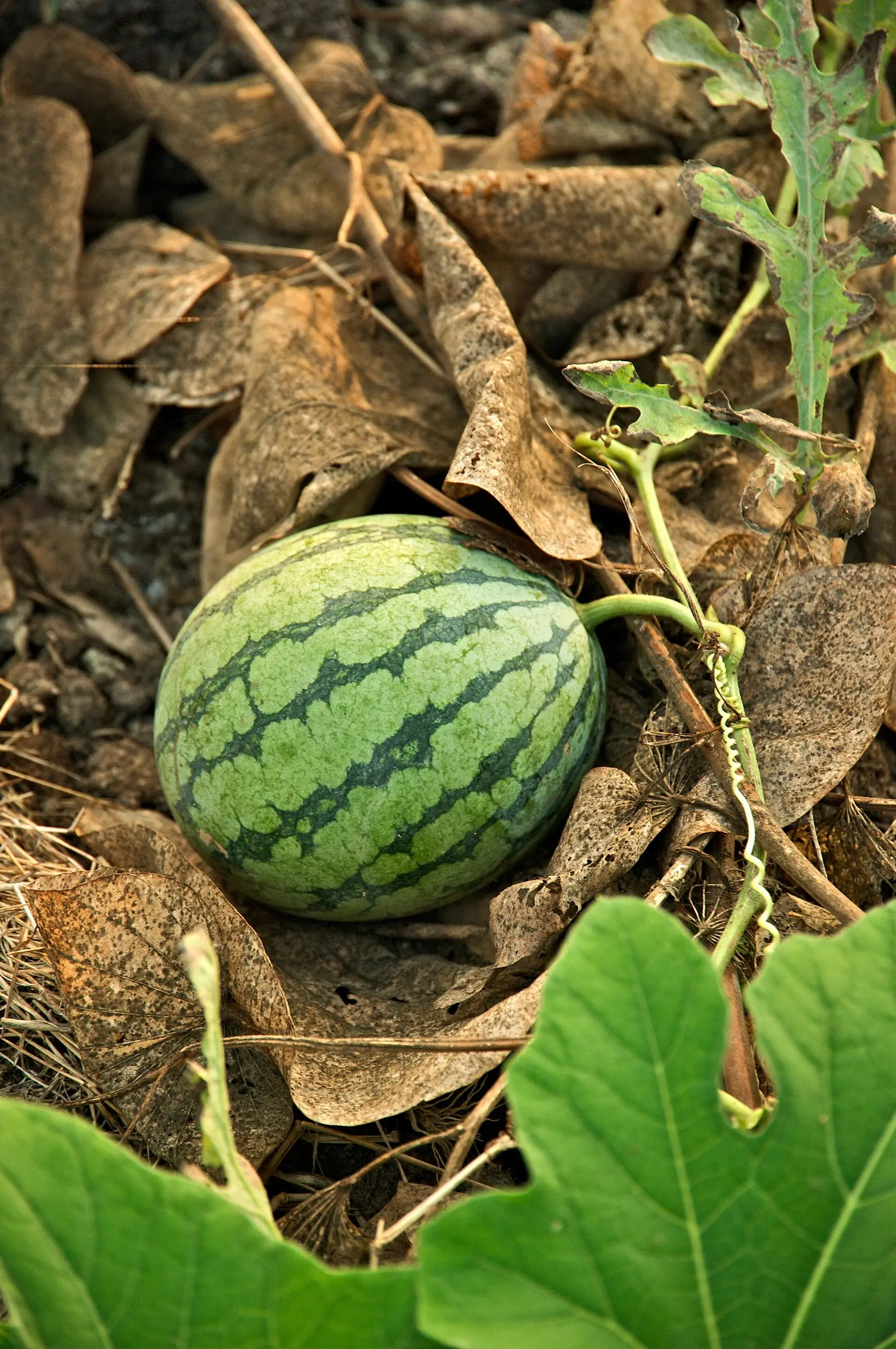
- The tendril nearest the fruit — the curly wisp on the stem at the fruit’s joint — has dried and turned brown. Green tendril means wait.
- The ground spot — where the melon rests on the soil — has turned from white to a creamy or buttery yellow. White means unripe.
- The skin has dulled from glossy to matte, and resists a fingernail rather than being scratched easily.
Watermelons do not ripen after picking
Unlike bananas or tomatoes, a watermelon’s sugar content is fixed at harvest. There is no ripening on a windowsill — an underripe melon stays bland forever. That makes the three signs above genuinely worth learning, because the cost of picking early is total.
On thumping: the difference between the dull, deep thud of a ripe melon and the higher, tighter sound of an unripe one is real, but it takes practice most people never get and it is easily misjudged. The tendril and the ground spot are visible, unambiguous, and free.
Cut the melon off with an inch or two of stem rather than pulling it.
Common questions
How do you know when a watermelon is ripe?
How much space does a watermelon plant need?
How long does watermelon take to grow?
Why is my watermelon not sweet?
Do you need to hand-pollinate watermelons?
Should you prune a watermelon vine?
Backyard Weekly
Know what to plant, week by week
Free planting calendar. Join the weekly email for seasonal jobs, fixes for what is going wrong, and gear worth buying.
Set MONETIZATION.email.endpoint in src/config/site.ts to enable this form.
By subscribing you agree to our privacy policy. Grow In Backyard will never sell your address.
Keep reading
How to Grow Cucumbers: Heat, Water, and Bitter Fruit
Cucumbers fail from cold soil at the start and inconsistent water later. Bush or vining, why the first flowers set nothing, and what actually makes them bitter.
How to Grow Strawberries (And Get Fruit the First Year)
Strawberries are easy to grow and easy to get wrong. Which of the three types to plant, why you pinch the first flowers, and how to keep a bed producing.
How to Grow Tomatoes: Determinate or Indeterminate First
That one word on the seed packet decides your spacing, your pruning, and your harvest shape. Then it is warmth, consistent water, and feeding at the right time.
How Deep to Plant Potatoes (And Why Hilling Matters More)
Four inches at planting, then hill as they grow. Why planting deep in cold spring soil backfires, and how depth differs in containers and no-dig beds.