How to Grow Broccoli Without It Bolting or Buttoning
Broccoli bolts in heat and buttons when checked as a seedling. Timing the sowing, spacing for a decent head, and cutting so the side shoots keep coming.

On this page
Broccoli fails in two distinct ways, and they look similar but have opposite causes.
Bolting is heat — the plant flowers instead of heading. Buttoning is a tiny head on a small plant, caused by a check to growth while it was still a seedling. Getting broccoli right is mostly about avoiding both.
Timing is most of it
Broccoli wants to grow in cool weather and finish before heat. That gives two windows:
- Spring: start indoors 6 to 8 weeks before the last frost, plant out 2 to 4 weeks before it. Risky — the head forms as temperatures rise.
- Autumn: the better bet. Count back the variety’s days to maturity from your first expected frost, add a couple of weeks, and sow then. The plant matures into cooling weather, which is exactly what it wants.
Broccoli tolerates frost well, and light frost improves the flavour.
Soil
Brassicas are hungry and want firm, fertile, slightly alkaline ground.
- Dig in compost or well-rotted manure before planting.
- pH 6.0 to 7.5. On acidic soil, lime it — alkaline conditions also suppress clubroot, which is why mushroom compost suits brassicas particularly well.
- Firm the soil. Brassicas dislike loose ground and rock in wind, which damages the roots. Tread the bed before planting and firm around each plant.
- Full sun, though broccoli tolerates light shade better than most vegetables.
Sowing and planting out
Sow in modules rather than a seed tray, half an inch deep, and pot on or plant out before the roots start circling.
This is the buttoning prevention step. A seedling that becomes root-bound, dries out, or runs short of nitrogen concludes that conditions are hostile and rushes to reproduce — producing a tiny head on a plant with no frame to support a real one. Once it has buttoned, nothing recovers it.
Plant out at four to six true leaves, 18 to 24 inches apart, rows 24 to 36 inches apart, setting them slightly deeper than they sat in the module and firming well.
Broccoli needs its leaves before it needs anything else
The head is built from what the leaf canopy produces, so a plant that stays small produces a small head — and no amount of feeding after the head appears changes that. All the important growing happens in the weeks before you see a head. Crowding, drought and nitrogen shortage in that window are what produce the disappointing golf-ball harvest people blame on variety.
Water and feed
Consistent water — about an inch to an inch and a half a week, more in heat. Broccoli is shallow rooted and checks quickly when dry, and a check is what triggers both buttoning and bolting.
Mulch to hold that moisture steady and keep the roots cool.
Feed nitrogen early. Unlike fruiting crops, broccoli wants nitrogen throughout — you are growing leaves and a flower bud, not fruit, so the switch to potassium described for tomatoes does not apply here. A nitrogen-rich feed three or four weeks after planting out, and again a few weeks later, is about right.
Harvest, and the second crop
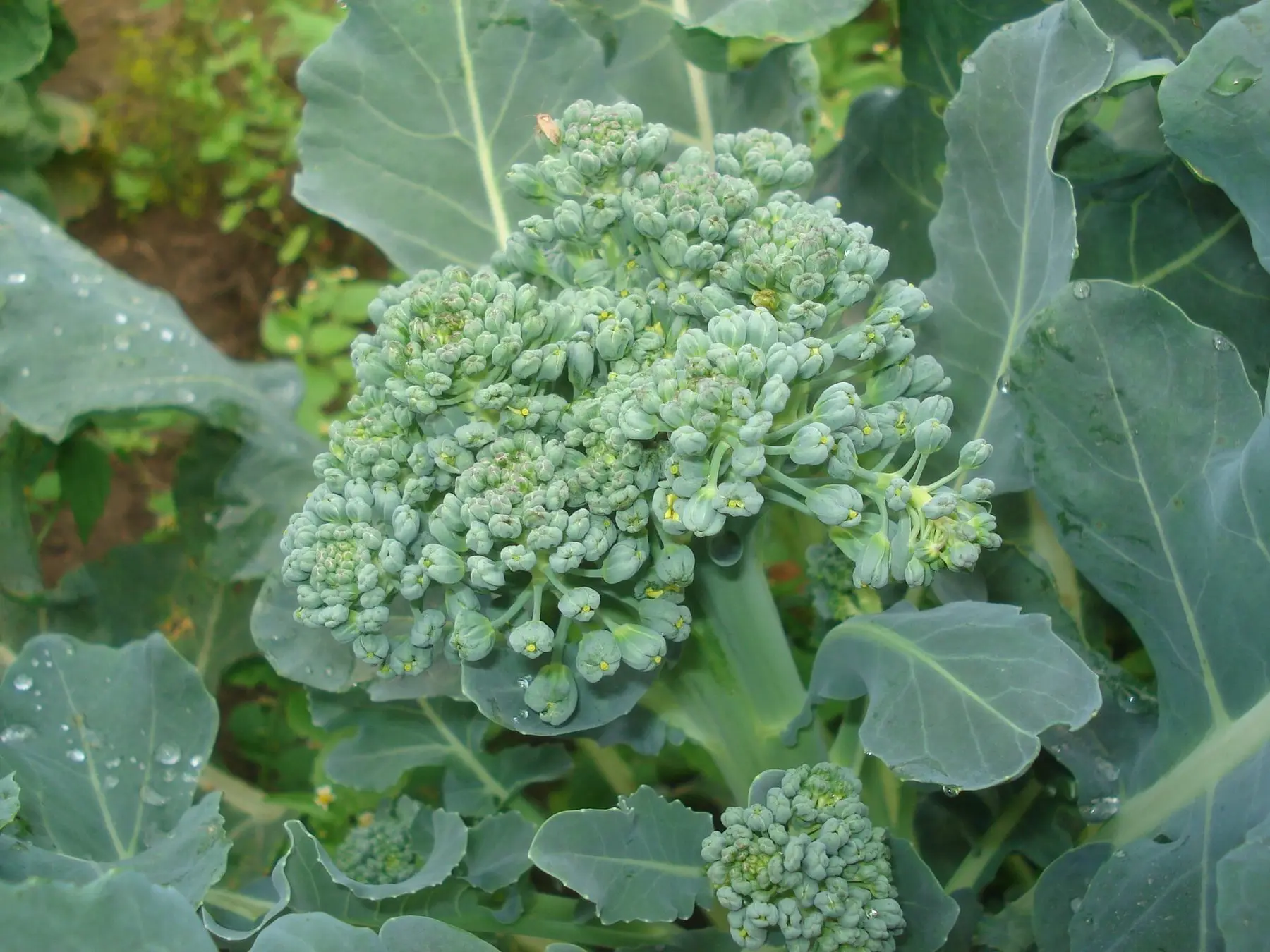
Cut when the head is full and firm and the individual buds are still tight. The moment they begin to loosen and show yellow, it is flowering and the quality drops quickly.
Cut the main head with four to six inches of stem, at an angle so water runs off the cut.
Then keep the plant fed and watered. Most varieties produce side shoots from the leaf joints — smaller florets that can crop for several more weeks, and often add up to more than the main head. Varieties bred for a single large head produce fewer, so check the packet if the second crop matters to you.
Broccoli does not store well fresh — a few days in the fridge — but freezes well after blanching.
Pests
Brassicas attract more pests than almost anything else in a vegetable garden, and the answer is nearly always exclusion.
| Pest | Sign | Answer |
|---|---|---|
| Cabbage white caterpillars | Holed leaves, green caterpillars | Fine insect mesh from planting |
| Cabbage root fly | Sudden wilting, roots eaten | Collars at the base, or mesh |
| Aphids | Grey-green clusters in the head | Blast off with water; encourage predators |
| Flea beetle | Shot-holes in young leaves | Mesh; keep seedlings growing fast |
| Pigeons | Stripped leaves | Netting — the only thing that works |
| Slugs | Ragged holes, trails | Clear debris; go out at dusk |
| Clubroot | Swollen roots, stunted plants | Lime to raise pH; long rotation; resistant varieties |
Fine mesh over hoops from the day of planting deals with most of that list at once, which is the same logic as excluding carrot fly. Rotate brassicas on a three- to four-year cycle, because clubroot persists in soil for years.
Common questions
Why did my broccoli bolt before making a head?
What is buttoning, and how do you prevent it?
How far apart should broccoli be planted?
Does broccoli regrow after you cut the head?
When should you plant broccoli?
Why is my broccoli head small?
Backyard Weekly
Know what to plant, week by week
Free planting calendar. Join the weekly email for seasonal jobs, fixes for what is going wrong, and gear worth buying.
Set MONETIZATION.email.endpoint in src/config/site.ts to enable this form.
By subscribing you agree to our privacy policy. Grow In Backyard will never sell your address.
Keep reading
How to Grow Carrots: Stones, Thinning, and Carrot Fly
Forked carrots come from obstacles and fresh manure, not bad seed. Sowing direct into stone-free soil, why you should barely thin, and the fly barrier that works.
How to Grow Onions: Day Length Decides Your Bulb Size
Onions bulb on day length, not on age — so the wrong variety for your latitude never sizes up. How to pick the right type, plant it, and feed it to a full bulb.
Mushroom Compost: What It Is and Where Not to Use It
Spent mushroom substrate is cheap, alkaline and salty when fresh. Excellent on clay and vegetable beds, actively harmful around acid-loving plants and seedlings.
How Deep to Plant Potatoes (And Why Hilling Matters More)
Four inches at planting, then hill as they grow. Why planting deep in cold spring soil backfires, and how depth differs in containers and no-dig beds.