How Do Pineapples Grow? On the Ground, One Per Plant
Pineapples do not grow on trees but on a low ground plant, one fruit per plant, from hundreds of flowers fused into one. How they grow, and how long it takes.

On this page
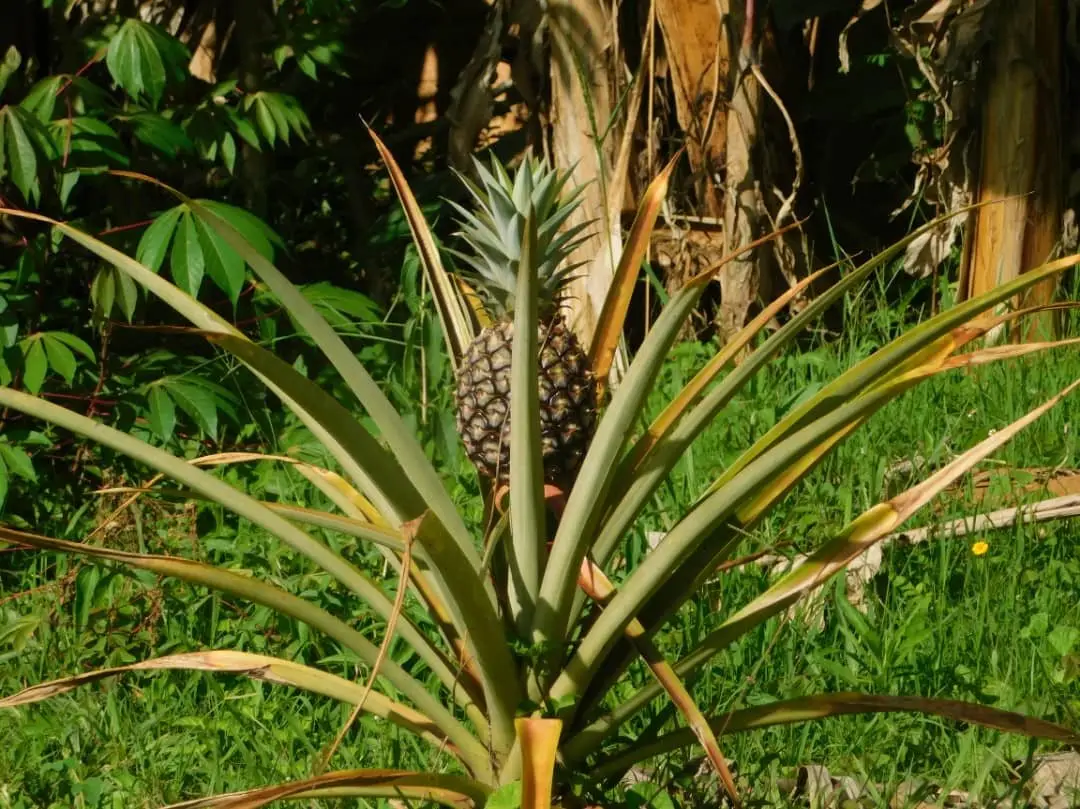
The most common mental image of a pineapple harvest — someone reaching up into a palm-like tree — is wrong in an interesting way. Pineapples grow at knee height, on a spiky plant that looks more like a large aloe than anything you would call a fruit tree, and each plant produces exactly one.
What the plant actually looks like
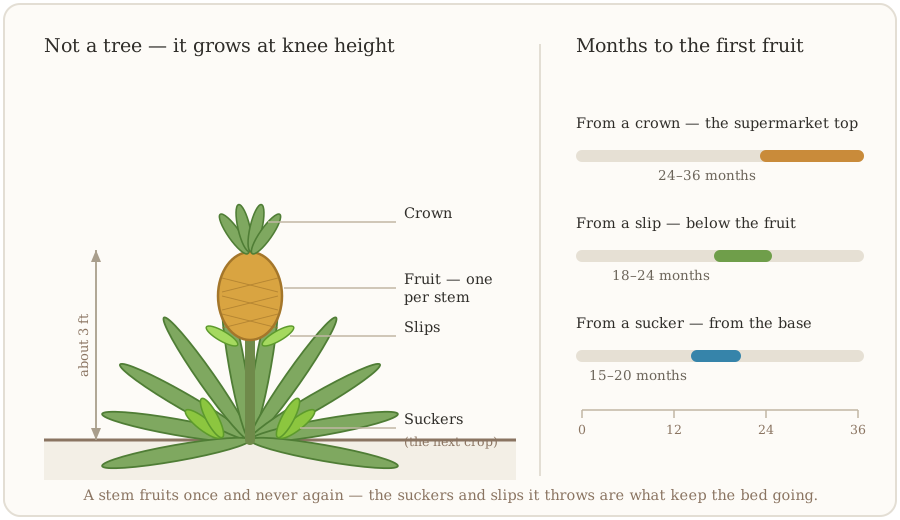
A pineapple plant is a rosette: thirty to forty stiff, sword-shaped leaves up to five feet long, often edged with small spines, radiating out from a central point close to the ground. The whole plant occupies roughly a three-to-five-foot circle and stands about three feet tall.
It is a bromeliad — the same family as Spanish moss and the tank bromeliads sold as houseplants — and it shares their key trick. The leaf bases form overlapping cups that catch and hold rainwater, and the plant absorbs moisture and nutrients directly through specialized scales on the leaves as well as through its roots. Its actual root system is shallow and modest, which is why pineapples grow perfectly well in a pot and poorly in waterlogged ground.
When the plant is mature, it pushes a short thick stalk straight up from the center of the rosette. The fruit forms on top of that stalk, sitting in the middle of the plant like an egg in a nest.
Two hundred flowers, one fruit
This is the part that makes a pineapple genuinely unusual.
The stalk produces a dense spike of individual flowers — commonly a hundred to two hundred of them, opening in a spiral over a couple of weeks, purple against red bracts. Each of those flowers develops its own small fruit. Rather than staying separate, those fruitlets swell until they press against each other and fuse, along with the central stalk and the bracts, into one solid body.
That is what a pineapple is: a multiple fruit, one object assembled from hundreds. The hexagonal plates on the skin are not decorative texture — each one is the remnant of a single flower, and the short tuft at the center of each plate is where its petals were.
Why supermarket pineapples have no seeds
Pineapple flowers are largely self-incompatible, so a field of a single clone sets almost no seed. In Hawaii, hummingbirds were historically excluded from growing regions for exactly this reason — cross-pollination produces hard seeds in the flesh, which is a defect commercially. The seedless fruit you buy is a deliberate outcome, not a natural one.
The timeline
| Starting material | Time to fruit | Notes |
|---|---|---|
| Crown (the leafy top) | 24–36 months | The usual home method; slowest |
| Slip (offshoot below the fruit) | 18–24 months | Faster and more reliable than a crown |
| Sucker (offshoot from the base) | 15–20 months | Fastest; what commercial fields replant |
| Commercial field crop | ~18 months | Flowering is hormone-induced to schedule harvests |
Growth is slow because the plant will not flower until it has built enough leaf mass to support a fruit — commonly cited as around 70–80 mature leaves. Everything before that point is the plant getting big enough, and there is no way to hurry it other than giving it good light and warmth.
After fruiting, the main stem is done. It never produces a second pineapple. What it does instead is send out suckers from the base and slips from just beneath the fruit, and each of those is a fresh plant that will fruit in its turn — which is how a single original plant becomes a bed that keeps producing.
Where they grow
Pineapples want tropical lowlands: warmth year-round, no frost at all, and free-draining soil. Costa Rica, the Philippines, Brazil, Thailand, and Indonesia dominate world production.
In the US, growing them outdoors in the ground is realistic in Hawaii and south Florida, and marginal along the warmest parts of the Gulf. Everywhere else, they are a container plant — which works surprisingly well, since the shallow root system suits a pot and the plant tolerates being moved indoors for winter as long as it gets strong light.
Growing one from a supermarket top
Twist — do not cut — the crown off the fruit, then strip the lowest inch of leaves to expose bare stem. Let the cut end dry and callus for two or three days, then set it in a free-draining mix, barely covering the stem. Water sparingly until roots take, around six to eight weeks. Then give it the brightest spot you have, and patience: two to three years is normal.
Telling when one is ripe
A pineapple does not sweeten after it is picked. Starch does not convert to sugar off the plant, so whatever sweetness it has at harvest is what it will ever have — it only softens and turns from there.
On the plant, look for the shell color shifting from green toward gold at the base and moving upward, a strong sweet smell at the bottom of the fruit, and a slightly softer, hollower sound when tapped. The old advice about pulling a center leaf out is unreliable — it comes loose on underripe fruit often enough to be worthless as a test.
Common questions
Do pineapples grow on trees?
How long does a pineapple take to grow?
How many pineapples does one plant produce?
Where do pineapples grow?
Can you grow a pineapple from the top of one you bought?
Is a pineapple one fruit or many?
Backyard Weekly
Know what to plant, week by week
Free planting calendar. Join the weekly email for seasonal jobs, fixes for what is going wrong, and gear worth buying.
Set MONETIZATION.email.endpoint in src/config/site.ts to enable this form.
By subscribing you agree to our privacy policy. Grow In Backyard will never sell your address.
Keep reading
How to Grow Strawberries (And Get Fruit the First Year)
Strawberries are easy to grow and easy to get wrong. Which of the three types to plant, why you pinch the first flowers, and how to keep a bed producing.
Can You Grow a Banana Tree From a Banana? Not From That
Supermarket bananas are seedless clones, so there is nothing in one to plant. What actually works is a pup or a corm — and a banana is not a tree at all.
How to Grow Blackberries: Planting, Pruning and Picking
Thornless erect varieties on a two-wire trellis, pruned on the floricane-primocane cycle. Planting, feeding, and the one pruning rule that decides your crop.
Can You Eat Crab Apples? Yes, and They Make Better Jelly
Crab apples are edible, sour, and unusually high in pectin — which is exactly why they set jelly no other fruit will. The one part to avoid, and which trees to pick.