
Holly Tree: Getting Berries, and Which Species to Plant
Hollies are male or female and only females berry, with a male nearby. Species, pairing cultivars, acid soil, and why yours has no berries this year.
 By
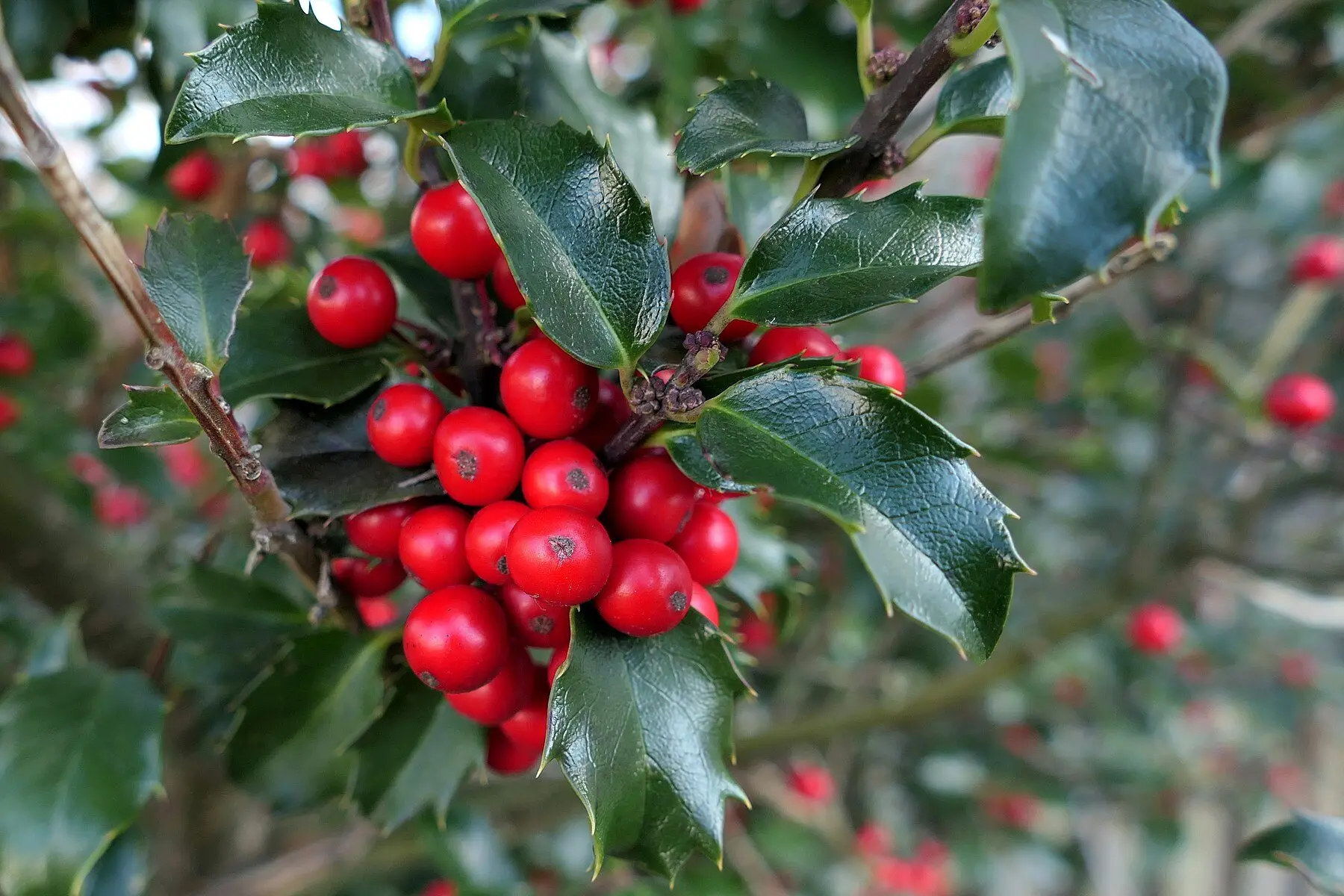

On this page
The reason a holly has no berries is almost always the same: it is male, or it is a female with no male nearby. Everything else about growing one is straightforward.
The berry problem
Hollies are dioecious — separate male and female plants — which is unusual enough among garden shrubs that most people buy one and wait several years to find out.
| Male flower | Female flower | |
|---|---|---|
| Stamens | Four, stubby, yellow with pollen | Vestigial, non-functional |
| Centre | Flat | Green rounded ovary — a berry in waiting |
| Berries follow? | Never | Yes, if pollinated |
Both carry small white flowers in clusters where the leaf meets the stem, and the leaves, habit and size tell you nothing. Off-season, berries prove a female and only a label proves a male.
Cultivar names lie about sex
‘Blue Prince’ is male and ‘Blue Princess’ female, which is helpful. ‘Golden King’ is female and ‘Golden Queen’ is male, which is not.
Never infer sex from a name. Check the plant label or the nursery’s description.
Compatibility matters too. A male must be the same or a closely related species and must flower at the same time. An English holly male will not reliably pollinate an American holly female. Nurseries sell matched pairs — Blue Prince with Blue Princess, China Boy with China Girl — precisely to remove the guesswork.
Self-fertile options exist if there is only room for one: Ilex aquifolium ‘J.C. van Tol’ and ‘Pyramidalis’ both berry without a partner.
| Cause | Sign |
|---|---|
| No male in range | Flowers appear, berries never set |
| Too young | Under 4–5 years; no flowers at all yet |
| Late frost | Flowered, then a cold snap |
| Pruned in early summer | Sheared after flowering — the fruit went with it |
| Drought at fruit set | Small fruit dropped in early summer |
| Heavy shade | Sparse flowering, sparse fruit |
Which holly
| Species | Size | Zones | Notes |
|---|---|---|---|
| American (I. opaca) | 15–50 ft | 5–9 | Matte leaves, native to eastern US |
| English (I. aquifolium) | 15–50 ft | 6–9 | Glossy, classic Christmas holly. Invasive in the Pacific Northwest |
| Chinese (I. cornuta) | 8–15 ft | 7–9 | Heat-tolerant; ‘Burford’ berries near-alone |
| Japanese (I. crenata) | 3–10 ft | 5–8 | Small box-like leaves, black fruit. A hedging plant |
| Winterberry (I. verticillata) | 6–12 ft | 3–9 | Deciduous — bare stems covered in red berries |
| Blue / Meserve (I. × meserveae) | 6–15 ft | 4–7 | The cold-hardy choice. Blue-green leaves |
| Yaupon (I. vomitoria) | 10–20 ft | 7–10 | Southern US native, drought-tolerant |
| Inkberry (I. glabra) | 4–8 ft | 4–9 | Spineless, native, good for wet ground |
For cold regions, Meserve hybrids or winterberry. For the deep south, yaupon or Chinese. For hedging, Japanese holly or inkberry. For berries on bare stems in midwinter, winterberry is unmatched — and being deciduous, it needs a male winterberry specifically.
Growing one
| Light | Full sun to part shade. Sun gives the most berries |
| Soil | Moist, free-draining, acidic pH 5.0–6.5 |
| Water | Regular for the first two years; fairly drought-tolerant after |
| Exposure | Shelter from cold drying wind — winter leaf scorch |
| Feeding | Little. An ericaceous or acid-loving feed in spring if growth is poor |
| Mulch | Yes, generously. Shallow roots, and it holds the moisture |
Planting: autumn or early spring. Dig wide rather than deep, plant at the depth it grew at — hollies resent deep planting — and mulch a wide ring without piling against the trunk.
Yellow leaves with green veins means the pH is wrong
Interveinal chlorosis — yellow leaf, green veins — is iron deficiency, and on holly it nearly always means alkaline soil rather than a lack of iron in the ground. The iron is there; the pH locks it away.
Chelated iron treats the symptom for a season. Sulphur lowers pH slowly and needs repeating. On genuine chalk or limestone, the honest answer is a large pot of ericaceous compost, or a different evergreen.
Pruning
- Late winter to early spring, before growth starts — and the cuttings are useful indoors
- Hollies regrow from old wood, so a neglected plant can be reduced hard and recovered over two seasons
- Never shear a berrying female in late spring or early summer. That is the flowers, or the developing fruit, going into the bin
- For a hedge, one shaping cut in late winter and a light tidy in late summer
Pests, problems and berries
- Leaf miner — pale winding blotches in the leaves. Cosmetic; remove affected leaves
- Scale insects — sticky honeydew and sooty mould on the leaves beneath
- Winter scorch — brown crisped leaf edges after a cold windy winter; shelter is the fix
- Waterlogging — hollies will not tolerate standing wet, inkberry excepted
The berries are toxic to people — saponins, causing vomiting and diarrhoea. Rarely serious, but a child eating a handful warrants a call to poison control, and that is worth weighing before planting a heavily berried female beside a play area.
Birds are unaffected and strip them eventually — usually late, because most holly berries need repeated freezing before birds will take them. A tree still full in January is normal, not rejected.
Common questions
Why does my holly tree have no berries?
How can I tell if a holly is male or female?
Do I need two holly trees to get berries?
What soil do hollies need?
When should I prune a holly?
Are holly berries poisonous?
Backyard Weekly
Know what to plant, week by week
Join the weekly email for seasonal jobs, fixes for what is going wrong, and gear worth buying.
Not ready to subscribe? The planting calendar is free and needs no email.
By subscribing you agree to our privacy policy. Grow In Backyard will never sell your address.
Keep reading
Juniper: Choosing One That Fits, and Keeping It Alive
Junipers are near-indestructible in sun and sharp drainage, and doomed in shade or wet soil. Picking a form that suits the space, and the pruning rule that matters.
Southern Magnolia: Size It Before You Plant It
Magnolia grandiflora reaches 60 to 80 feet and drops leathery leaves all year. The cultivars that stay small, and what it needs to flower well.
Jasmine: Which One You Have, and Getting It to Flower
Half the plants sold as jasmine are not jasmine. How to tell them apart, which are hardy, and the pruning mistake that costs a season of flower.
How to Cut a Tree Down, and When Not to Try
Felling is decided before the saw starts: lean, hazards, escape routes, and whether the tree is within your competence at all. Where the line is, honestly.