
Why Do Deer Snort Wheeze? It Is a Buck Threatening a Rival
The snort-wheeze is an aggressive buck call, not an alarm. How to tell it from the alarm blow, when you hear each, and what the deer does next.
 By
On this page
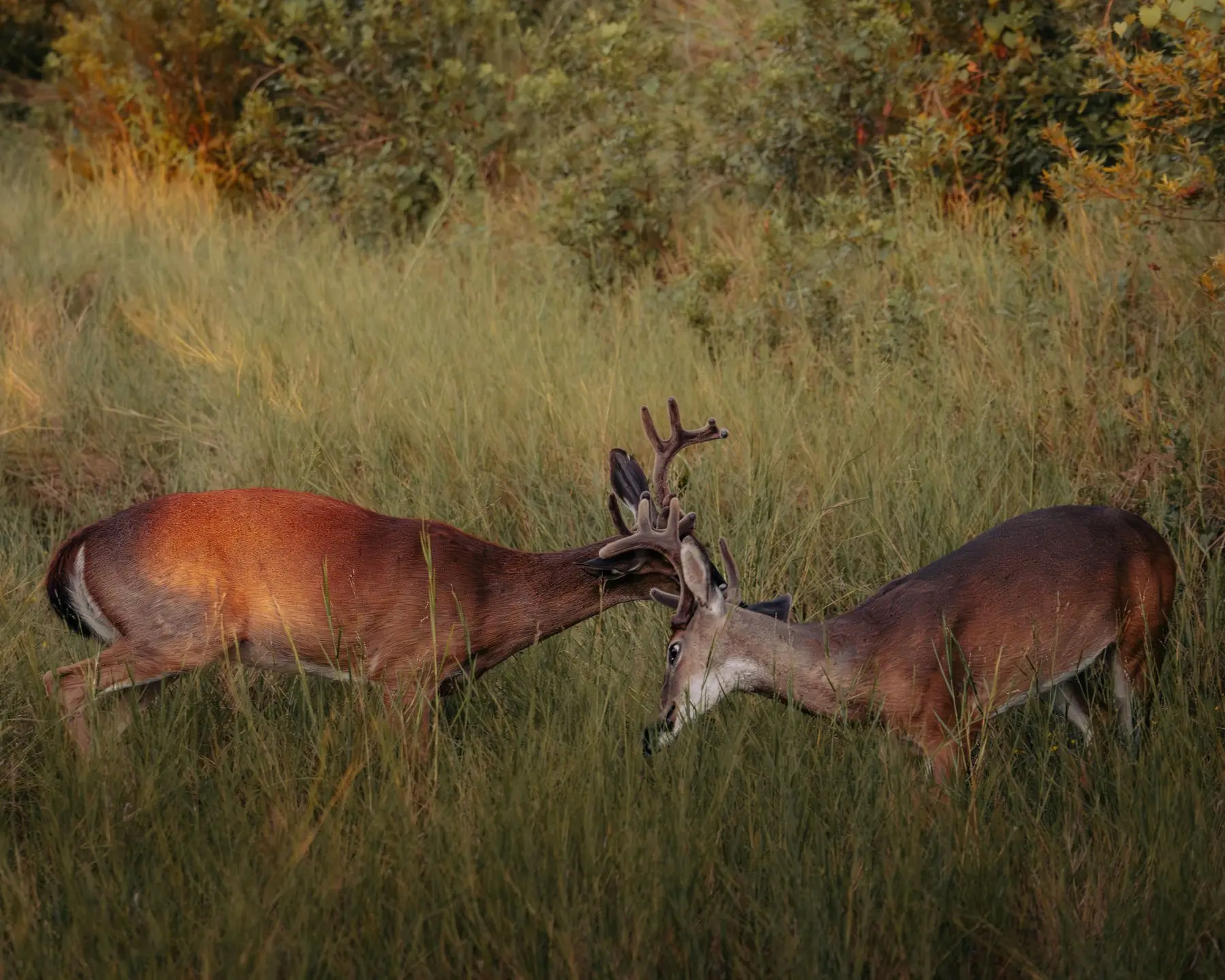
It is a buck threatening another buck — not an alarm. A short burst of sharp expulsions through the nostrils followed by a long drawn-out wheeze: the most confrontational sound a white-tailed deer makes.
Snort-wheeze against alarm blow
These get mixed up constantly, and they mean opposite things.
| Snort-wheeze | Alarm blow | |
|---|---|---|
| Sound | Short bursts, then a long wheeze | Single explosive snort, often repeated |
| Who | Mature buck | Any deer, either sex |
| Means | Aggression — a challenge | Fear — I have detected something |
| Body language | Ears back, hair raised, stiff-legged approach | Foot stomp, tail up, then flight |
| Aimed at | Another buck | Other deer — a warning |
| When | Autumn, pre-rut and rut | All year |
The quickest discriminator is the ending. An alarm blow is percussive and finished. A snort-wheeze trails off into a drawn-out wheeze, and once you have heard it you do not mistake it again.
The second discriminator is what the deer does next. A blowing deer is leaving. A snort-wheezing buck is usually coming forward.
Why it exists
A fight between two mature bucks is expensive for both. Antlers break, animals get injured, and the winner spends condition it needs for winter.
So most contests are settled by display instead — posture, hair, approach, and sound.
The call working means the other buck leaves
A snort-wheeze that avoids a fight has done exactly its job. The display is the point.
What follows if the rival stands his ground is a stiff-legged approach with the ears laid back and the hair raised, then sparring, and occasionally a real fight. That is the escalation the call exists to avoid.
Timing
- Pre-rut and rut — autumn across most of the white-tailed deer’s range
- That is when encounters between mature bucks are frequent and dominance is unsettled
- Outside that window it is uncommon, which is itself a clue: the alarm blow happens all year, the snort-wheeze does not
If you hear one nearby
Give a rutting buck distance
The call is aimed at another deer, not at you. But a buck in the rut is a large animal in an aggressive frame of mind, and incidents during the rut do happen.
- Do not approach, and do not close the distance for a photograph
- Let it move away rather than trying to move it
- Keep dogs leashed — a loose dog reads as a competitor or a threat, and that is how people get caught up in something that had nothing to do with them
Does it ever come from a doe?
Effectively no. It is a mature-buck call tied to rut dominance.
Does and young deer use the alarm snort, and does have a separate repertoire of grunts and bleats for keeping contact with fawns. If what you heard ended in that long wheeze, you were listening to a buck.
Common questions
Why do deer snort wheeze?
Is the snort-wheeze the same as a deer blowing at you?
When do you hear a snort-wheeze?
What does a buck do after a snort-wheeze?
Do does snort-wheeze?
What should I do if a deer snort-wheezes near me?
Backyard Weekly
Know what to plant, week by week
Join the weekly email for seasonal jobs, fixes for what is going wrong, and gear worth buying.
Not ready to subscribe? The planting calendar is free and needs no email.
By subscribing you agree to our privacy policy. Grow In Backyard will never sell your address.
Keep reading
Why Do Deer Snort? Reading the Alarm, Stomp and Blow
A snort is a deer telling every animal nearby it has seen you — and testing whether you move. What each sound means and how smart deer actually are.
Where Do Deer Go in the Summer? Into Cover, Not Away
Summer deer shift to dense cover and feed at dawn and dusk to avoid heat and flies. They rarely leave — you are just seeing them less.
Why Do Deer Sleep in My Yard? It Feels Safer Than Woods
Deer bed in yards because suburbs have food, cover and almost no predators. Repeated bedding means they've decided your garden is low risk.
Why Do Possums Play Dead? And How Long It Lasts
Playing possum is an involuntary shock state, not a decision. Why it happens, how long it lasts, and what to do with one lying in your yard.