
Snakes in a Pond: Which Ones, and What to Do
Most pond snakes are harmless water-hunting species eating frogs and fish. How to tell them from a cottonmouth, and why removing the food removes the snake.
 By

On this page
A snake at the pond edge is usually a harmless water snake hunting frogs, and usually passing through. The anxiety is understandable; the actual risk, in most places, is very low.
What is usually there
North America: Nerodia water snakes — northern, banded, brown. Non-venomous, strong swimmers, often basking on banks and overhanging branches. Frequently killed on sight because they are mistaken for cottonmouths.
Britain and Europe: the grass snake, an excellent swimmer that hunts amphibians and is entirely harmless. Protected by law in the UK.
Southeastern US: the cottonmouth (water moccasin) genuinely is venomous, and is the one worth identifying correctly.
Telling them apart
| Harmless water snake | Cottonmouth | |
|---|---|---|
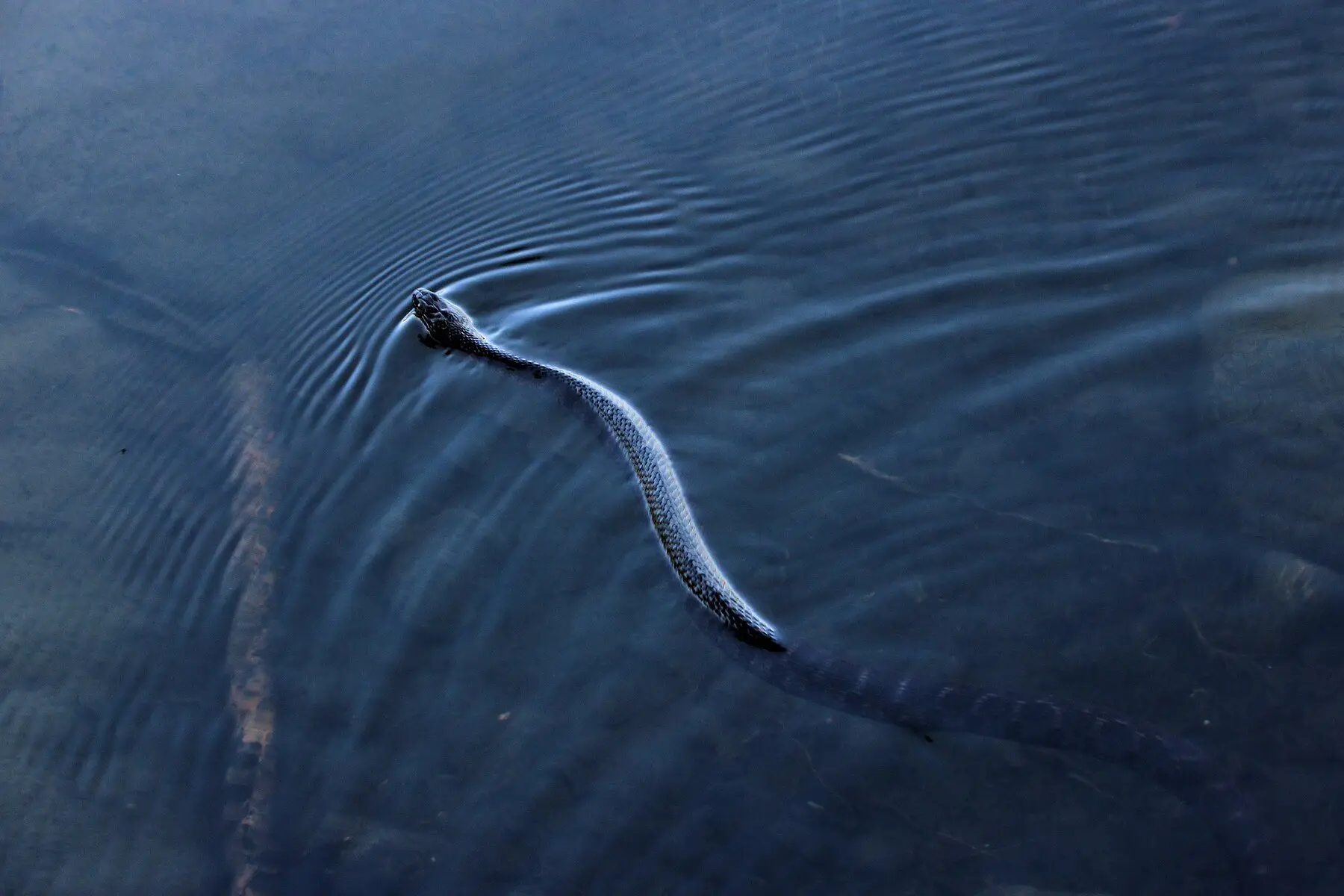
| Swimming | Only the head above water | Floats high, much of body visible |
| Head | Slim, continuous with neck | Blocky, triangular, distinct from neck |
| Pupils | Round | Vertical, cat-like |
| Eye stripe | Absent | Dark stripe through the eye |
| Threatened | Flees, or flattens and bluffs | Gapes, showing white mouth lining |
| Range | Widespread | Southeastern US only |
Swimming posture is the most useful single tell — and it is visible from a distance, which is where you should be.
Identify from a distance, not up close
A photograph from ten feet away, checked afterwards, is the right method. Most snakebites happen while people are trying to catch, kill or move a snake — the encounter itself is rarely the dangerous part.
Why it is there
Food and shelter, nothing else:
- Frogs and tadpoles — the main draw for most water snakes
- Small fish
- Rodents attracted to spilled fish food or a compost heap
- Cover — brush piles, log stacks, rock heaps, long grass, gaps under decking
A pond with lots of frogs has snakes because it has lots of frogs. That is a functioning pond.
Discouraging them
Work on the habitat rather than the animal:
- Clear brush, log piles and rock heaps near the water.
- Keep grass short in a band around the pond — snakes avoid crossing open ground.
- Seal gaps under sheds, decking and steps.
- Do not leave fish food out, which attracts rodents, which attract snakes.
- Steep-sided pond edges are less attractive to hunting snakes than gently sloping ones — though they are also worse for amphibians and for any animal that falls in.
What does not work: snake repellent granules, which have very little evidence behind them. And avoid glue traps — they kill slowly, catch birds and lizards indiscriminately, and are illegal in some jurisdictions.
If one is there now
Leave it. It will move on, usually within minutes of being noticed.
Where a venomous species is genuinely established somewhere it presents a hazard — near a child’s play area, for instance — call a professional removal service or your local wildlife agency. Many snake species are legally protected, and killing them can be an offence as well as unnecessary.
Worth keeping in perspective: a snake that eats rodents around a garden is doing something useful, and in most of the world the species you will meet at a pond edge cannot hurt you.
Common questions
Are snakes in a pond dangerous?
How do you tell a water snake from a cottonmouth?
Do snakes eat pond fish?
How do you keep snakes away from a pond?
Will snakes stay in a garden pond permanently?
What should I do if I find a snake in my pond?
Backyard Weekly
Know what to plant, week by week
Join the weekly email for seasonal jobs, fixes for what is going wrong, and gear worth buying.
Not ready to subscribe? The planting calendar is free and needs no email.
By subscribing you agree to our privacy policy. Grow In Backyard will never sell your address.
Keep reading
How to Get Rid of Frogs — 3 Fixes That Cut the Draw
How to get rid of frogs starts with the water and light drawing them in. 3 fixes compared for yards and pools. See which matches your problem.
What Do Backyard Lizards Actually Eat?
Wild lizards in a garden are almost entirely insect-eaters, not the varied diet pet-care sites describe. What they hunt, and what draws more of them to your yard.
Are Corn Snakes Poisonous? No, and Not Venomous Either
Corn snakes are harmless constrictors often killed on sight because they mimic copperheads. How to tell them apart, and why one is worth keeping around.
What Can I Feed Koi Besides Fish Food? Greens, Fruit and Prawns
Lettuce, peas, watermelon and prawns all work as supplements. They stay supplements — pellets carry the vitamins a pond cannot, and bread harms.