
How to Keep Birds From Nesting on a Porch, Deck or Ledge
Deter birds before they build, because once eggs are laid the nest is protected by law. Physical blocking, timing, and what deterrents fail at.
 By

On this page
The whole of this problem is timing. Block the ledge in February and it is a twenty-minute job. Wait until there are eggs in it and, in the US, you are legally required to leave it alone.
The legal part, first
In the United States the Migratory Bird Treaty Act protects nearly all native birds. It is illegal to destroy an active nest — one with eggs or young in it — without a permit.
- An empty nest under construction can generally be removed. This is why early action is the whole strategy
- House sparrows, European starlings and feral pigeons are non-native and unprotected
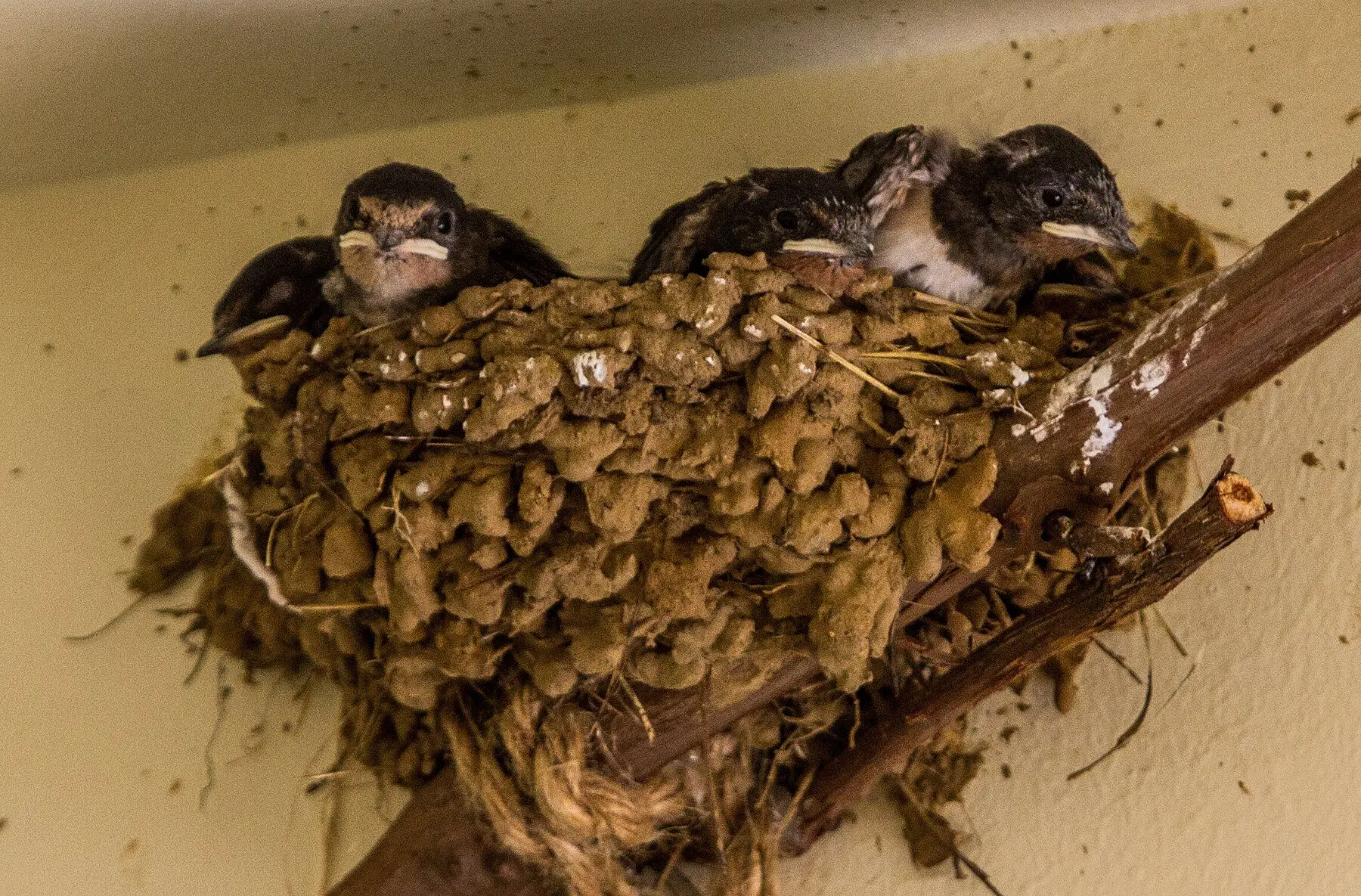
- Identifying the bird correctly is on you. A nest full of mud in a porch corner is a swallow’s, and swallows are protected
- Canada, the UK and the EU have broadly similar protections in effect
Once there are eggs, the decision is made
Two to five weeks from eggs to fledging, sometimes longer if the pair raises a second brood. That is the wait, and there is no legal shortcut for a protected species.
Note the exact spot. Block it the day they are gone for good.
Why your porch
The birds using it are choosing a flat surface with a roof over it and nothing that can climb to it. Porches, deck undersides, light fixtures, beam junctions and the tops of downpipes are all exactly that.
Common occupants:
- Barn and cliff swallows — mud cups stuck to a vertical wall under an eave
- Eastern phoebe — mossy cup on a ledge or beam
- American robin — bulky nest on any flat support
- House finch — hanging baskets, wreaths, light fittings
- House sparrow — any cavity; not protected
- Mourning dove — a careless heap of twigs on a ledge
What works: remove the site
| Situation | Fix |
|---|---|
| Open porch bay | Netting across the opening, taut, edges sealed |
| Under a deck | Fine mesh or lattice closing the perimeter |
| Flat ledge or beam top | Angled board or flashing at ~45° |
| Beam or pipe run | Bird spikes, fitted properly |
| Light fixture top | A cone, or a smooth cap |
| Corner under an eave | Netting or a smooth fillet in the angle |
| Hanging basket, wreath | Bring it in during the spring, or skip it |
Two principles cover almost every case:
- No level surface. Anything above about 45 degrees is unbuildable
- No access. Netting or mesh, stretched tight and sealed at the edges — a sagging net is a trap, and birds get caught in it
Surface matters too. Swallows attach mud nests far better to rough timber or masonry than to smooth painted board or metal. A slick surface at the favoured corner does real work.
What does not work
- Fake owls and plastic hawks. Effective for roughly three days
- Shiny tape, old CDs, reflective spinners. Same
- Ultrasonic devices. Birds mostly cannot hear the frequencies, and habituate to what they can
- Sprays and gels. Short-lived, weather away, and gels trap small birds and foul their feathers
- Removing a nest repeatedly during the season. Illegal for protected species and, for the bird, just more building
The pattern is habituation. Anything that works by frightening a bird stops working once the bird learns nothing happens.
If they are already nesting
- Leave it. Eggs or chicks means wait
- Use another door, and keep foot traffic away from directly underneath
- Catch the droppings — cardboard, a plastic tray or a taped sheet below the nest
- Keep cats indoors. Fledglings on the ground are the vulnerable stage
- Wait for fledging, then check for a second brood before assuming it is over
- Clear it properly with gloves and a dust mask — nests carry mites and droppings
- Wash the surface down, which removes the chemical and visual cue that says “safe site”
- Fit the physical block immediately, before next spring
Give them somewhere else, if you can stand them
Swallows eat an extraordinary volume of flying insects. A nest platform or open-fronted box on a barn, shed or garage wall fifty feet from the house is often accepted, and a colony that has somewhere better to be is not arguing with you over the porch.
It only works if the alternative goes up before the season, and if the porch is genuinely blocked.
Common questions
How do I stop birds nesting on my porch?
Is it illegal to remove a bird's nest?
What is the best bird deterrent for a porch?
When should I bird-proof a porch?
Birds are already nesting — what can I do now?
Why do birds keep coming back to the same porch?
Backyard Weekly
Know what to plant, week by week
Join the weekly email for seasonal jobs, fixes for what is going wrong, and gear worth buying.
Not ready to subscribe? The planting calendar is free and needs no email.
By subscribing you agree to our privacy policy. Grow In Backyard will never sell your address.
Keep reading
Bird Repellent for Trees — 5 Options Ranked on Fruit
Bird repellent for trees works by movement, not smell. 5 options compared on fruit crops, plus the ones that fail. See which suits your tree.
How to Stop Birds Pooping on Your Patio or Balcony
Droppings on a patio come from a perch, not from the sky. Find the perch, make it unusable, and the mess stops — plus how to clean it safely.
Bird House Hole Size: The Number That Picks the Tenant
Entrance diameter decides which species can use a box and which predators cannot. A size chart, the dimensions that go with each, and why perches are harmful.
Do Birds Like Hanging Bird Houses? What the Evidence Says
Hanging boxes swing, which most cavity nesters dislike and predators exploit. Which species accept them, and why a post-mounted box is safer.