
How to Get Rid of Snapping Turtles in a Pond
Most snapping turtles do far less damage than people assume. How to judge whether yours is a problem, what the law allows, and the options that work.
 By
On this page
Probably leave it. A common snapping turtle is mostly a scavenger, and stomach-content studies keep finding plant material, carrion and slow or sick fish rather than healthy stock. In a pond of any size, one or two are neutral or mildly useful.
Is it actually a problem?
| Situation | Verdict |
|---|---|
| Large pond, mixed coarse fish | Leave it. Neutral to beneficial |
| Natural or wildlife pond | Leave it. It belongs there |
| Small ornamental pond, valuable koi | Genuine problem — small stocked population |
| Ducklings disappearing | Genuine problem |
| People swim, or children reach the edge | Safety judgement, not an ecological one |
| “I saw one and did not like it” | Not a reason |
Why the reputation is worse than the animal
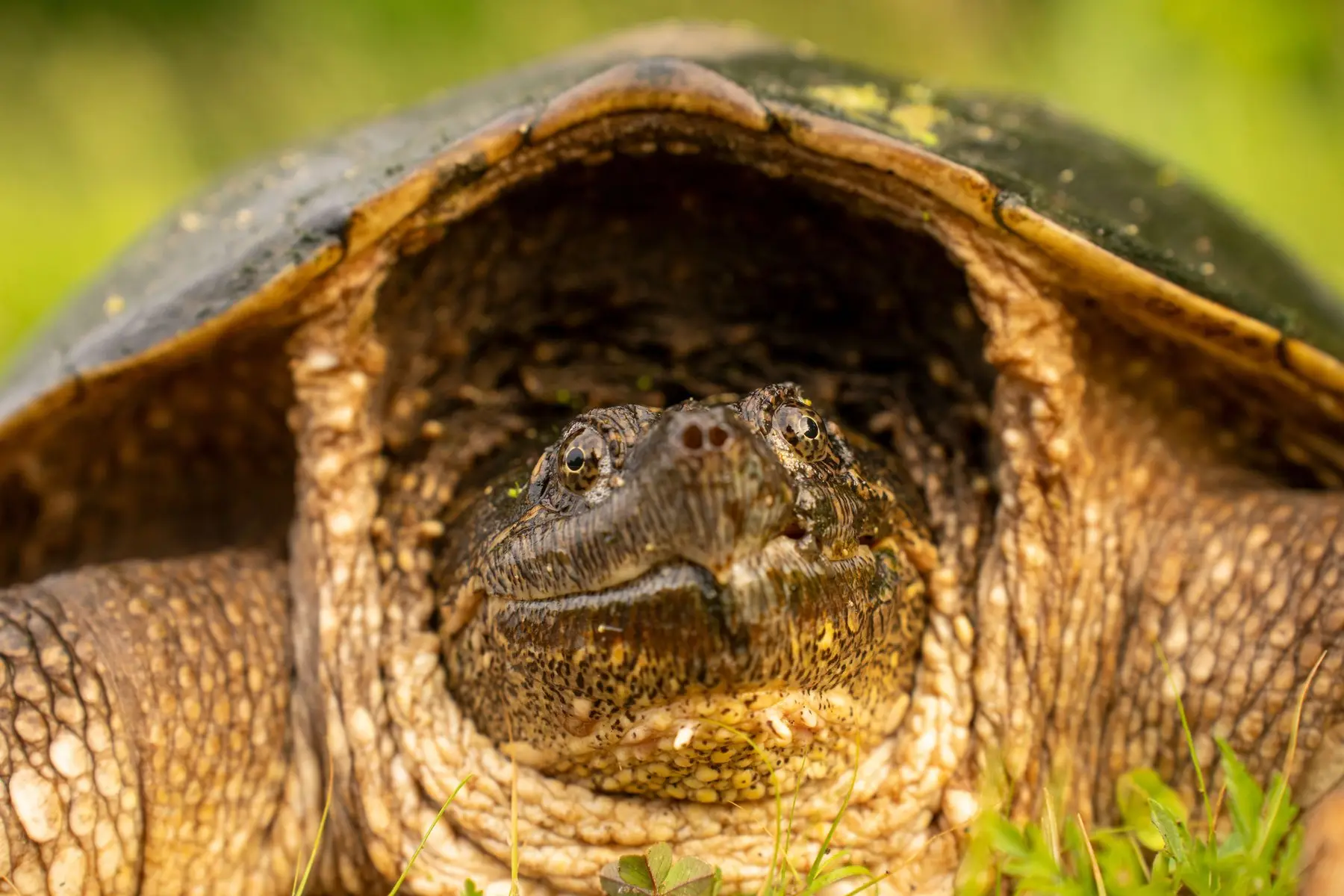
A snapping turtle on land, cornered, is genuinely formidable — it cannot retreat into its shell, so it defends itself hard, and that is the encounter people remember and describe.
In water the same animal is retiring and avoids people. The defensive display on land gets read as aggression and then projected onto what it does to a fish population, where the evidence does not support it.
Check the law before you do anything
Assume it is regulated until told otherwise
- Many jurisdictions treat snapping turtles as a game species with seasons, size limits and licence requirements
- The alligator snapping turtle is protected across much of its range
- Relocation is frequently restricted, because moving reptiles spreads disease
- Trapping methods are often specified in law
Ask your state or local wildlife agency. This is the kind of thing where acting first and checking later carries a real penalty.
If it has to go
Handling is the part to avoid. A large snapper’s neck reaches well back over its own shell, and the bite causes serious injury.
- Flat shovel or a board to slide it into a bin, from behind
- Or lift by the rear of the shell, above the back legs, with both hands
- Never by the tail — it dislocates the vertebrae and is a lasting injury
- Anything large: call a licensed removal service. This is not the place to find out how strong your grip is
On trapping: hoop or box traps baited with oily fish do work, and they are also the most heavily regulated part and the most likely to catch non-target animals. A trap left unchecked drowns whatever is in it, so it must be checked daily and set so a captured animal can breathe. Usually a job to hand over rather than improvise.
The option that actually lasts
Removal buys you a season or two. Snapping turtles range widely, and a pond with suitable habitat that loses one tends to get another.
Change the pond, not the population
- Steeper banks and deeper margins — less of the shallow warm edge they favour
- Remove basking sites close to the water
- Remove nesting habitat — the areas of loose sandy soil near the bank they dig into
- For koi specifically, a netted or fenced section is more reliable than any removal programme
None of this is dramatic, and all of it keeps working after you have stopped paying attention.
Common questions
Are snapping turtles actually bad for a pond?
When is a snapping turtle a genuine problem?
Is it legal to remove or kill a snapping turtle?
How do you safely remove a snapping turtle?
Will removing one solve the problem?
What about trapping?
Backyard Weekly
Know what to plant, week by week
Join the weekly email for seasonal jobs, fixes for what is going wrong, and gear worth buying.
Not ready to subscribe? The planting calendar is free and needs no email.
By subscribing you agree to our privacy policy. Grow In Backyard will never sell your address.
Keep reading
Koi Pond Cover Ideas — 5 Builds, Netting to Frames
Koi pond cover ideas run from leaf netting to a framed predator guard. 5 builds compared on cost and looks. See which suits your pond.
Are Turtles Bad for a Pond? Usually Not, With Limits
One or two turtles in a garden pond are harmless and useful scavengers. Where they do real damage is fish stocks, liners and stocking density.
What Do Pond Turtles Eat? Wild, and in a Backyard Pond
Most pond turtles start carnivorous and turn increasingly vegetarian with age. What arrives to eat naturally, what to feed, and why they eat your fish.
Best Fish for a Small Pond (And How Many It Holds)
Goldfish and shubunkins suit small ponds; koi do not. Stocking limits by volume, which species survive a frozen winter, and what actually eats algae.