
How to Attract Dragonflies Without a Pond
Dragonflies breed in water, so a yard with none starts at a disadvantage. What still works, what a container pond changes, and the honest limits.
 By
On this page
You can attract adults. You cannot make them breed. Dragonfly larvae are aquatic and spend months to years in water — so with no water there is no breeding. What you can do is make the garden good hunting territory for adults from water nearby.
Why the pond matters so much
A dragonfly spends most of its life underwater. The flying adult is the short final stage, sometimes only weeks, after months or even years as an aquatic larva.
That is the whole constraint. Without water you are not providing habitat — you are providing a hunting ground for adults bred somewhere else.
Which is a real goal, not a consolation prize
Adults hunt well away from their breeding water, commonly a few hundred metres and sometimes much further — certain darters and skimmers migrate hundreds of miles.
So if there is a pond, ditch, stream or even a large neighbouring water butt within reasonable distance, there is a genuine supply of dragonflies to attract. If there is no water for miles, expect few whatever you do.
Perches first
This is the highest-return change and the one most people skip.
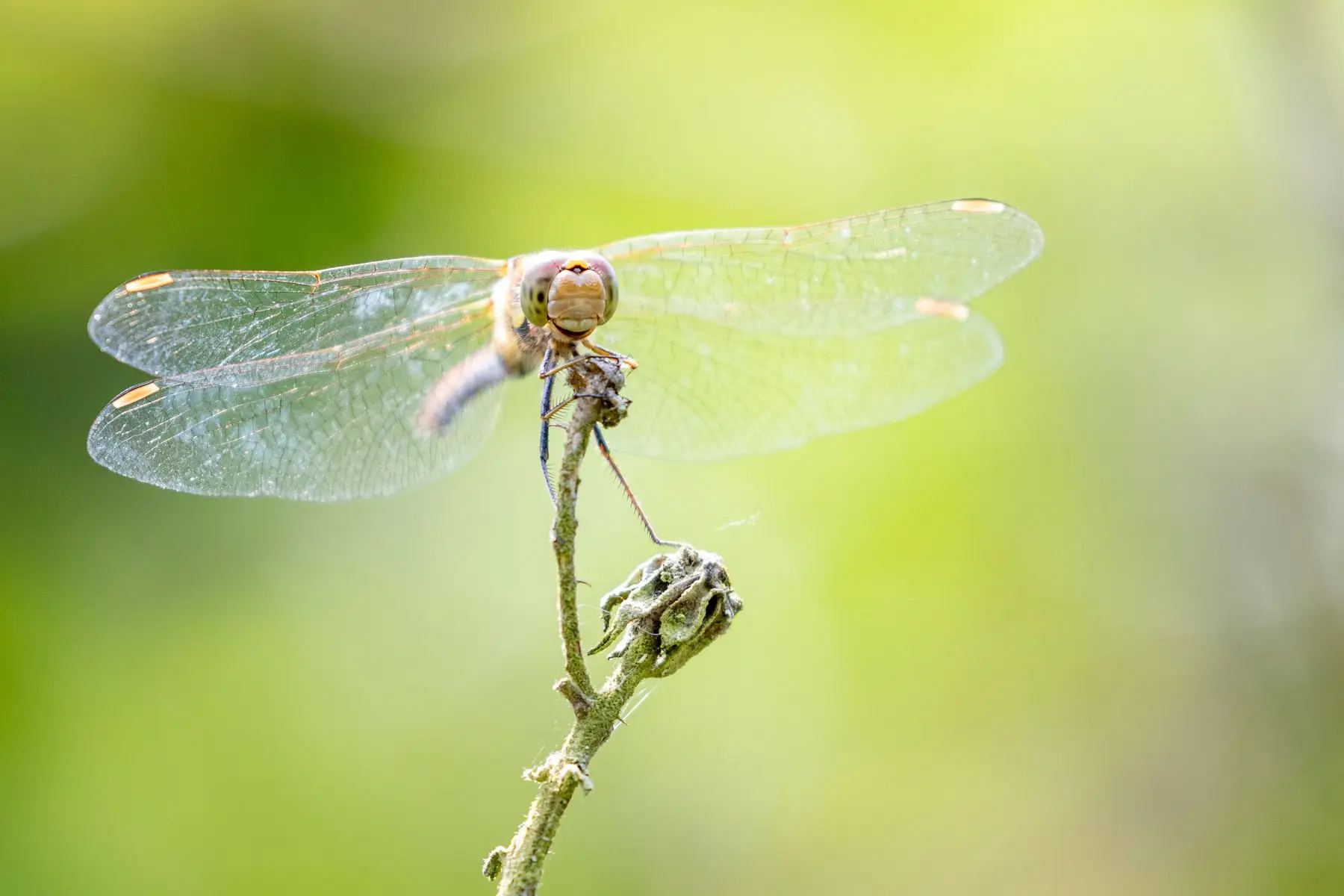
Dragonflies are visual hunters that work from vantage points, scanning and launching. They want bare vertical stems with a clear view.
- Stakes, canes and bare stems at varying heights — roughly knee height up to head height
- Clear of surrounding foliage at the tip, so the view is open
- Scattered, not in a row — several territories rather than one
- Leave last year’s dead stems standing instead of cutting everything back in autumn
Sun, space and warmth
| Why | What to do | |
|---|---|---|
| Perches | Visual hunting from vantage points | Bare vertical stems, mixed heights |
| Open sunny space | Patrol routes | Keep an unshaded corridor or lawn |
| Warm pale surfaces | Raising body temperature | Light stone, paving, a flat rock |
| Small flying insects | Food | Diverse planting; no spraying |
| Shelter from wind | They hunt poorly in wind | A hedge or fence on the windward side |
The container pond
If you want more than visitors, this is the step that changes the category.
- Forty litres or more — a half-barrel, a trug, a large tub
- In sun
- Oxygenating plants, and something emergent for larvae to climb out on
- Sloping access or a ramp so emerging adults and anything else can get out
- No fish. They eat the larvae
That will support damselflies and the smaller dragonfly species. It will not suit the large hawkers, which want a proper pond.
A container pond with fish in it is worse than no pond
Fish eat dragonfly larvae, and in a small volume they will eat essentially all of them.
A stocked container becomes a place dragonflies lay eggs that never produce adults — which is worse than not providing one, because it draws them in to fail.
The mosquito claim, honestly
Dragonflies do eat mosquitoes — larvae underwater, adults on the wing.
They do not control them. No realistic garden dragonfly population eliminates mosquitoes, and the claim is repeated far past what the evidence supports.
If mosquitoes are the actual problem, remove standing water
Blocked gutters, saucers under pots, water butts without lids, a wheelbarrow left out. That does more in an afternoon than any amount of predator encouragement.
Enjoy dragonflies as part of a varied predator community. Do not buy them as pest control.
What to avoid
- Insecticides, including broad-spectrum sprays aimed at something else. Dragonflies depend on a large population of small flying insects, so spraying removes the food supply as well as risking them directly
- Cutting every stem down in autumn — those bare stalks are the perches
- Fish in any small water feature
Common questions
Can you attract dragonflies without a pond?
What actually brings adult dragonflies in?
How far will dragonflies travel from water?
Does a container pond work?
Do dragonflies really control mosquitoes?
What should I avoid?
Backyard Weekly
Know what to plant, week by week
Join the weekly email for seasonal jobs, fixes for what is going wrong, and gear worth buying.
Not ready to subscribe? The planting calendar is free and needs no email.
By subscribing you agree to our privacy policy. Grow In Backyard will never sell your address.
Keep reading
Frogs in the Backyard: Why They Are There, and the Holes
Frogs in a yard mean damp cover, insects and water nearby. What they eat, what those holes in the lawn really are, and whether to keep them around.
Do Butterfly Houses Work? Almost Never, and Here Is Why
Butterfly houses are sold everywhere and are essentially never used by butterflies. What the research found, and what actually helps them overwinter.
How to Keep Bees Away From a Deck or Porch, Safely
Most deck bee problems are carpenter bees, yellowjackets or foraging honeybees, and each needs a different answer. Identify first, then act.
How to Attract Foxes to Your Garden (Carefully)
Foxes come for cover, quiet and easy food. How to make a garden welcoming without creating a tame fox — and why feeding is the part to get right.