
How to Keep Bees Away From a Deck or Porch, Safely
Most deck bee problems are carpenter bees, yellowjackets or foraging honeybees, and each needs a different answer. Identify first, then act.
 By
On this page
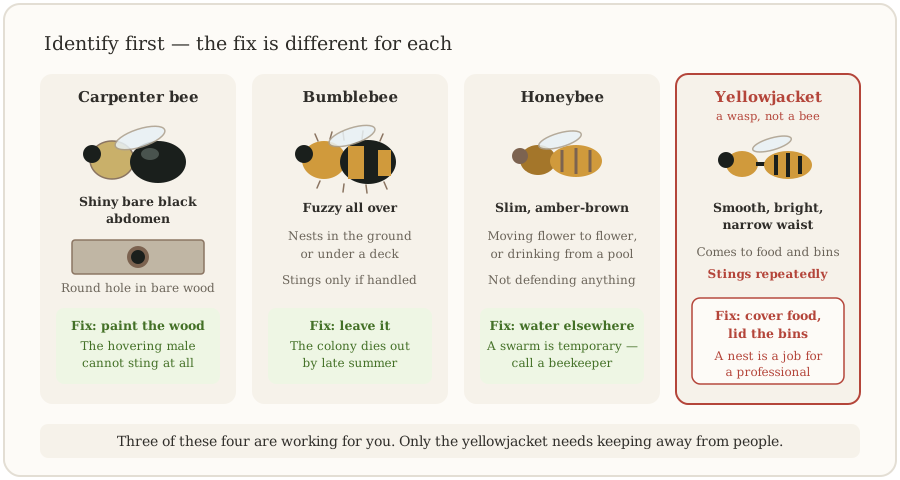
There is no single answer here, because there is no single insect. Carpenter bee, yellowjacket and foraging honeybee are three different problems with three different fixes.
Which one is it
| Carpenter bee | Bumblebee | Honeybee | Yellowjacket | |
|---|---|---|---|---|
| Look | Shiny bare black abdomen | Fuzzy all over | Slim, amber-brown | Smooth, bright yellow and black |
| Behaviour | Hovers, bores wood | Slow, on flowers | Flower to flower | Fast, comes to food |
| Nest | Round hole in bare wood | Ground, cavity | Hive or wall void | Paper nest, or underground |
| Sting | Male: none. Female: rarely | Rarely | Once, defensive | Repeatedly, aggressive |
| On a deck | Boring | Passing through | Foraging or drinking | After your food |
The big bee that flies at your face cannot sting you
That is the male carpenter bee defending his patch of air. He has no sting at all, and the whole aggressive display is bluff.
The female does the boring, does have a sting, and almost never uses it.
Carpenter bees
The fix is paint. Everything else is secondary.
- Paint, stain or polyurethane every exposed surface. They will not bore a finished surface, and strongly prefer bare cedar, redwood, pine and fir
- Check the undersides — rail bottoms, fascia, joist faces, the underside of handrails. That is where they work, because it stays unpainted
- Plug old holes in autumn, once the galleries are empty: hardwood dowel and wood filler, not caulk alone, then paint over the repair
- Hardwood or composite where you are replacing boards
- Carpenter bee traps hung near affected wood catch females before they bore
Do not plug a hole with the bee inside
She bores a new exit, and you have added a hole rather than removed one.
Plug in autumn or winter, after the season, and confirm the gallery is empty first.
On damage: one season is trivial. The problem is that galleries are reused and extended every year, so a rail worked for a decade can be genuinely weakened — and woodpeckers hear the larvae and tear the wood open to reach them, which does far more damage than the bees.
Yellowjackets
The one that actually justifies caution. This is a wasp, not a bee: it stings repeatedly, it is drawn to protein and sugar, and it gets markedly more aggressive in late summer as the colony peaks.
What works:
- Cover food and drinks outdoors. A can left open is the classic incident
- Move bins away from the deck, with tight lids, and rinse them
- Clear fallen fruit under trees
- Rinse recycling before it goes out
- Traps placed at the far edge of the yard, never on the deck — a trap draws them toward it
- Find the nest and keep everyone away from it
A yellowjacket nest is a professional job
Ground nests and wall nests both produce a large defensive response, and people are stung badly every year trying to deal with one themselves.
Call a professional. If you must act, it is at dusk, in full cover, with a clear exit — and even then, mostly, don’t.
Honeybees and bumblebees
Usually not a problem to solve at all. They are foraging, and they are on your deck for a reason you can remove:
- Flowers nearby — they are passing through. Nothing to do
- A pool, hot tub or leaking tap — bees need water, and a pool is the nearest source. Put a shallow water dish with stones out at the far end of the yard and they mostly switch
- Sweet drinks, fruit, hummingbird feeders — cover or move them
- A swarm hanging in a cluster is a temporary resting stage, usually gone within a day or two. Call a local beekeeper, who will collect it free
- A colony inside a wall is a different matter, and needs a beekeeper or specialist removal — killing it in the wall leaves honeycomb that ferments, attracts pests and stains through the plaster
Bumblebee nest under the deck: a colony dies out naturally by late summer and does not reuse the site. If it can be left alone for a few weeks, that is the easiest outcome available.
What does not work
- Broad-spectrum insecticide sprayed around a deck. Kills pollinators indiscriminately, often illegal on flowering plants, and does nothing about the cause
- Ultrasonic repellers — no effect
- Mothballs — no effect, and illegal used this way
- Fake paper wasp nests. Widely sold, repeatedly tested, no reliable effect
- Peppermint, citrus and cucumber peel — brief at best
- Swatting. Crushing a yellowjacket releases an alarm pheromone that recruits others
Things that genuinely help a deck
- Paint the bare wood — carpenter bees, solved
- Lidded bins, covered food, cleared fruit — yellowjackets, mostly solved
- A water source elsewhere — honeybees, mostly solved
- Fix leaking taps and pooling water
- Move the strongly scented flowering pots off the deck and to the garden edge
- Screened porch, if the deck is a losing battle in late summer
Common questions
How do I keep bees away from my deck?
What are the bees drilling holes in my deck?
Do carpenter bees damage a deck seriously?
How do I stop carpenter bees without killing them?
Are the bees on my deck dangerous?
What should I not use against bees on a deck?
Backyard Weekly
Know what to plant, week by week
Join the weekly email for seasonal jobs, fixes for what is going wrong, and gear worth buying.
Not ready to subscribe? The planting calendar is free and needs no email.
By subscribing you agree to our privacy policy. Grow In Backyard will never sell your address.
Keep reading
Best Beehive for Beginners — 5 Hives, One Lifting Test
The best beehive for beginners is the one you can lift full. 5 hive types compared on weight, cost and first-year work. See which suits your back.
Bees Behind Siding: How to Identify and Remove Them
Identify what is actually nesting before anything else — honey bees behind siding need a beekeeper, not a spray, and a sealed-in colony rots in the wall.
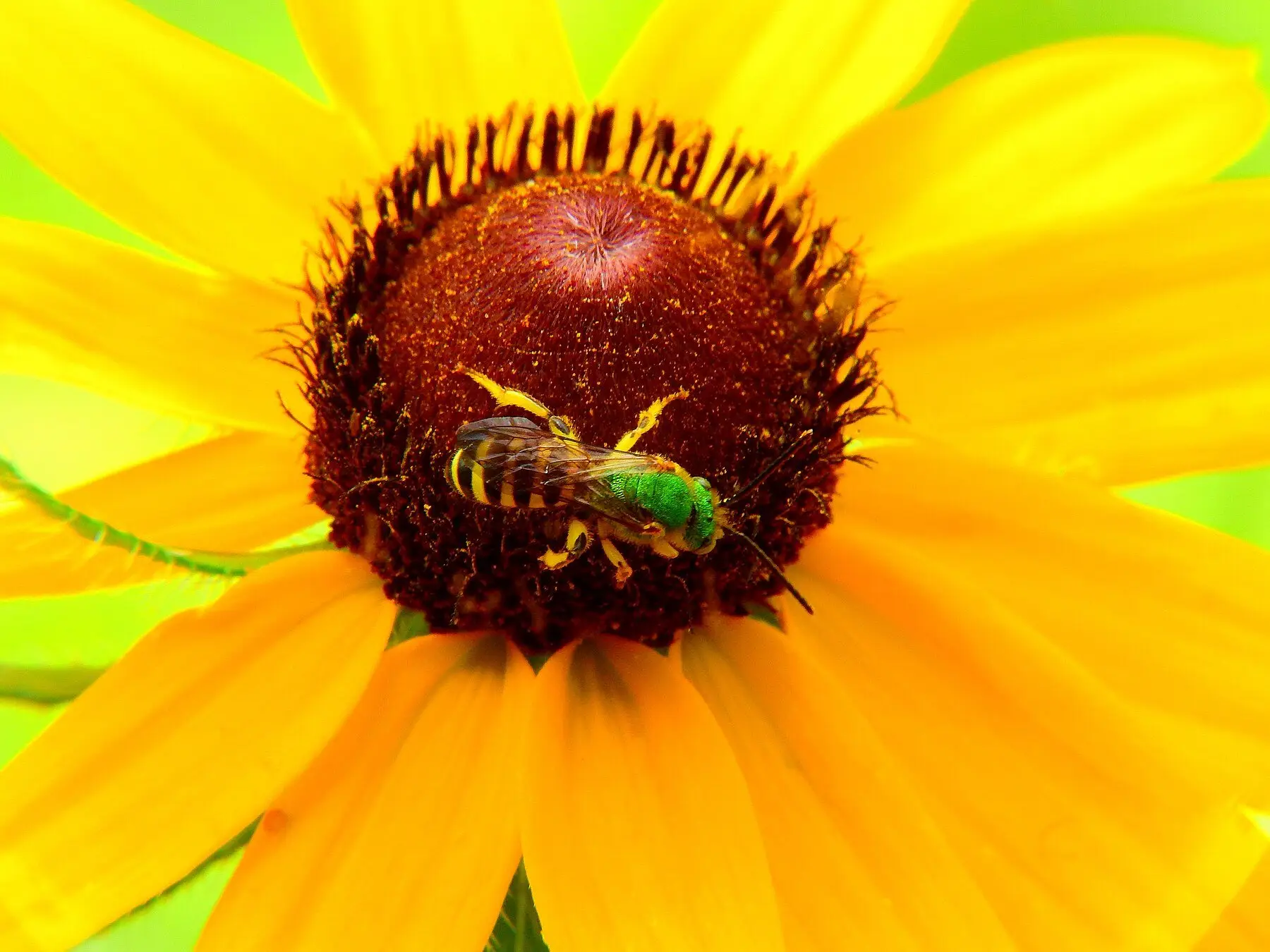
Bee With a Green Head: What You Are Actually Looking At
Metallic green usually means a sweat bee, an orchid bee or a green bottle fly. How to tell them apart, whether they sting, and why they are worth keeping.
Outdoor Garden Lighting Ideas That Get Used Past Month Two
Most outdoor lighting gets hung once and never turned on again. The five kinds worth the effort, and the color temperature that makes or breaks all of them.