
Bee With a Green Head: What You Are Actually Looking At
Metallic green usually means a sweat bee, an orchid bee or a green bottle fly. How to tell them apart, whether they sting, and why they are worth keeping.
 By

On this page
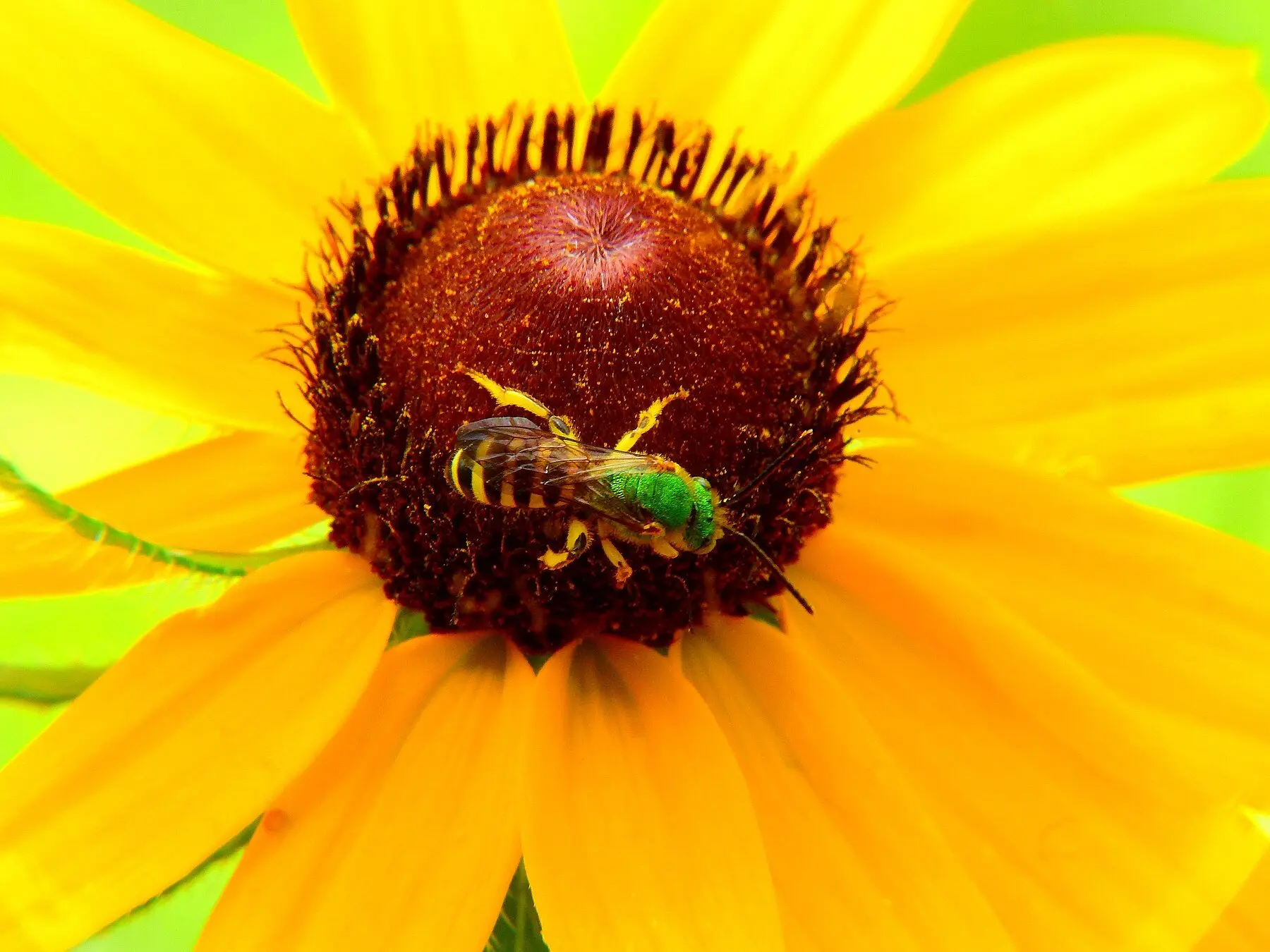
Metallic green almost always means one of three things: a sweat bee, an orchid bee if you are in the American tropics, or — surprisingly often — a fly. The first is by far the most likely in a temperate garden.
Telling them apart
| Sweat bee (Agapostemon) | Sweat bee (Augochlora) | Orchid bee | Green bottle fly | |
|---|---|---|---|---|
| Size | ¼–½ in | ¼–½ in | ½–1 in | ¼–½ in |
| Colour | Green head and thorax, striped abdomen | Metallic green throughout | Brilliant iridescent green or blue | Metallic green, shiny |
| Wings | 4 | 4 | 4 | 2 |
| Antennae | Long, elbowed | Long, elbowed | Long | Short, stubby |
| Waist | Narrow | Narrow | Narrow | None |
| Eyes | Small, at the sides | Small, at the sides | Small | Very large, often meeting |
| Where | North America, widespread | Eastern woodland | Tropical Americas | Everywhere, often near waste |
The quickest test is the eyes. A fly’s eyes are enormous and often meet over the top of the head. A bee’s are small and set at the sides, leaving an obvious face between them.
The second quickest is hairiness. Bees carry pollen and are built for it — even the sleek ones have branched hairs. A bottle fly is smooth and hard-looking, like enamel.
Sweat bees, properly
Halictidae is a large family, and the metallic green members are the ones people notice.
- Size: small. Quarter to half an inch — much smaller than a honey bee.
- Nesting: mostly in the ground, in bare well-drained soil, sometimes in rotting wood. Some are solitary, some share a nest entrance in loose communal groups.
- Season: active early spring to late autumn, which is the point — they cover the gaps at either end of the year when honey bees are not flying.
- Behaviour: non-aggressive, do not swarm, do not defend a hive because most of them do not have one.
The sting, and the landing
They land on people for salt and moisture in perspiration — hence the name. They are after the sodium. It is harmless and most noticeable on hot days doing physical work outside.
Why they occasionally sting
Almost every sweat bee sting happens because the bee was trapped against skin — brushed hard, leaned on, or caught under a sleeve. They are not defending anything. Let it walk off, or blow it away gently, and nothing happens.
The sting itself is very mild — commonly rated at the bottom of the scale, well below a honey bee, and gone in a few minutes. Males cannot sting at all, which is true of every bee species: the sting is a modified egg-laying organ.
The exception that applies to any sting
Anyone with a known venom allergy should treat any sting as significant regardless of the species, and carry what their doctor prescribed. Mildness is a statement about typical reactions, not about allergy.
Why they are worth having
Sweat bees are serious pollinators, and in several respects better than honey bees for a garden:
- They fly in cooler and duller conditions than honey bees will.
- They are active earlier and later in the season.
- They pollinate a wide range of wildflowers, fruit and vegetables, including some crops honey bees handle poorly.
- They are native, unlike honey bees across most of the Americas.
- They carry pollen loose and dry on body hairs, which makes them messier and therefore better at transferring it.
Encouraging them
The important part is the one most gardens get wrong.
- Leave bare soil. Most sweat bees are ground nesters, and they need sunny, well-drained, undisturbed bare patches. A garden mulched to the last inch has nowhere for them to nest, and a bee hotel drilled for cavity nesters does not help them at all.
- Leave a dead log or stump for the wood-nesting species.
- Skip the insecticides, particularly systemic ones, which persist in pollen and nectar.
- Plant a long succession of open flowers — asters, coreopsis, sunflowers, goldenrod, mint-family herbs, native wildflowers. Small bees need shallow, accessible flowers.
- Do not fill in their holes. Small neat holes in a dry sunny bank in spring are usually ground-nesting bees, not an infestation.
If they are genuinely a nuisance
Rarely worth acting on, but if a communal nesting patch is in a spot people use constantly:
- Water the area. Ground-nesting bees want dry soil, and regular irrigation makes a site unattractive without killing anything.
- Mulch or plant over that specific patch, leaving bare soil somewhere else.
- Wait. Most are active for a few weeks, and the adults you see now are gone before long.
Insecticide is the wrong answer for an animal that is not defending a hive, stings barely, and is doing more for the garden than most things in it.
Common questions
What is the small bee with a green head?
Do green sweat bees sting?
Why do sweat bees land on me?
Is it a bee or a fly?
Are green sweat bees good for the garden?
How do I attract green sweat bees?
Backyard Weekly
Know what to plant, week by week
Join the weekly email for seasonal jobs, fixes for what is going wrong, and gear worth buying.
Not ready to subscribe? The planting calendar is free and needs no email.
By subscribing you agree to our privacy policy. Grow In Backyard will never sell your address.
Keep reading
Best Beekeeping Books for Beginners — 6 Worth Owning
Pick the best beekeeping book for beginners by the job it does. 6 books compared: one to learn from, one to look things up in. See which you need.
Best Beehive for Beginners — 5 Hives, One Lifting Test
The best beehive for beginners is the one you can lift full. 5 hive types compared on weight, cost and first-year work. See which suits your back.
Bees Behind Siding: How to Identify and Remove Them
Identify what is actually nesting before anything else — honey bees behind siding need a beekeeper, not a spray, and a sealed-in colony rots in the wall.
What Butterflies Need to Survive in a Backyard
Nectar flowers feed adult butterflies but cannot raise any. Caterpillars only eat specific host plants — that gap is why most butterfly gardens stay empty.