
How Strong Are Squirrels? Stronger Than Their Size Suggests
Bite force that cracks walnuts, a jump nine times body length, and the ability to carry nearly their own weight up a vertical trunk.
 By
On this page
Most of a squirrel’s strength is leverage rather than muscle — a chisel-edged incisor working a seam, and a hind limb geared for a three-metre jump.
The numbers that matter
| measure | grey squirrel |
|---|---|
| Horizontal jump | up to ~3 m |
| Vertical jump, standing | 1.2–1.5 m |
| Drop survived | the full canopy |
| Load carried up a trunk | approaching half body weight |
| Running speed | ~20 km/h |
Why the teeth do so much work
| feature | consequence |
|---|---|
| Enamel front, dentine behind | self-sharpening chisel edge |
| Continuous growth | wear never blunts them |
| Large masseter for skull size | high force at the incisor tip |
| Gnaw-and-lever technique | opens shells without crushing them |
Levering, not crushing
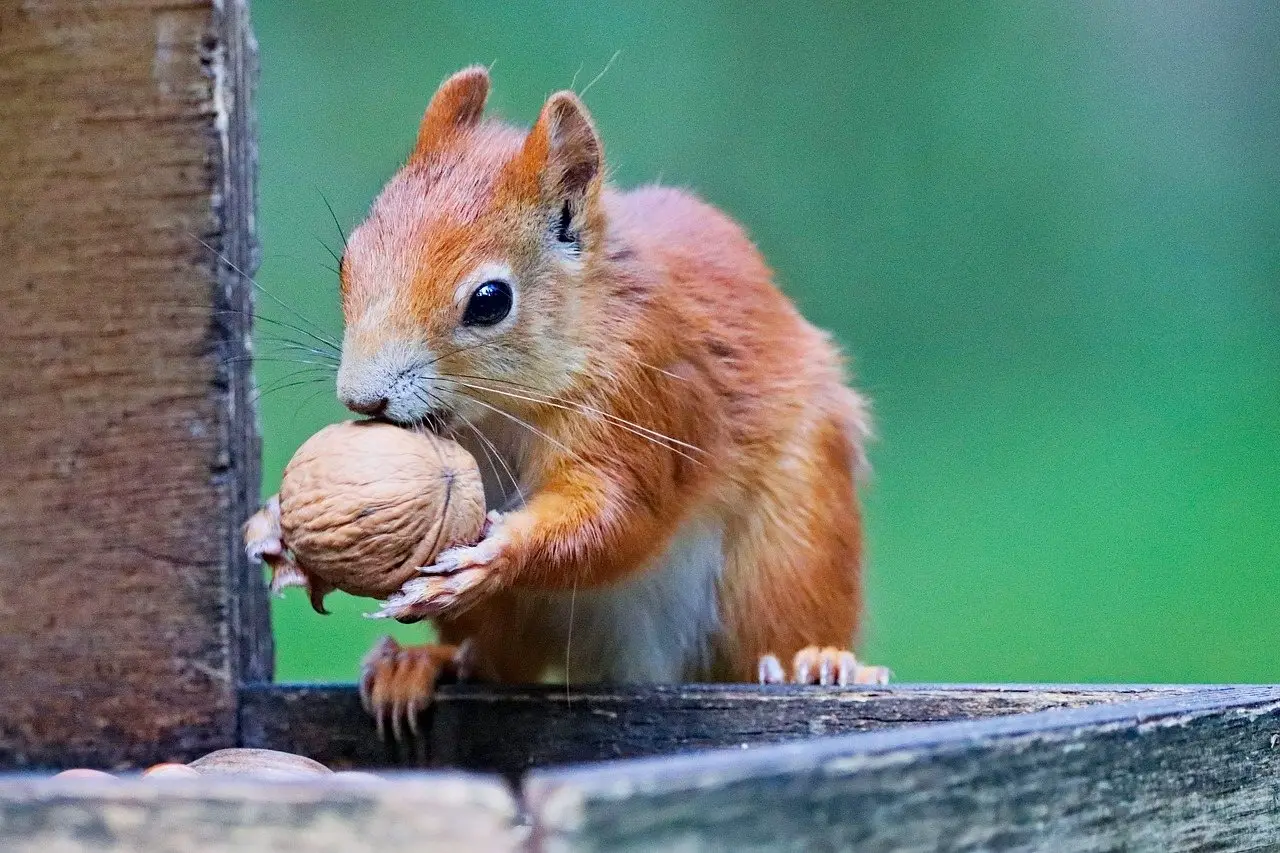
A squirrel does not bite a walnut in half. It cuts a groove along the natural seam, inserts the lower incisors and prises. That is why a shell that resists a human hand yields to an animal weighing half a kilo.
What this means for squirrel-proofing
- Baffle height: at least 1.5 m above the ground and above anything to jump from
- Clearance: 3 m of open air on every side of a feeder pole
- Mesh: steel, 12 mm or finer — anything softer is a chew toy
- Weight-triggered feeders work because mass, not strength, is what they test
- Nothing sprayed, hung or smeared has ever beaten the jump
Do not hand-feed
Almost every squirrel bite happens at a hand holding food. The incisors that open a walnut make a deep puncture wound, which needs cleaning and usually medical attention for infection and tetanus rather than rabies.
Common questions
How strong is a squirrel's bite?
Can a squirrel crack a walnut shell?
How far can a squirrel jump?
How much can a squirrel carry?
Are squirrels tough as well as strong?
Should I be worried about being bitten?
Backyard Weekly
Know what to plant, week by week
Join the weekly email for seasonal jobs, fixes for what is going wrong, and gear worth buying.
Not ready to subscribe? The planting calendar is free and needs no email.
By subscribing you agree to our privacy policy. Grow In Backyard will never sell your address.
Keep reading
Do Squirrels Have Sharp Teeth? Chisels That Never Stop
Four incisors that grow about six inches a year and self-sharpen against each other. What they cut through, and why a bite is a puncture wound.
How Fast Can Squirrels Run? 12 to 20 mph, By Species
Grey squirrels top out around 12–15 mph, fox squirrels a little higher, and ground squirrels near 20. Why the sprint matters less than the turning.
Squirrel-Proof Bird Feeders — 5 Measures That Stop Them
Squirrel-proof bird feeders work on distance and mechanism, not claims. 5 measures compared on cost and success. See which suits your yard.
How to Attract Butterflies to a Butterfly House
Butterfly houses attract spiders far more often than butterflies. What the research shows, and the planting that genuinely brings butterflies in.