
Bird in a Dryer Vent: Getting It Out and Keeping It Shut
A nest in a dryer vent is a fire risk as well as a noise. How to get the bird out safely, when the law says wait, and the cover that stops it.
 By
On this page
Two things are true at once here: there is a bird in the wall, and there is dry nesting material in a duct full of hot lint. The second one is the reason this cannot wait.
Why it happens
A dryer vent is, to a starling, an excellent cavity: warm, dry, sheltered, high off the ground, with a flap that props open and nothing that can climb to it.
The usual occupants:
- European starling — by far the most common, and not protected
- House sparrow — also not protected
- House finch — protected
- Carolina wren, chickadee — protected, less common
Season is March to June in most of North America.
Signs
- Scratching, fluttering or chirping in the laundry-room wall, loudest at dawn
- The dryer takes two or three cycles to dry one load
- The laundry room gets hot and humid while it runs
- The exterior flap will not open, or is propped ajar by twigs
- Nest material, droppings or feathers on the ground below the hood
Do not run the dryer to blow it clear
The duct is full of dry grass and lint and the air going into it is hot. Blocked dryer vents are a documented cause of house fires, and this is the version of that with kindling already in it.
On a gas dryer there is a second problem: a blocked exhaust pushes combustion gases, including carbon monoxide, back into the room.
Stop using it until the duct is clear.
The legal part
In the US the Migratory Bird Treaty Act protects nearly all native birds, and an active nest — eggs or chicks — cannot legally be removed without a permit.
The saving grace is who is usually in there: European starlings and house sparrows are non-native and unprotected, and between them account for most dryer vent nests. Their nests can be removed at any time.
If it is a protected species with an active nest: dry laundry another way for two to four weeks, and fit the guard the moment they fledge.
Getting the bird out
- Unplug the dryer, or turn off the gas
- Go outside. Everything happens at the hood, not in the laundry room
- Remove the exterior vent hood — usually four screws
- Wait a minute. With light and an opening, most birds leave on their own
- If it is close, lift it out with a gloved hand, holding the wings against the body
- If it is deeper in, feed a dryer vent brush gently in from the outside to encourage it back toward the opening
- Never push anything toward the appliance. That drives the bird further into the run and compacts nesting material where you cannot reach it
If it will not come out in a few minutes, stop
A bird wedged deep in a duct run, or one that has gone past a bend, is a job for a wildlife removal service. Coat hangers, vacuums and improvised hooks injure birds and damage flexible duct.
The call costs less than replacing the duct run.
Clearing the duct properly
- Gloves and a dust mask. Nest debris and droppings carry mites, and dry accumulated material carries fungal spores
- Pull everything out — nest, feathers, droppings, lint
- Brush the full run with a dryer vent brush. Material travels much further down than the visible nest
- Check inside at the appliance end too, and clean the lint trap housing
- Test it: run the dryer and confirm the exterior flap opens strongly with the airflow
Rigid metal duct throughout is the right specification. Flexible foil or plastic duct sags, traps lint, and is exactly what a nest compacts inside.
Keeping them out
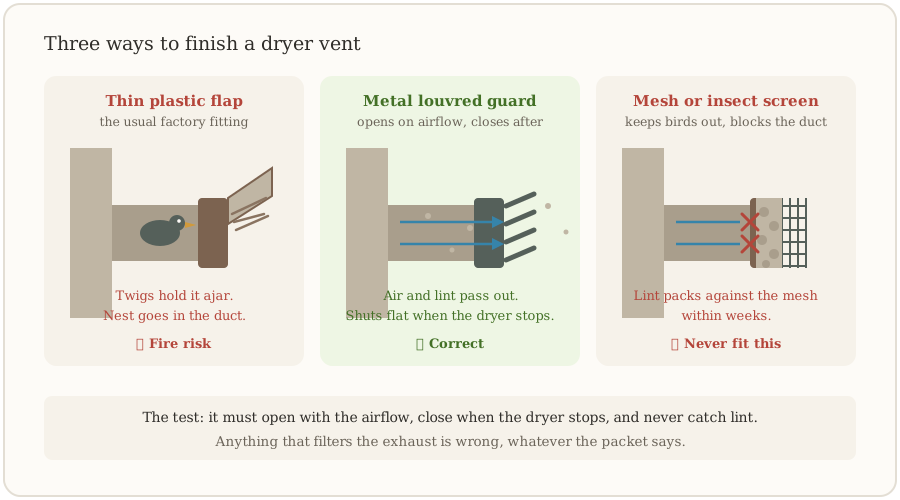
| Cover | Verdict |
|---|---|
| Metal louvred bird guard | Correct. Opens on airflow, closes after |
| Hinged metal flap hood | Correct |
| Standard thin plastic flap | The usual factory fitting, easily propped open |
| Insect screen or wire mesh | Never. Clogs with lint in weeks — a fire hazard |
| Magnetic or spring covers | Check they open fully under dryer airflow |
The rule is simple: it must open with the airflow and close when the dryer stops, and it must not catch lint. Anything that filters the exhaust is wrong, whatever it says on the packet.
Fit it in autumn or winter, between nesting seasons, and check every spring that the flap still moves freely.
Common questions
How do I get a bird out of a dryer vent?
Is a bird nest in a dryer vent a fire hazard?
Can I remove a bird nest from my dryer vent legally?
How do I know there is a bird in my dryer vent?
What keeps birds out of a dryer vent for good?
Should I clean the duct after removing a nest?
Backyard Weekly
Know what to plant, week by week
Join the weekly email for seasonal jobs, fixes for what is going wrong, and gear worth buying.
Not ready to subscribe? The planting calendar is free and needs no email.
By subscribing you agree to our privacy policy. Grow In Backyard will never sell your address.
Keep reading
How to Keep Birds From Nesting on a Porch, Deck or Ledge
Deter birds before they build, because once eggs are laid the nest is protected by law. Physical blocking, timing, and what deterrents fail at.
Do Birds Like Hanging Bird Houses? What the Evidence Says
Hanging boxes swing, which most cavity nesters dislike and predators exploit. Which species accept them, and why a post-mounted box is safer.
Bird House Hole Size: The Number That Picks the Tenant
Entrance diameter decides which species can use a box and which predators cannot. A size chart, the dimensions that go with each, and why perches are harmful.

Bird Netting for Tomatoes — 5 Options, One Mesh Size
Bird netting for tomatoes works on mesh size, not strength. 5 options compared on framing, safety and cost. See which suits your plants.