
Best Bird Food to Attract Colorful Birds — 6 by Species
The best bird food to attract colorful birds changes by species. 6 foods matched to cardinals, orioles, bluebirds and more. See which to put out first.
 By
We may earn a commission when you buy through links on this page, at no extra cost to you.
On this page
The search phrase assumes a product that does not exist. There is no bag of food that brings bright birds in general, because the bright birds in a North American backyard do not eat the same things — and the ones that come to a seed feeder are a minority of them.
What works is picking three or four foods, each aimed at a species you actually have.
Match the food to the bird, not to the bag
| Bird | Food that works | Presentation | Season |
|---|---|---|---|
| Northern cardinal | Safflower, black oil sunflower | Hopper or tray near cover | Year-round |
| American goldfinch | Nyjer, sunflower chips | Mesh or fine-port tube | Year-round, peaks late winter |
| Baltimore oriole | Grape jelly, orange halves, nectar | Jelly cup, fruit spike | Late April to July |
| Eastern bluebird | Mealworms | Open dish, caged feeder | Year-round, best in nesting season |
| Hummingbirds | 1:4 sugar water | Nectar feeder with ant moat | Spring to first frost |
| Blue jay | Peanuts in shell, sunflower | Tray or platform | Year-round |
| Rose-breasted grosbeak | Black oil sunflower, safflower | Hopper or tray | Migration and summer |
| Woodpeckers | Suet, peanuts | Suet cage, peanut mesh | Autumn to spring |
The pattern is that seed covers two or three of these and nothing else. A yard with only a seed feeder is structurally limited to the seed-eating birds, no matter how good the seed is.
Check your range before you buy anything
The most expensive mistake in bird feeding is buying food for a bird that does not live where you live. Painted buntings, indigo buntings, western tanagers and evening grosbeaks all turn up in articles like this one and are regionally restricted.
Spend ten minutes with a regional bird list or a local sightings map first. Then buy for the three or four bright species that are genuinely present, which is almost always a shorter and less glamorous list than the one in the advertising — and a list you can actually succeed with.
Timing beats quantity for migrants
Orioles and hummingbirds are the two species where the date you start matters more than anything else you do.
Both arrive hungry, both are looking for a food source in their first days back, and both settle into a route within a week or two. A feeder that goes up in mid-May has missed the window in much of the country; a feeder that went up in mid-April gets adopted.
Watch out
Jelly and nectar both ferment. In hot weather, change nectar every one to two days and offer jelly in small daily amounts rather than a full cup — fermented sugar and mouldy jelly are genuinely harmful, not merely unappetising.
Water does more than food for variety
This is the part that gets left out, and it is the cheapest change on the list.
Warblers, tanagers, vireos and thrushes — a large share of the brightest birds in North America — will never come to a seed feeder because they eat insects and fruit. They will come to water. A shallow bath, no more than two inches deep, with moving water from a small dripper or wiggler, pulls in species that a feeder cannot.
Three things make a bath work: shallow, rough-bottomed so birds can grip, and moving, because sound is what they locate it by. Clean it every few days in summer.
Cover is the other half
A bright bird is a conspicuous bird, and conspicuous birds do not feed in the open unless they can reach cover in one flight. A feeder ten feet from a shrub line will hold species that the same feeder in the middle of a lawn never sees.
If the yard is mostly grass, the highest-value change is not a better bag of seed. It is a shrub, a small native tree, and a strip of edge left unmown.
How we picked
Picks assembled from species diet research, feeder-preference studies and owner reports — nothing here was tested in our own yard. · Picks last checked October 2026.
- It targets a specific bright species
- There is no food that attracts colorful birds generally. Orioles want fruit and sugar, bluebirds want insects, goldfinches want tiny oil seed. One bag cannot do all three.
- The species is actually in your range
- No food brings a painted bunting to Ohio. Check your region's bird list first, then buy for what is there.
- It needs the right presentation
- Jelly needs a cup, mealworms need a dish, nectar needs a feeder with the right port. Buying the food without the vessel wastes both.
- Spoilage risk in warm weather
- Nectar, jelly and live mealworms all turn fast in heat, and spoiled versions of each actively harm birds.
- Season it works in
- Oriole and hummingbird food is useless in January across most of the US. Suet is near-useless in July. Buying out of season is the commonest wasted purchase.
Our picks
| # | Pick | Best for | Where to buy |
|---|---|---|---|
| 1 | Black oil sunflower seed | Best single food for the most bright species | Check price for Black oil sunflower seed → |
| 2 | Grape jelly and orange halves | Best for orioles | Check price for Grape jelly and orange halves → |
| 3 | Dried mealworms | Best for bluebirds | Check price for Dried mealworms → |
| 4 | Nyjer (thistle) seed | Best for goldfinches | Check price for Nyjer (thistle) seed → |
| 5 | Sugar water (1 part sugar to 4 parts water) | Best for hummingbirds | Check price for Sugar water (1 part sugar to 4 parts water) → |
| 6 | Suet cakes (plain or insect) | Best for woodpeckers in winter | Check price for Suet cakes (plain or insect) → |
Best single food for the most bright species
Black oil sunflower seed
If you want colour and only want to buy one thing, buy this. Cardinals, blue jays and grosbeaks are all on it.
- Brings
- Cardinals, jays, grosbeaks, house finches, woodpeckers
- Feeder
- Hopper, tray or tube
- Season
- Year-round
- Spoilage
- Low in shell, keeps months when cool and dry
What we liked
- The broadest species range of any single food
- Works in every feeder type
- Cheapest good seed per pound
- High fat content, which matters most in winter
Worth knowing
- Squirrels, grackles and starlings compete hard for it
- Shell mat kills the grass below the feeder
Best for orioles
Grape jelly and orange halves
Use plain grape jelly without high-fructose corn syrup, offer it in small amounts, and refresh daily. Timing matters more than brand.
- Brings
- Baltimore and orchard orioles, sometimes catbirds and tanagers
- Feeder
- Oriole feeder with jelly cups and orange spikes
- Season
- Late April to July in most of the US
- Spoilage
- High — replace jelly daily in heat
What we liked
- Orioles respond to it faster than to anything else
- Visually unmistakable birds, so the payoff is immediate
- Cheap to run; a jar lasts weeks
Worth knowing
- Has to be out before migration passes, not after
- Ferments and draws wasps and ants in hot weather
- Only a seasonal food across most of the country
Best for bluebirds
Dried mealworms
Offer a small measured amount at the same time each morning. Bluebirds learn a schedule, and it stops starlings cleaning you out.
- Brings
- Bluebirds, wrens, chickadees, robins
- Feeder
- Open dish or caged mealworm feeder
- Season
- Year-round, best in nesting season
- Spoilage
- Low when dry and sealed
What we liked
- Close to the only feeder food bluebirds reliably take
- Keeps for months, unlike live worms
- Also pulls in wrens and nesting chickadees
Worth knowing
- Dried are less attractive than live; some birds need coaxing
- Starlings and jays will clear a dish fast
- Dear per pound
Best for goldfinches
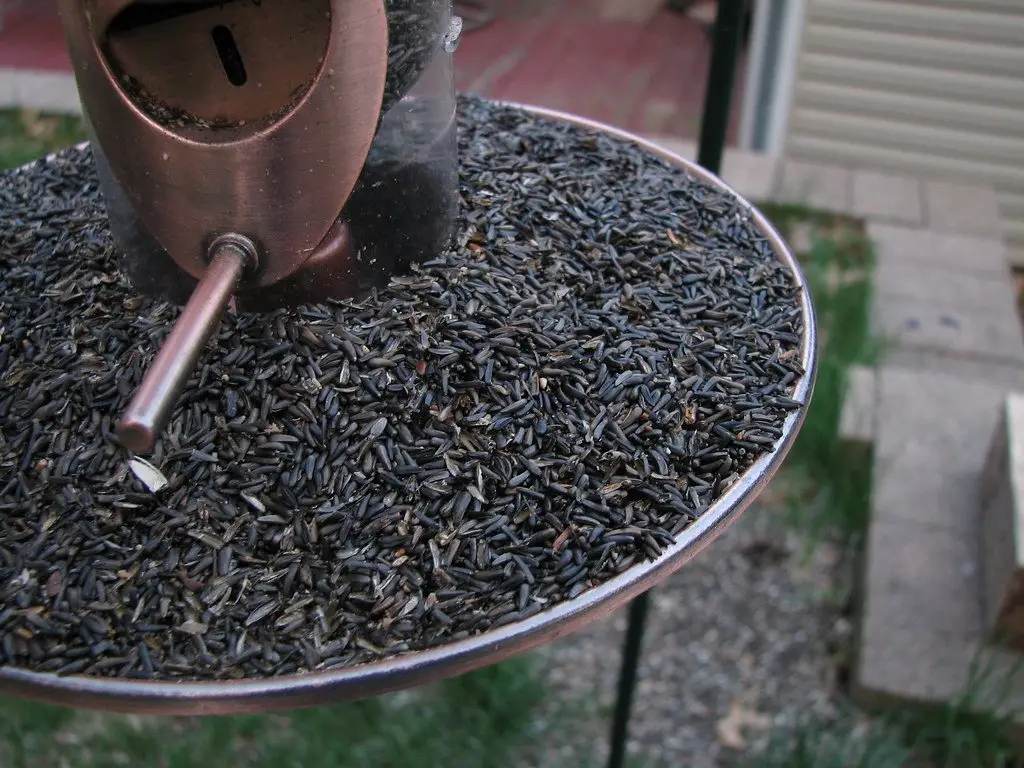
Nyjer (thistle) seed
The brightest yellow in most backyards for about twelve dollars a bag. Freshness is the whole game.
- Brings
- American goldfinches, siskins, redpolls
- Feeder
- Mesh tube or fine-port finch tube
- Season
- Year-round; peak late winter to spring
- Spoilage
- High — rancid in about 3 months
What we liked
- Near species-selective; sparrows and squirrels ignore it
- Goldfinches in breeding plumage are as bright as anything in the yard
- Flock feeders, so a mesh tube fills up visibly
Worth knowing
- Needs a dedicated feeder
- Short shelf life; buy 2–3 lb at a time
- Fine husk litter below the feeder
Best for hummingbirds
Sugar water (1 part sugar to 4 parts water)
Buy the feeder, not the nectar. White sugar and water in a 1:4 ratio is what the research supports, with no dye and never honey.
- Brings
- Hummingbirds, occasionally orioles and woodpeckers
- Feeder
- Hummingbird feeder with red ports
- Season
- Spring to first frost in most of the US
- Spoilage
- Very high — change every 2 days in heat
What we liked
- Plain table sugar and water beats every bottled nectar
- Costs pennies per fill
- The feeder's red parts do the attracting, so no dye is needed
Worth knowing
- Must be changed every one to two days in hot weather
- Draws ants and wasps without a moat or guard
- Ferments fast; cloudy means dump it
Best for woodpeckers in winter
Suet cakes (plain or insect)
Use an upside-down or caged suet feeder to cut out starlings, and take it down in high summer. Plain or insect suet beats the fruit-flavoured kinds.
- Brings
- Downy, hairy and red-bellied woodpeckers, nuthatches, chickadees
- Feeder
- Wire suet cage
- Season
- Autumn through spring
- Spoilage
- Melts and goes rancid above about 80°F
What we liked
- Brings the boldly marked woodpeckers nothing else does
- High-energy food for the coldest weeks
- Cages are cheap and last years
Worth knowing
- Not for summer; it melts and turns
- Starlings dominate an open cage
- Mess under the feeder in warm spells
Which should you buy?
Our verdict
- Best overall:
- Black oil sunflower seed
- Best value:
- Sugar water (1 part sugar to 4 parts water)
If you buy one thing, buy black oil sunflower — cardinals, jays, grosbeaks and house finches are all on it. Sugar water is the cheapest colour in the yard: table sugar, tap water, and the only cost is the feeder.
| If you… | Buy | Because |
|---|---|---|
| You want the widest range of bright birds from one feeder | Black oil sunflower in a hopper with a tray | Cardinals, jays, grosbeaks, house finches and woodpeckers all take it, and it works year-round in any feeder. |
| You want orioles specifically | Grape jelly and orange halves, from late April | Orioles are fruit and nectar feeders in spring. Put it out before they arrive, not after you see one, because they move through fast. |
| You want bluebirds | Dried or live mealworms in an open dish | Bluebirds are insect eaters and will largely ignore seed. Mealworms are the only reliable feeder food for them. |
| You want goldfinches | Fresh nyjer in a mesh tube | Small oil seed suits their tiny bills, and almost nothing else at the feeder competes for it. |
| You want hummingbirds | Plain sugar water, four parts water to one of sugar | It is better than any bottled nectar and costs almost nothing. Never add red dye, and never use honey. |
When not to buy at all
Skip anything sold as an 'attract colorful birds' mix. These are general wild-bird mixes with a bright bag, usually millet- and milo-heavy, and they bring house sparrows and doves. The bright birds people are hoping for each need a specific food that is not in the bag.
Common questions
What bird food attracts the most colorful birds?
Is there a seed mix that attracts colorful birds?
When should I put out oriole food?
Do bluebirds eat bird seed?
Should I buy red hummingbird nectar?
What else besides food attracts colorful birds?
Backyard Weekly
Know what to plant, week by week
Join the weekly email for seasonal jobs, fixes for what is going wrong, and gear worth buying.
Not ready to subscribe? The planting calendar is free and needs no email.
By subscribing you agree to our privacy policy. Grow In Backyard will never sell your address.
Keep reading
Best Bird Baths — 2 Inches Deep Is the Whole Secret
The best bird baths are 2 inches deep with a rough bottom. 6 picks compared on grip, depth and winter use. See which one birds will actually use.
Mourning Dove Bird Feeder — 5 Trays and Platforms
A mourning dove bird feeder needs a flat surface, not a perch. 5 trays and platforms compared, plus the seed. See which fits your yard.
Best Bird Seed for Cardinals — 5 Picks, Safflower First
The best bird seed for cardinals is safflower, which squirrels leave alone. 5 seeds compared on pull, cost and mess. See which suits your feeder.
Best Bird Seed for Finches — 5 Picks, 2 They Actually Eat
The best bird seed for finches is nyjer or sunflower hearts, little else. 5 options compared with the feeders they need. See which fits yours.