Yard Games for Adults: What Works With a Real Group
Games for grown-ups fail on space, drink-compatibility, or needing eight people. What holds up at a party, what suits teams, and the footprint each needs.

On this page
Adult yard games fail for reasons that have nothing to do with whether the game is good. They need too much space, or an exact number of players, or two free hands, or five minutes of rules explanation that nobody listens to.
The ones that survive a real gathering share three properties: join anytime, explain in a sentence, play with a drink in one hand.
The games that hold up
| Game | Space | Players | Learn in | Drink-compatible | Durability |
|---|---|---|---|---|---|
| Cornhole | 33 × 8 ft | 2–4, rotating | 30 sec | Yes | High if hardwood |
| Pétanque / bocce | 30 × 10 ft | 2–12 | 1 min | Yes | Decades |
| Giant Jenga | 6 × 6 ft | Any | 0 sec | Yes | Medium; warps if wet |
| Ladder toss | 20 × 10 ft | 2–8 | 30 sec | Yes | Medium |
| Washers | 25 × 6 ft | 2–8 | 30 sec | Yes | High |
| Kubb | 26 × 16 ft | 2–12 | 3 min | Mostly | High |
| Giant Connect Four | 5 × 5 ft | 2 | 0 sec | Yes | Medium |
| Horseshoes | 45 × 10 ft | 2–4 | 1 min | Yes | Very high |
| Spikeball | 30 ft circle | 4 | 2 min | No | High |
| Molkky | 15 × 10 ft | 2–10 | 2 min | Yes | High |
| Volleyball | 60 × 30 ft | 8+ | 1 min | No | Medium |
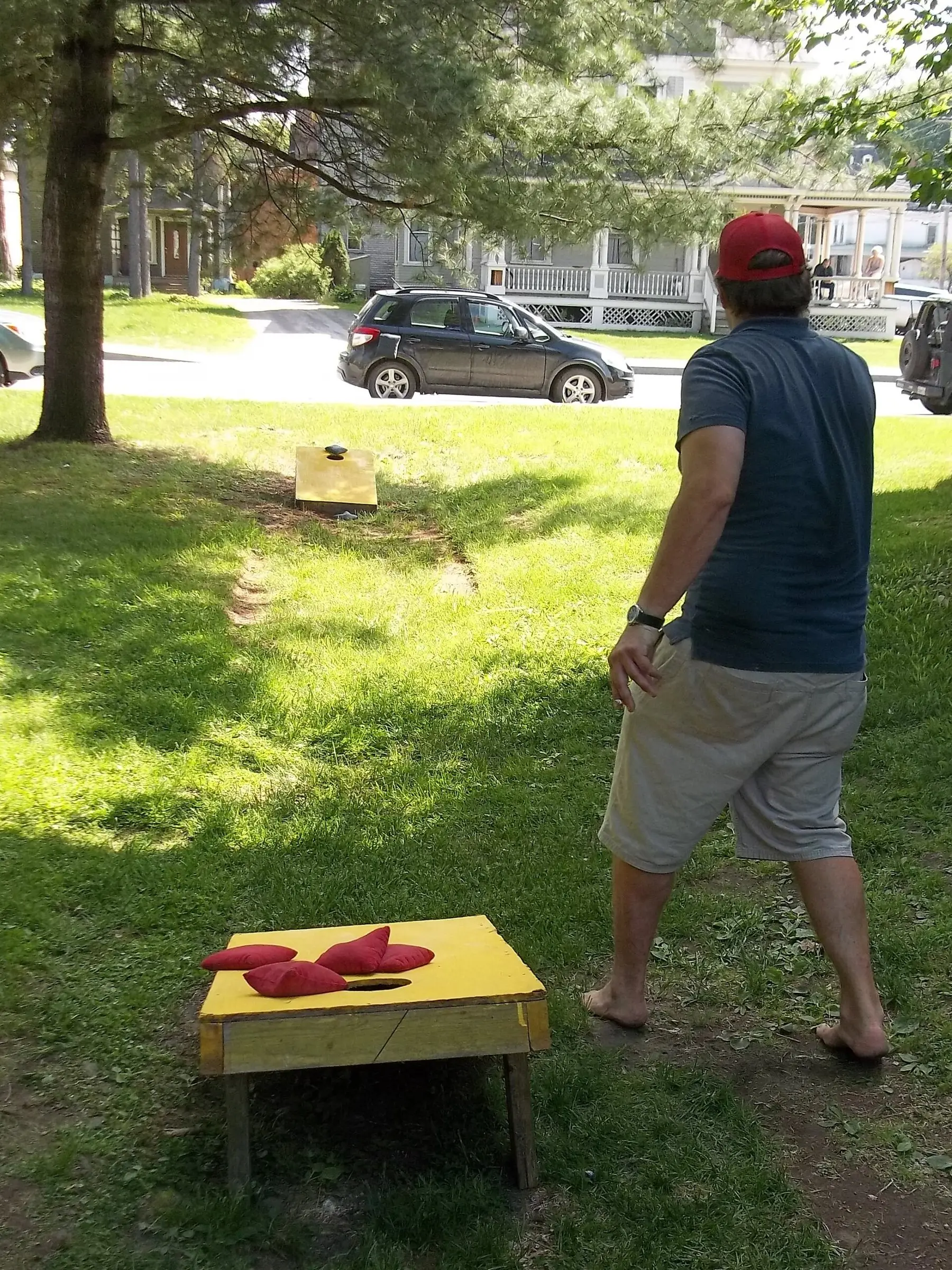
Cornhole is the default because it is genuinely good at the constraints: two boards, rotating turns, trivial rules, and it works while holding a drink. Buy hardwood if you will keep it; the cheap plastic sets bow.
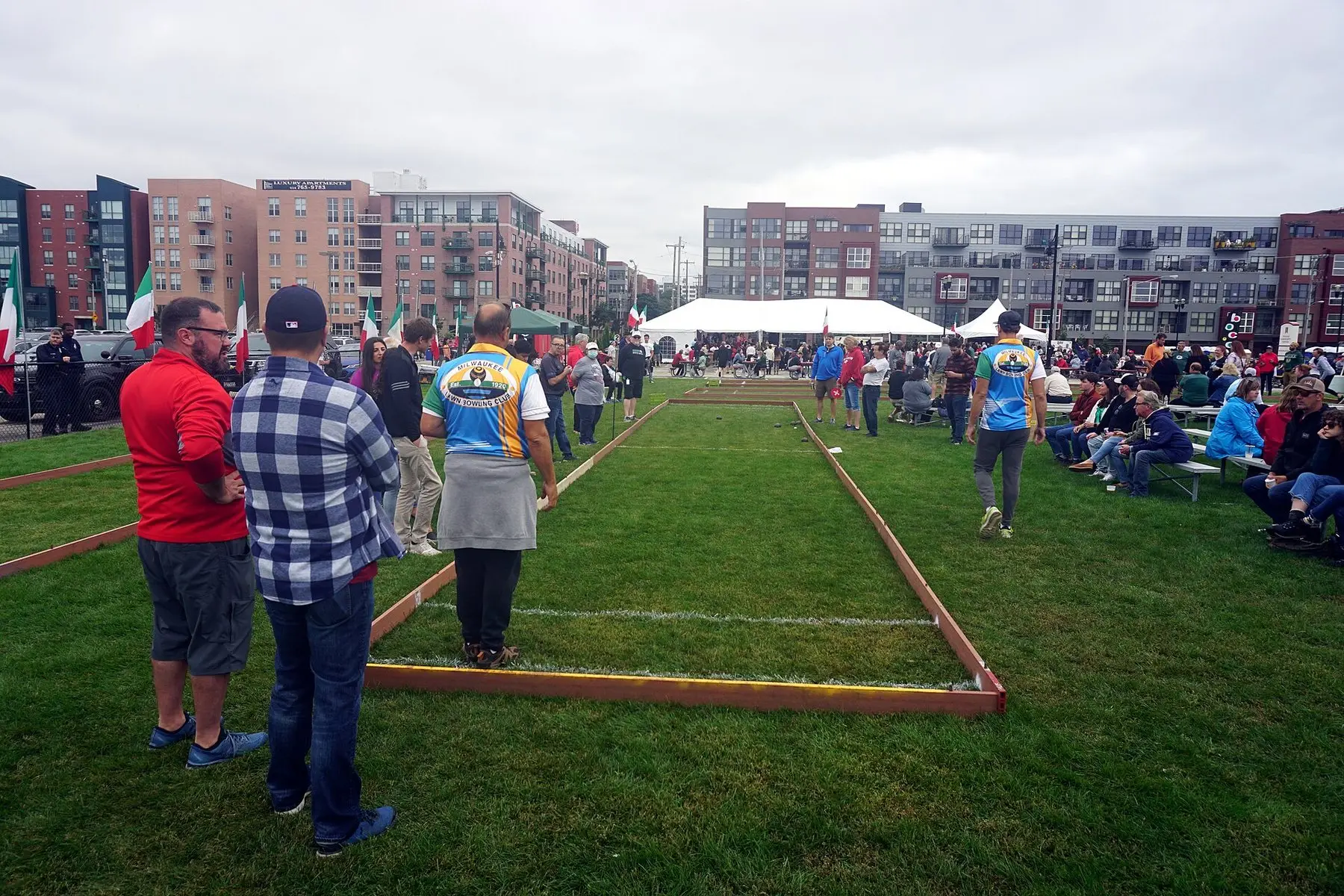
Pétanque or bocce is the most under-rated entry here. It plays on grass, gravel, dirt or a rough path — the surface being imperfect is the point — the balls are essentially indestructible, and a set lasts thirty years. It also scales gracefully from two people to a dozen.
Kubb takes three minutes to explain, which is its only real drawback, and it is the best game on this list for mixed groups. Throwing accuracy matters more than strength, so it does not collapse into one athletic person dominating.
Washers is cornhole’s smaller cousin — less space, cheaper, near-indestructible, and the boxes store flat.
Two sets beats one big game
With more than about twelve people, one board becomes a queue and people drift away. Two cornhole sets or two ladder-toss frames running a simple bracket keeps everyone playing. The second set costs less than the attention you lose without it.
For team building specifically
The failure mode of team-building games is that one fit, competitive person takes over and everyone else watches. Choose games where that cannot happen:
- Kubb. Precision over power, and turns rotate through the whole team.
- Tug of war. Genuinely collective; nobody can carry it alone.
- Relay formats — anything where the team is only as fast as its handover.
- Blindfold navigation courses, where one person directs and another moves.
- Human knot and similar puzzle games, for smaller groups and no equipment.
Avoid: volleyball, spikeball, anything with a run-up, and anything scored on individual performance. They are good games and they are the wrong tool for this.
Mixed ability is the whole design problem
A team-building game that a former college athlete wins single-handedly has taught the group something, but not what was intended. The test to apply before choosing: could the least athletic person present plausibly make the decisive contribution? If not, pick a different game.
Measure before you buy
The most common regret is a set that does not fit. Official footprints:
- Cornhole: boards 27 feet apart, so a 33 × 8 ft lane with room to stand behind.
- Horseshoes: stakes 40 feet apart — 45 × 10 ft. This is bigger than most gardens allow.
- Kubb: pitch 26 × 16 ft.
- Spikeball: a 30 ft circle, because play goes in every direction.
- Volleyball: 60 × 30 ft plus run-off. Rarely realistic in a back garden.
And add space for people standing around watching, which is where the game actually happens.
Shorter versions of most of these are entirely legitimate. Cornhole at 21 feet plays fine.
What to skip
- Anything with elastic cord. UV perishes it within a couple of seasons.
- Printed fabric games — mats, banners, targets. They fade and fray in one summer.
- Oversized board games other than Jenga and Connect Four. Heavy, slow to set up, played once.
- Games needing an exact number of players. At a party the number changes every ten minutes.
- Anything requiring a hard, level surface, unless you have one.
- Lawn darts. Banned in some jurisdictions, and for good reason.
Storage decides whether it gets used
A game that lives at the back of a shed behind the mower gets played once a year.
Set aside somewhere the games can be pulled out in thirty seconds, keep the pieces in one bag per game, and bring anything wooden or fabric indoors over winter. Giant Jenga blocks left out in rain warp permanently, and a warped set is unplayable rather than merely shabby.
For the general roundup — including games for mixed-age family groups — see outdoor games that actually get played.
Common questions
What are the best outdoor games for adults at a party?
How much space do yard games need?
What outdoor games work for team building?
What games work with a very large group?
Are giant versions of board games worth buying?
What is the most durable yard game to buy once?
Backyard Weekly
Know what to plant, week by week
Free planting calendar. Join the weekly email for seasonal jobs, fixes for what is going wrong, and gear worth buying.
Set MONETIZATION.email.endpoint in src/config/site.ts to enable this form.
By subscribing you agree to our privacy policy. Grow In Backyard will never sell your address.
Keep reading
Outdoor Games That Actually Get Played
Most backyard games get used twice and live in the garage after that. Which ones hold up, how much space each really needs, and what to skip.
Two-Zone Grilling: The Setup That Fixes Most Problems
Burnt outside, raw inside is a heat-layout problem, not a timing one. How to build a hot zone and a cool zone, and which foods belong on each.
Backyard Table and Chairs: Sizing, Materials, and Wind
Most outdoor dining sets are bought too small and blow over. The clearances a table actually needs, what each material costs you in upkeep, and how to weight it.
Games That Work Indoors and Out When Plans Change
Rain moves a gathering inside with ten minutes' notice. Games that survive the move, what each needs in a living room, and the ones not to attempt indoors.