Cucumber Trellis Ideas, and Why Vertical Growing Wins
Cucumbers off the ground give straighter fruit, less mildew and half the footprint. Five trellis designs, the height you actually need, and how to train the vines.

On this page
Cucumbers grown flat on the ground curl, rot on the underside, hide from you, and get powdery mildew. Grown vertically they do none of those things and take up about a fifth of the space.
The plants are already built for it — they climb by tendril, and want to.
Why vertical is genuinely better
- Straight fruit. A cucumber lying on soil curves around whatever it meets. Hanging in air, it grows straight under its own weight.
- Much less disease. Foliage off the ground dries within an hour of rain or dew, and airflow through the plant is what suppresses powdery mildew. Ground-level leaves stay damp for hours.
- No rot on the underside. The pale, soft patch where a fruit sat on wet soil simply does not happen.
- A fifth of the space. A sprawling vine covers several square feet; the same plant on a trellis occupies about a foot of bed.
- You find the cucumbers. Fruit hanging in view gets picked at the right size. Fruit hidden under leaves becomes a marrow-sized, seedy, bitter thing that also tells the plant to stop producing.
That last point matters more than it sounds. Cucumbers stop setting new fruit once seeds mature in one you missed — picking consistently is what keeps a plant producing, and you can only pick what you can see.
Five designs that work
| Design | Space | Strength | Cost | Best for |
|---|---|---|---|---|
| A-frame | Moderate | Very good | Low–medium | Beds; shade crops underneath |
| Cattle panel arch | Moderate | Excellent | Medium | Two beds and a path between |
| Flat panel or netting on posts | Least | Good if braced | Low | Along a fence or wall |
| String and overhead wire | Least | Depends on the wire | Lowest | Greenhouses, polytunnels |
| Obelisk or tripod | Small circle | Good | Low | Containers, ornamental beds |
A-frame. Two panels hinged or tied at the top. Self-supporting, stable in wind, and the space underneath grows lettuce or other shade-tolerant crops through summer. Folds flat for storage.
Cattle panel arch. A 16-foot livestock panel bent into an arch between two beds, staked at both ends. It is the strongest option, it lasts decades, the fruit hangs down inside where it is easy to reach, and walking under it is one of the genuine pleasures of a vegetable garden.
Flat panel or netting. Posts driven at each end with wire mesh, netting or hog panel between. Takes the least space and works against a fence. Brace the end posts properly — a fully grown row of cucumbers on netting has a large sail area.
String from an overhead wire. Standard commercial practice under cover. A string per plant, anchored at the base, wound around the growing stem as it rises.
Obelisk or tripod. For a pot or a mixed bed. Set it in the container at planting so the weight is inside the pot rather than pushing it over.
Put it in before the plants run
This is the mistake that costs a crop. Driving stakes or setting posts beside an established cucumber spears the roots, and untangling a sprawling vine to lift it up breaks stems and knocks off flowers and fruit. Cucumbers are brittle. Build the structure first, plant at its base, and train from the start — exactly as with staking tomatoes.
Height, and which variety
Five to six feet is the practical answer for vining types: tall enough for the plant, low enough that you can pick the top without a ladder. Vines that reach the top can be pinched out, or trained back down again.
Check the packet before building anything, because the two types are different plants in practice:
- Vining (indeterminate) — Marketmore, Straight Eight, most slicers and picklers. These want a trellis and will run 6 to 8 feet.
- Bush (determinate, compact) — Spacemaster, Bush Champion, Patio Snacker. These stay 2 to 3 feet and need a small cage at most. Bred for containers and small beds.
Training them
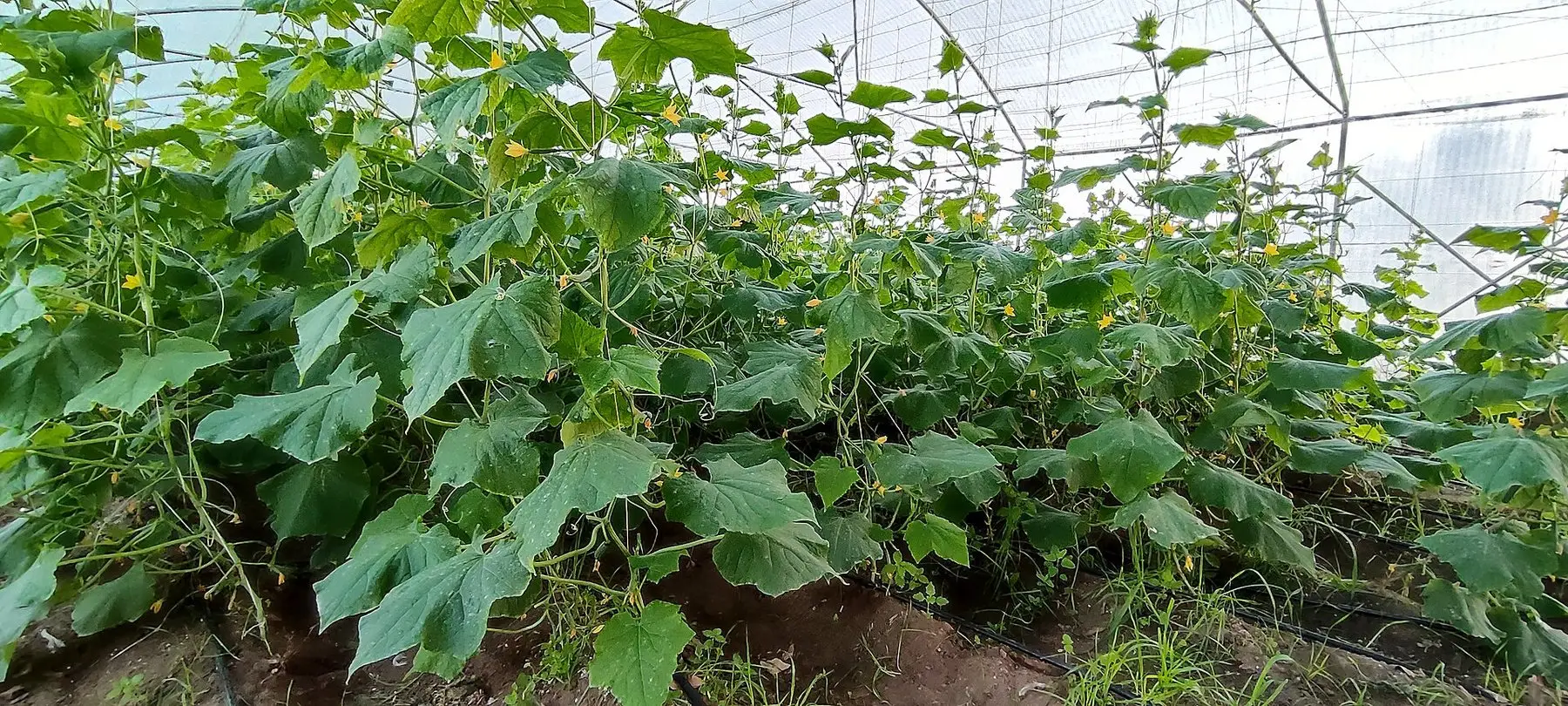
Cucumbers climb by tendril — thin coiling shoots that grip anything narrow. Once a tendril finds the support, the plant does the rest.
Your job is only the beginning:
- Guide the young vine onto the lowest part of the structure by hand.
- Check every few days for the first two or three weeks and redirect anything heading sideways.
- Tie loosely with soft twine where a stem needs holding — loose loops, never tight, because stems thicken.
- After that, let it climb.
Mesh with 4 inch or larger openings is much easier to pick through than fine netting, where fruit grows through a gap and then cannot be pulled back out.
The rest of the growing
Vertical growing changes the structure, not the requirements. Cucumbers still want full sun, warm soil, steady moisture and regular feeding — and they dry out faster off the ground, so mulch the base and water consistently.
Inconsistent water is what makes cucumbers bitter, and it is the same mechanism that splits tomatoes. For pots specifically, see growing cucumbers in containers.
Common questions
Do cucumbers need a trellis?
How tall should a cucumber trellis be?
What is the best type of cucumber trellis?
How do you train cucumbers up a trellis?
When should you put a cucumber trellis in?
Can you grow cucumbers vertically in a container?
Backyard Weekly
Know what to plant, week by week
Free planting calendar. Join the weekly email for seasonal jobs, fixes for what is going wrong, and gear worth buying.
Set MONETIZATION.email.endpoint in src/config/site.ts to enable this form.
By subscribing you agree to our privacy policy. Grow In Backyard will never sell your address.
Keep reading

Growing Cucumbers in Pots: Size, Support, and Water
Cucumbers grow well in containers if the pot is big enough and they climb. Pot size, variety choice, and the watering rhythm that prevents bitter fruit.
How to Grow Tomatoes: Determinate or Indeterminate First
That one word on the seed packet decides your spacing, your pruning, and your harvest shape. Then it is warmth, consistent water, and feeding at the right time.

Powdery Mildew: Why It Spreads and What Actually Stops It
Powdery mildew is the one fungus that does not need wet leaves — it thrives in humid air and dry foliage. How to spot it early and what treatments hold up.
How to Build a Retaining Wall That Does Not Lean
Base depth, gravel backfill, and drainage decide whether a wall lasts thirty years or bulges in three. The full build, and when to call an engineer.