
Grass Clippings as Mulch — 3 Rules for a Thin Layer
Grass clippings as mulch mat and sour unless dried and spread thin. 3 items make that easy. See how to use what the mower already produces.
 By
We may earn a commission when you buy through links on this page, at no extra cost to you.

On this page
Grass clippings are the most abundant free mulch most gardens produce, and they are genuinely good — about 4% nitrogen, breaking down fast enough to feed a bed within weeks.
They are also the mulch people most often ruin, in one specific way: piling them on thick and green. Do that and you get a slimy, ammonia-smelling mat that water runs off.
Why thin and dry
A fresh clipping is mostly water. Piled up, the pile collapses as that water leaves, the blades knit together, and air stops moving through. What follows is anaerobic decomposition — the ammonia smell, the slime, and a surface that sheds rain instead of admitting it.
Dried clippings have already shrunk. They stay loose, let water through, and break down aerobically.
Half an inch to an inch per application. It looks thin next to bark or wood chips, and it should: grass breaks down in weeks, not seasons. Top it up every couple of weeks through the mowing season and you end up with a continuous, constantly-feeding mulch.
Where it works, and where it does not
| Use | Verdict |
|---|---|
| Around tomatoes, squash, brassicas | Excellent — hungry crops, and the nitrogen is welcome |
| Potato beds | Excellent — also helps keep tubers dark |
| Between rows, on paths | Good — suppresses weeds, easy to top up |
| Around seedlings | Careful — keep it off stems; heat and ammonia can scorch |
| Around woody shrubs and trees | Poor — they want a slower, higher-carbon mulch |
| On the lawn itself | Best of all — just leave them where they fall |
The one that genuinely matters: herbicides
Some lawn herbicides survive composting
Clopyralid, aminopyralid and picloram persist through the compost heap, through an animal’s digestive system, and through a season in soil. At concentrations of a few parts per billion they deform and kill tomatoes, beans, potatoes, peppers and lettuce — the classic symptom is cupped, fern-like, twisted new growth.
If the lawn has been treated with any broadleaf weedkiller, do not use the clippings on a vegetable bed. Wait at least three or four mowings after an ordinary product, and considerably longer for the persistent ones. If you do not know what was applied, do not use them.
Also skip clippings from a lawn that has gone to seed — you will be weeding grass seedlings out of the bed for months — and from one with an active fungal problem.
Leave them on the lawn instead
For most people this is the better answer. Clippings left where they fall return roughly a quarter of a lawn’s annual nitrogen, and they break down within a week or two.
They do not cause thatch. Thatch is built from roots, stems and crowns — the tough, lignin-rich parts — not from leaf blades, which are mostly water and decompose almost immediately. That myth sells a lot of bags.
Bag them only when you want the material elsewhere, or when the lawn got away from you and the clumps would smother the turf underneath.
In the compost heap
Here the rule inverts: fresh, green clippings are exactly what a heap wants. They are the nitrogen-rich “green” that drives the pile hot.
Mix them with two to three parts browns by volume — dry leaves, shredded cardboard, straw — and turn the heap. Grass alone compacts into the same anaerobic mat it makes as a thick mulch, which is the commonest reason a compost heap smells.
A quick test for whether it is dry enough
Grab a handful and squeeze. If it feels cool and damp and holds its shape, it needs another day in the sun. If it springs apart and rustles, it is ready to spread.
Our picks
| # | Pick | Best for | Where to buy |
|---|---|---|---|
| 1 | Mulching mower blade | Best use of clippings | Check price for Mulching mower blade → |
| 2 | Landscape tarp | For drying clippings first | Check price for Landscape tarp → |
| 3 | Spring-tine lawn rake | For spreading and lifting | Check price for Spring-tine lawn rake → |
Best use of clippings
Mulching mower blade
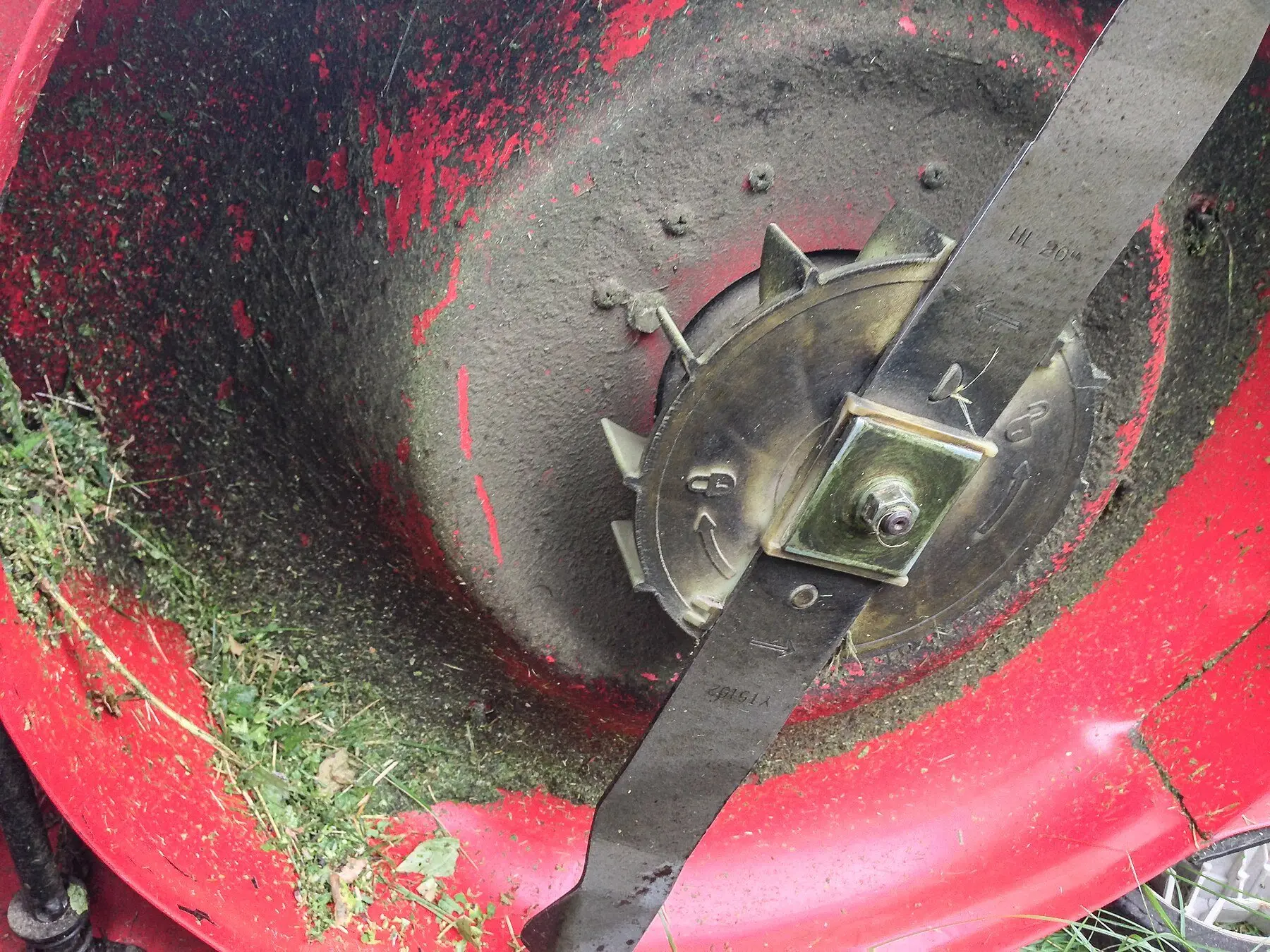
The page's own conclusion in hardware form: the best place for most clippings is straight back on the lawn.
- Does
- Cuts clippings fine enough to fall into the sward
- Why
- Leaving them on the lawn returns the nitrogen
- Fit
- Model specific — check the part number
- Also
- Sharpen or replace annually
What we liked
- Returns nutrients to the lawn rather than carting them away
- Fine clippings disappear rather than sitting in rows
- No collection, no emptying, no disposal
- Does not cause thatch, which is a persistent myth
Worth knowing
- Struggles in long or wet grass
- Needs a sharp blade to cut finely enough
For drying clippings first
Landscape tarp
The step that decides whether grass mulch works or sours. One to two days in the sun until straw-coloured, then half an inch at a time.
- Use
- Spread clippings 1–2 days until straw-coloured
- Why
- Green clippings mat, heat and go slimy
- Size
- 8x10 ft or larger
- Also
- Carting leaves and prunings
What we liked
- Drying is what stops clippings matting into an airless layer
- Makes moving a bulky load easy
- Cheap and lasts seasons
Worth knowing
- Needs somewhere to spread out
- Blows away without weights
For spreading and lifting
Spring-tine lawn rake
Useful because the failure mode is depth. Half an inch spread thin works; three inches of green grass turns into a sour mat.
- Use
- Spreading clippings thinly, lifting wet clumps
- Depth
- 1/2 to 1 in of dried clippings at a time
- Also
- Scarifying light thatch
- Material
- Spring steel tines
What we liked
- Spreads a thin even layer, which is the whole technique
- Lifts wet clumps before they mat and smell
- Doubles as a light scarifier in spring
Worth knowing
- Hard work over a large area
Common questions
Can you use grass clippings as mulch?
Should you dry grass clippings before using them?
Do grass clippings steal nitrogen from the soil?
When should you not use grass clippings?
Is it better to bag clippings or leave them on the lawn?
How thick should a grass clipping mulch be?
Backyard Weekly
Know what to plant, week by week
Join the weekly email for seasonal jobs, fixes for what is going wrong, and gear worth buying.
Not ready to subscribe? The planting calendar is free and needs no email.
By subscribing you agree to our privacy policy. Grow In Backyard will never sell your address.
Keep reading
Wood Chips in the Garden: The Nitrogen Myth, Explained
Wood chips only rob nitrogen where they meet soil, so they are excellent as a surface mulch and a bad idea dug in. Where to use them, and which chips to avoid.
How to Make a Compost Bin — 4 Parts, 3 Designs
How to make a compost bin: pick the design, then size it for the heat. 4 parts cover all 3 builds. See which suits the space you have.
Mushroom Compost — 3 Uses and Where It Does Harm
Mushroom compost is alkaline and salty, which rules out some beds. 3 uses compared, plus what to use on acid-lovers. See where it fits your soil.

How Big Is a 5,000 Square Foot Lawn? With Real Comparisons
About an eighth of an acre, or a 70 by 71 foot square. Here is what that means for seed, fertiliser, water and how long it takes to mow.