
Mother of Thousands: Care, and Containing the Plantlets
A succulent that drops hundreds of rooting babies from its leaf edges. How to grow it, why it is toxic and invasive, and how to stop it spreading.
 By

On this page
A succulent that clones itself along every leaf edge and drops the results into whatever pot is nearest. Easy to grow, hard to get rid of, and toxic enough to matter around pets.
The two plants people mean
| Mother of thousands | Mother of millions | |
|---|---|---|
| Species | K. daigremontiana | K. delagoensis |
| Leaves | Broad, triangular, scalloped | Narrow, tubular, pencil-like |
| Plantlets | Ringing the whole leaf edge | Only at the leaf tips |
| Toxic? | Yes | Yes |
| Invasive? | Yes, in warm climates | Yes, often worse |
Care and cautions are the same for both, and hybrids between them are sold under either name. Both are sometimes listed under Bryophyllum rather than Kalanchoe.
Growing it
| Light | Bright, with a few hours of direct sun. Stretches without it |
| Soil | Gritty cactus mix. Ordinary compost holds too much water |
| Water | Only when dried right through — every 2–3 weeks in summer, rarely in winter |
| Feed | Almost none. A weak cactus feed once or twice in summer |
| Temperature | 60–80°F. Hardy only to about 40°F |
| Pot | Terracotta with drainage. It dries faster, which suits the plant |
This is a plant that thrives on being left alone. Over-watering is the only common way to kill one — the stem goes soft and brown at the base and the whole thing collapses.
A leggy plant is not a lost plant
Stretched, gappy growth means it has been too dark, and that stretch is permanent. But the fix is easy: move it into brighter light, then cut the stem back hard. It reshoots from the cut within weeks, and the piece you removed roots as a cutting in gritty compost.
The plantlets
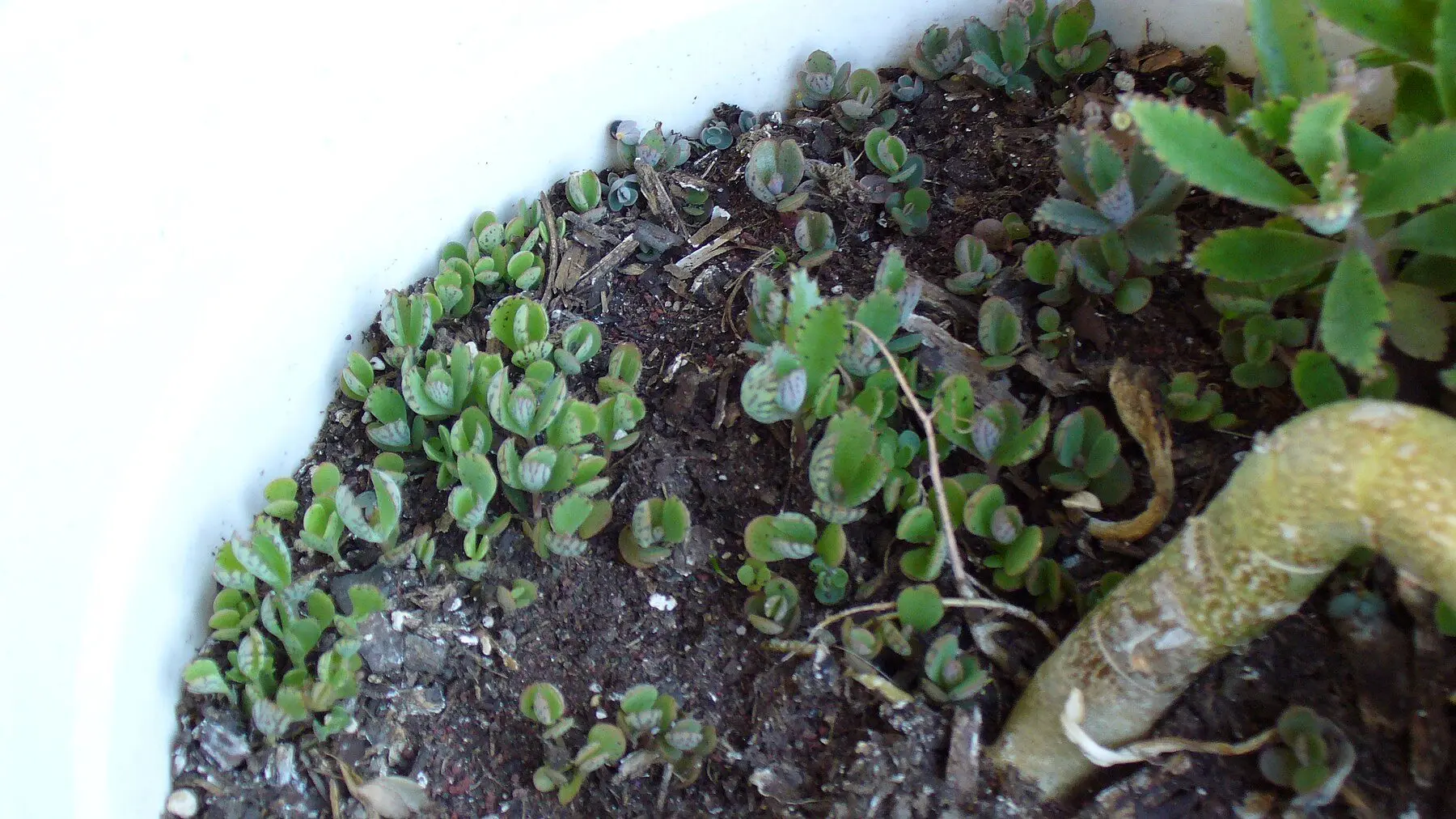
Each scalloped notch along the leaf edge produces a complete miniature plant — leaves, and often aerial roots — while still attached to the parent. They detach at a touch, and any that lands on damp compost roots within days.
This is genuinely impressive and genuinely a nuisance. A single mature plant sheds hundreds over a season.
Containing them:
- Stand the pot on a saucer or tray, never directly on soil, gravel or a propagation bench
- Keep it away from other pots — neighbouring compost is the usual escape route
- Sweep or vacuum around it periodically
- Pinch off leaves heavily loaded with plantlets before they drop
- Bin the trimmings. Do not compost them in a frost-free climate
Never plant it in the ground in a warm climate
Kalanchoe daigremontiana and K. delagoensis are declared weeds in parts of Australia and serious invasives in Florida, Hawaii and other frost-free regions, where they form dense colonies and poison grazing livestock.
Where winters freeze, it cannot survive outdoors and is a harmless houseplant. Where they do not, it belongs in a pot on a hard surface — or not at all.
Toxicity
Every part contains bufadienolides — cardiac glycosides that act on the heart — and the plantlets carry the highest concentration.
- Toxic to cats, dogs and horses (ASPCA), and to cattle, where poisoning is well documented
- Symptoms: drooling, vomiting, lethargy, and in serious cases an abnormal heart rhythm
- Call a vet rather than waiting it out if a pet has chewed one
The practical problem is not the plant on the shelf — it is the shed plantlets on the floor, which are the most toxic part and the hardest to keep picked up. If you have a cat that chews plants, this is one to skip.
Propagating, if you want more
You will not need to try. But deliberately:
- Take a detached plantlet, or pinch one off a leaf edge
- Sit it on the surface of damp gritty compost. Do not bury it
- Keep it lightly moist and bright
- Roots in days, a recognisable plant in weeks
Stem and leaf cuttings work as well, and a cut stem on the parent reshoots. Nothing about this plant is difficult to increase.
Flowering
A mature plant — usually several years old — sends up a tall stalk of drooping pinkish-orange bell flowers, most often in winter.
That flowering stem then dies back, which is normal for the species rather than a failure. By then it has produced hundreds of plantlets, so the plant has already replaced itself several times over.
Problems
- Soft brown stem base — over-watering. The commonest killer
- Stretched, gappy growth — too little light
- Wrinkled, curling leaves — genuinely thirsty, which takes a while
- White cottony clumps — mealybugs, the usual pest on Kalanchoe
- Plantlets everywhere — normal. Manage it rather than fight it
Common questions
How do you care for a mother of thousands plant?
What is the difference between mother of thousands and mother of millions?
Is mother of thousands toxic to cats and dogs?
How do I stop mother of thousands from spreading?
Why is my mother of thousands leggy and stretched?
Does mother of thousands flower?
Backyard Weekly
Know what to plant, week by week
Join the weekly email for seasonal jobs, fixes for what is going wrong, and gear worth buying.
Not ready to subscribe? The planting calendar is free and needs no email.
By subscribing you agree to our privacy policy. Grow In Backyard will never sell your address.
Keep reading
Spider Plant Care: Brown Tips, Babies and Why It Stops
Spider plants are nearly unkillable but tell you everything through their tips. Water, light, why yours has no babies, and propagating the ones it has.
How to Grow Aloe Vera: Underwater It and Give It Sun
Aloe is killed by watering, not neglect. How to tell thirst from rot, why the leaves go flat or brown, and what to do with the pups it keeps producing.
Cast Iron Plant: The One for the Dark Corner
Aspidistra tolerates deep shade, neglect and cold that kills other houseplants. What it will not tolerate, how slowly it grows, and outdoor use.
New Guinea Impatiens Care: Sun Tolerant, But Never Dry
Unlike bedding impatiens these take real sun and resist downy mildew. What they will not take is drying out — they collapse within hours.