How to Grow an Apple Tree From Seed (Read This First)
Apple seeds grow, but never into the apple you ate — every seed is a new variety. How to germinate them anyway, and what you will actually get.

On this page
You can grow an apple tree from a seed, and it is a genuinely good project. What you cannot do is grow that apple. The seed inside the Honeycrisp you just ate will not produce a Honeycrisp — it will produce something that has never existed before, and probably will not be very nice.
That is not a failure of technique. It is how apples work, and knowing it up front changes what you plant the seed for.
Why apples never come true from seed
Apples are extreme outbreeders. They are self-incompatible — a flower generally cannot be fertilised by its own pollen — so every apple on a tree was pollinated by a different variety, often whatever was flowering nearby. The seed therefore carries genes from two parents, and apples are unusually heterozygous, meaning those genes vary enormously.
The practical consequence is that each seed is a genuine lottery ticket. Growers have understood this for centuries, which is why every named variety — Granny Smith, Gala, Bramley — exists as clones. Somebody found one exceptional seedling, and every tree of that variety since has been a piece of wood cut from it and grafted onto a rootstock.
The famous seedlings were flukes
Almost every apple you can name began as a chance seedling that someone noticed and propagated. That is the real odds picture: enormous numbers of seedling apples have been grown, and a few dozen were good enough to name. Your seedling is a ticket in that lottery, which is a fine reason to plant it — just not a reliable route to a specific apple.
Cold stratification is the whole trick
Apple seeds are dormant on purpose. A seed that germinated the moment it hit the ground in autumn would produce a tender seedling just in time for winter to kill it. The seed therefore requires a prolonged cold, moist period before it will respond to warmth — a chemical countdown that only runs at low temperature.
Simulating that is straightforward:
| Variable | What it needs | Common mistake |
|---|---|---|
| Temperature | 35–41°F | Freezer — too cold, kills seed |
| Duration | 8–12 weeks | Stopping at 3–4 weeks |
| Moisture | Damp, not wet | Soaking towel → mould |
| Air | Occasional opening | Sealed and forgotten |
| Medium | Paper towel or moist sand | Dry storage — no effect |
Check the bag every couple of weeks. Discard any seed that has gone furry, re-damp the towel if it has dried, and reseal. Toward the end you will often see seeds split and push a white root out inside the bag — pot those immediately rather than waiting for their siblings.
Growing the seedling on
Sow half an inch deep in ordinary potting mix, keep it bright and lightly moist, and expect seedlings in two to four weeks. From there it is an unremarkable young tree: pot up as the roots fill each container, harden it off before it lives outside permanently, and give it sun.
The one thing seedling apples dislike is being pot-bound. A seedling left too long in a small pot stalls and often never fully recovers its vigour, so move it up a size before it needs to.
Do not expect flowers early
Young apple trees go through a juvenile phase during which they will not flower regardless of care, feeding, or pruning. Six to ten years is normal for a seedling. Nothing you do shortens it much — this is the price of starting from seed rather than from grafted, already-mature wood.
The move that makes it worthwhile
Here is the part most seed-growing guides leave out. You do not have to choose between “a free tree from a seed” and “a known apple variety”. You can have both, from the same plant.
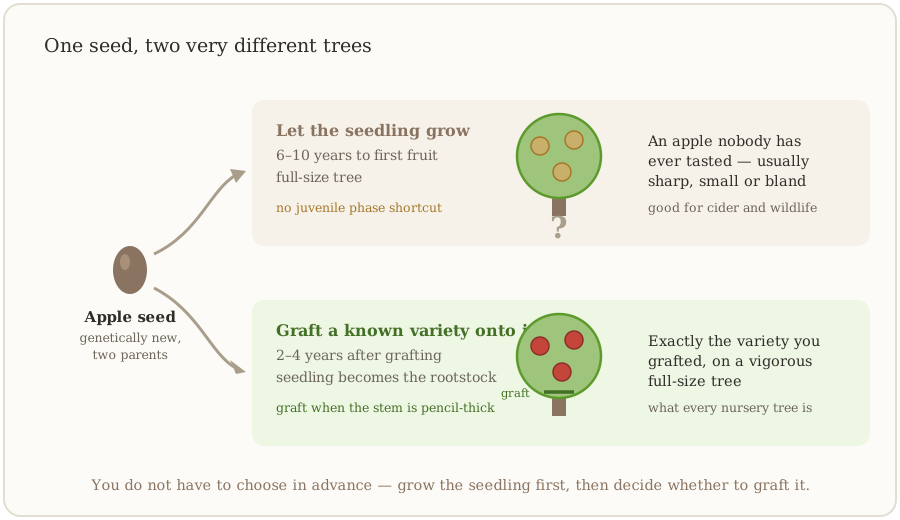
Grow the seedling for a year or two until the stem is roughly pencil-thick. Then graft a scion — a short length of dormant wood — from a variety you actually want onto it. The seedling becomes the rootstock, supplying roots and vigour, and the grafted top produces the named apple, usually within a few years rather than a decade.
That is precisely what commercial nurseries do, and it turns a lottery ticket into a real fruit tree. The one trade-off is vigour: a seedling rootstock produces a full-size tree, where nursery trees use dwarfing rootstocks to keep them pickable from the ground.
What to do with a seedling you let run
If you keep the seedling as it is, you get a large, generally healthy, long-lived tree, and in six to ten years, an apple nobody has ever tasted. Odds are it will be sharp, small, or bland.
That is still worth something. Sharp seedling apples make far better cider than dessert varieties do, cooking apples only need to break down well, and a mature apple tree feeds birds and pollinators regardless of how the fruit tastes to you. And there is the small, real chance that yours is the one worth naming.
Step by step
- Time
- P120D
- Cost
- $0
- You need
- Seeds from several ripe apples, Damp paper towel or moist sand, Zip-top bag or sealed container, Potting mix
- Tools
- Refrigerator, 4-inch pots
Take seeds from several different apples
Collect from three or four apples rather than one. Germination rates are mediocre and many seeds are not viable, so start with far more than the number of trees you want. Rinse the seeds to remove all fruit flesh, which otherwise moulds in storage.
Check which seeds are worth keeping
Drop the seeds in water. Plump, dark brown seeds that sink are worth sowing; pale, shrivelled, or floating ones generally are not. This one-minute test removes most of the duds before you commit fridge space to them.
Cold-stratify for 8–12 weeks
Apple seeds will not germinate without a simulated winter. Wrap them in a damp — not wet — paper towel, seal in a bag, and refrigerate at 35–41°F for 8 to 12 weeks. Check every couple of weeks for mould and discard any affected seeds.
Watch for the first root
Toward the end of stratification some seeds split and push out a small white root inside the bag. Those are ready to pot immediately; do not wait for the rest, because a root left in the bag will tangle or rot.
Pot into a free-draining mix
Sow half an inch deep in a 4-inch pot of ordinary potting mix. Keep it somewhere bright at normal room temperature and lightly moist. Seedlings usually appear within two to four weeks of coming out of the fridge.
Grow on and move outside gradually
Once seedlings have several true leaves, harden them off over a week or two and move them outdoors. Pot up as roots fill each container — apple seedlings resent being crowded and will stall if left pot-bound.
Plant out and wait, or graft
Plant into final position after a season or two in pots. A seedling apple typically takes 6–10 years to fruit and produces an unpredictable variety. If you want a known apple, use the seedling as rootstock and graft a scion of the variety you actually want onto it.
Common questions
Will an apple seed grow the same apple I ate?
How long does an apple tree take to fruit from seed?
Do apple seeds need to be refrigerated before planting?
Is fruit from a seed-grown apple tree edible?
How many apple seeds should I start with?
Backyard Weekly
Know what to plant, week by week
Free planting calendar. Join the weekly email for seasonal jobs, fixes for what is going wrong, and gear worth buying.
Set MONETIZATION.email.endpoint in src/config/site.ts to enable this form.
By subscribing you agree to our privacy policy. Grow In Backyard will never sell your address.
Keep reading
How to Grow Strawberries (And Get Fruit the First Year)
Strawberries are easy to grow and easy to get wrong. Which of the three types to plant, why you pinch the first flowers, and how to keep a bed producing.
How Do Pineapples Grow? On the Ground, One Per Plant
Pineapples do not grow on trees but on a low ground plant, one fruit per plant, from hundreds of flowers fused into one. How they grow, and how long it takes.
How to Grow Hydrangeas: Where to Plant and When to Prune
Morning sun, afternoon shade, and never let them dry out. Which type you have decides when to prune — and getting that wrong is why hydrangeas stop flowering.
15 Tree Stump Ideas (And When to Just Remove It)
Planters, seating, wildlife habitat, and log stools — what to do with a stump you would rather not grind, and when removal is the only sensible answer.