
5 Types of Sprinkler Systems, and Which Suits Your Yard
Spray, rotor, rotary nozzle, drip and impact each water a different shape and rate. How to pick, and why mixing two types on one zone wastes water.
 By

On this page
The five types differ in one number that matters more than any other: precipitation rate, the depth of water they apply per hour. Get that wrong and no amount of scheduling fixes it.
The five, compared
| Type | Radius | Rate | Best for |
|---|---|---|---|
| Fixed spray | 4–15 ft | ~1.5 in/hr | Small lawns, strips, awkward shapes |
| Gear-driven rotor | 15–50 ft | ~0.4 in/hr | Large open lawns |
| Rotary nozzle | 13–24 ft | ~0.6 in/hr | Medium lawns, clay, slopes |
| Drip / micro | At the plant | Very low, targeted | Beds, rows, hedges, containers |
| Impact | 20–80 ft | ~0.3 in/hr | Large, windy or agricultural sites |
Fixed spray heads
A pop-up that throws a fixed fan in a set pattern — quarter, half, full circle, or a strip. No moving parts beyond the pop-up itself.
Good: cheap, simple, precise in small spaces, easy to replace. Less good: the highest application rate of any type, so on clay or a slope the water runs off before it soaks in. Also the most prone to misting in wind, which loses water to evaporation.
Gear-driven rotors
A single stream driven slowly across an arc by an internal gear train. The workhorse for large turf.
Good: wide radius means few heads and less pipe; the low rate soaks in rather than running off; large droplets resist wind. Less good: needs adequate pressure and flow, poor in narrow spaces, and run times are long — which surprises people converting from spray.
Rotary nozzles
A multi-stream rotating nozzle that fits a standard spray body. Effectively an upgrade path: you can swap them into existing spray bodies without changing the pipework.
Good: low rate like a rotor at a radius closer to a spray, excellent on clay and slopes, very wind-resistant. Less good: long run times, and they need clean water — they clog more readily than a spray nozzle.
Drip and micro-irrigation
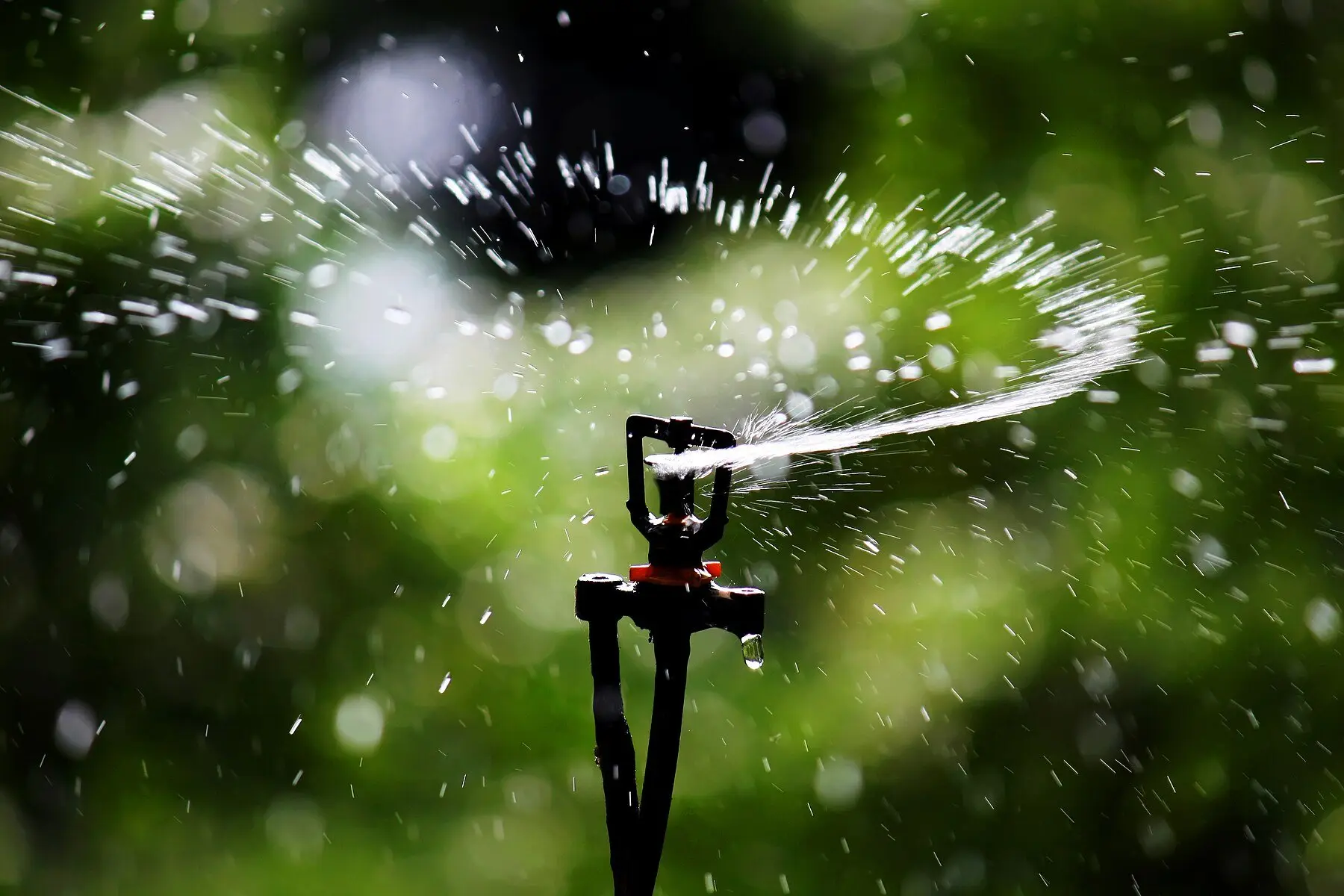
Emitters, inline dripline, micro-sprays and bubblers delivering water at the root zone.
Good: by far the most efficient, typically 30–50% less water for the same result; keeps foliage dry, which reduces fungal disease; ideal for rows, hedges and containers. Less good: not for lawns; emitters clog without a filter; the tubing needs checking each season, and rodents chew it.
Impact sprinklers
The classic ticking metal sprinkler, on a riser or a sled.
Good: long throw, very wind-tolerant, tolerant of dirty water, cheap. Less good: noisy, visually intrusive, and mostly superseded by rotors for residential use — though still the right answer for a large paddock or an orchard.
The rule that matters most
Never mix types on one zone
Every head on a zone runs for the same length of time, because they share a valve. Put a spray head applying 1.5 inches per hour on the same zone as a rotor applying 0.4 and there is no run time that works: 20 minutes gives the spray area half an inch and the rotor area barely a tenth. You end up with soggy patches and dry patches on the same lawn and no way to schedule out of it.
Group zones by: head type first, then sun and shade, then slope, then plant type. A shaded north bed and a south-facing lawn should not share a valve even if both use rotors.
Matching the system to the site
| Your situation | Use |
|---|---|
| Large open lawn, good pressure | Gear-driven rotors |
| Small lawn, strips, awkward corners | Fixed spray heads |
| Medium lawn on clay or a slope | Rotary nozzles, or rotors in short cycles |
| Vegetable rows, beds, hedges | Inline dripline |
| Containers and hanging baskets | Micro-drip with individual emitters |
| Windy, exposed site | Rotors or impacts — large droplets |
| Low pressure or low flow | Drip, or more zones with fewer heads each |
| Large paddock or orchard | Impact sprinklers |
Setting run times honestly
Do not guess, and do not trust the controller’s defaults.
The catch-can test, which takes fifteen minutes and settles it:
- Put five or six straight-sided containers (tuna cans work) around the zone.
- Run the zone for 15 minutes.
- Measure the depth in each and take the average.
- Multiply by four to get the hourly rate, then work out the run time for the depth you want.
The spread between cans also tells you about coverage uniformity — if one can has three times another, the problem is head spacing or pressure, not scheduling.
Cycle and soak on clay and slopes
If you see water running onto the path before the zone finishes, the soil cannot absorb water as fast as the heads apply it. Split the run into two or three shorter cycles with an hour between rather than watering less overall.
A few practical notes
- Head-to-head coverage is the standard: each head’s spray should reach the next head. Anything less leaves dry rings, and no run time fixes a spacing problem.
- Pressure regulation matters more than people expect — over-pressured spray heads mist, and misted water evaporates before it lands.
- Check valves in heads at the bottom of a slope stop low-head drainage, the puddle that appears under the lowest head every cycle.
- A rain sensor or a weather-based controller is usually the cheapest single water saving available, and required by code in a number of places.
- Backflow prevention is not optional and is regulated nearly everywhere. It is also the part that splits in a hard freeze, so it gets drained or removed for winter.
Common questions
What are the main types of sprinkler systems?
What is the difference between a spray head and a rotor?
Can I mix sprinkler types on the same zone?
Which sprinkler system is best for a lawn?
Is drip irrigation better than sprinklers?
How long should each sprinkler type run?
Backyard Weekly
Know what to plant, week by week
Join the weekly email for seasonal jobs, fixes for what is going wrong, and gear worth buying.
Not ready to subscribe? The planting calendar is free and needs no email.
By subscribing you agree to our privacy policy. Grow In Backyard will never sell your address.
Keep reading
How Does a Sprinkler System Work? Zones, Valves and Pressure
A controller opens one valve at a time because your water supply cannot feed every head at once. The parts, why zoning exists, and what backflow prevention is for.
How Deep Are Sprinkler Lines? Depths by Climate and Pipe
Most residential sprinkler lateral lines sit 8–12 inches down, mains deeper. What sets the depth, and how to find yours before you dig.
How to Use a Soaker Hose — 4 Parts, Even Watering
How to use a soaker hose comes down to pressure and layout. 4 parts make the run water evenly from end to end. See which your line is missing.
Water Hose Storage Ideas That Stop the Kinking and Rot
A hose dies from UV, kinks and freezing, not from use. Storage that prevents all three, from a $15 hook to a reel, and what to do before winter.