
How Deep Are Sprinkler Lines? Depths by Climate and Pipe
Most residential sprinkler lateral lines sit 8–12 inches down, mains deeper. What sets the depth, and how to find yours before you dig.
 By
On this page
For most residential systems: lateral lines 8–12 inches down, mainlines 12–18 inches. But the figure that matters is your local code and your own installer’s choice, and the only way to be sure before a shovel goes in is to locate them.
Typical depths
| Component | Typical depth | Notes |
|---|---|---|
| Lateral lines (to the heads) | 8–12 in | The bulk of the pipe in a system |
| Mainline (pressurised) | 12–18 in | Deeper because it holds pressure constantly |
| Drip tubing | 4–6 in, or on the surface under mulch | Meant to stay accessible |
| Under driveways and parking | 18–24 in, usually in a sleeve | Traffic loading |
| Valve boxes | Flush with the surface | Lid at grade for access |
| Sprinkler head body | 4–6 in (spray), up to 10 in (rotor) | Cap flush with the soil |
| Wiring to valves | With the pipe, in the same trench | Often in conduit |
What sets the depth
1. Local code. Municipalities specify minimum burial depths, backflow prevention requirements, and sometimes sleeve requirements under hard surfaces. This is the governing answer and it varies.
2. How it is winterised. In freezing climates there are two strategies:
- Blow-out winterisation — compressed air clears the water out each autumn. Standard across most of the cold US, and it means the pipe does not need to be below the frost line.
- Drain-based systems — rely on the pipe being laid to fall to drain valves, and are more depth- and slope-sensitive.
Burying below a frost line that runs three or four feet deep in northern states would be extraordinarily expensive, which is why virtually nobody does it.
3. What runs over the top. Lawn is one thing; a driveway is another. Anything under vehicle traffic goes deeper and usually inside a sleeve so it can be replaced without excavation.
4. Pipe material. Flexible polyethylene is standard in cold regions because it tolerates a little residual freezing without splitting. PVC is common in warm regions and is more brittle.
The backflow preventer is the freeze-vulnerable part
Buried pipe that has been blown out is fine. The assembly that sits above ground — the backflow preventer — is the component that actually splits in a hard freeze, which is why it gets drained, insulated, or removed for winter.
Where the pipe is, relative to the head
A common excavation mistake: digging straight down beside a head expecting to find the lateral immediately.
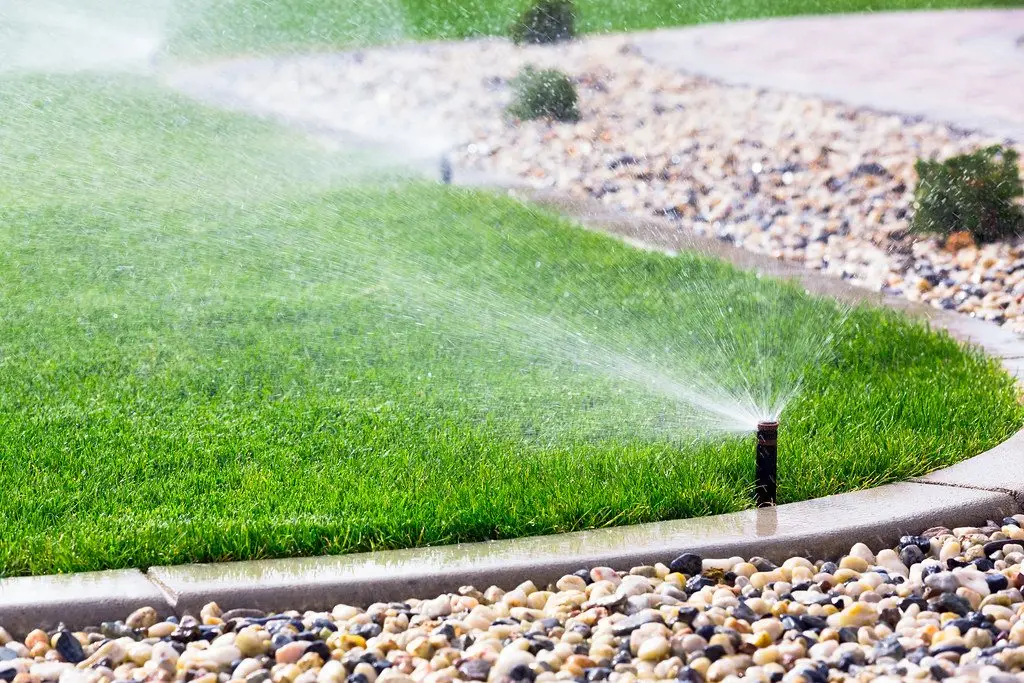
A pop-up head’s cap is flush with the soil, its body extends 4–10 inches down, and it connects to the lateral through a flexible swing joint — a short length of articulated pipe. That joint is deliberate, so a mower or a footfall does not snap the fitting off the main run.
So the pipe usually sits a few inches below and slightly to one side of the head base, and it runs roughly head to head in straight lines between them.
Finding them before you dig
- Call 811 first (US). It is free, and it is what you are expected to do before digging. Note that 811 marks utility lines — gas, electric, water, telecoms — and not private irrigation.
- Find the valve boxes. Rectangular lids at grade, usually near the supply or at zone boundaries. Everything radiates from there.
- Run each zone from the controller and mark every head with a flag as it pops up.
- Join the dots. Laterals run between heads in straight lines, and zones are usually laid out as loops or spurs from the valve.
- Probe carefully with a thin rod between heads if you need certainty — slowly, so you feel the pipe rather than punch it.
- Tracer wire, if the installer used it, lets a wire locator follow the run exactly.
Aeration is how most lines get cut
Core aeration tines reach 3–4 inches, which is usually safe — but fence posts, tree planting holes, edging, and a garden fork all comfortably reach 8 to 12 inches. Mark the heads before any of that work, and tell anyone working in the yard where the runs are.
If you are installing
- 10–12 inches for polyethylene laterals across most of North America; 12–18 for the mainline.
- Check local code and your utility’s requirements first — they override the figures above.
- Deeper under anything driven on, in a sleeve.
- Keep the depth consistent. A run that wanders between 6 and 14 inches is the one that gets hit.
- Lay tracer wire with the pipe. It costs almost nothing now and saves a day of probing later.
- Photograph the open trenches before backfilling, with a tape measure in shot and fixed landmarks visible. This is the single most useful thing you can do for whoever digs here next, including you.
Common questions
How deep are sprinkler lines buried?
Do sprinkler lines have to be below the frost line?
How deep should I bury irrigation pipe when installing?
How do I find sprinkler lines before digging?
How deep are sprinkler heads themselves?
What happens if sprinkler lines are too shallow?
Backyard Weekly
Know what to plant, week by week
Join the weekly email for seasonal jobs, fixes for what is going wrong, and gear worth buying.
Not ready to subscribe? The planting calendar is free and needs no email.
By subscribing you agree to our privacy policy. Grow In Backyard will never sell your address.
Keep reading
How Does a Sprinkler System Work? Zones, Valves and Pressure
A controller opens one valve at a time because your water supply cannot feed every head at once. The parts, why zoning exists, and what backflow prevention is for.
How to Use a Soaker Hose — 4 Parts, Even Watering
How to use a soaker hose comes down to pressure and layout. 4 parts make the run water evenly from end to end. See which your line is missing.
Best Garden Hose — 4 Picks and the Spec That Decides
The best garden hose is decided by burst pressure and fittings. 4 picks compared on weight, kinking and repair. See which suits your tap.
5 Types of Sprinkler Systems, and Which Suits Your Yard
Spray, rotor, rotary nozzle, drip and impact each water a different shape and rate. How to pick, and why mixing two types on one zone wastes water.