
Best Electric Brush Cutter: Voltage, Blade and Harness
Cordless brush cutters now clear real brush if you buy enough voltage and a straight shaft. What matters, and what the specs do not tell you.
 By
We may earn a commission when you buy through links on this page, at no extra cost to you.
On this page
Cordless brush cutters are now genuinely capable, with two conditions: enough voltage, and a straight shaft the maker approves for a blade.
What the specs do not tell you
| spec | what actually matters |
|---|---|
| Peak power claim | Sustained output under load, which is a voltage question |
| “Brush cutter” in the name | Whether the manual approves a metal blade |
| Run time | Measured trimming grass, not cutting brambles |
| Included blade | Whether the diameter matches the machine’s rating |
| Weight | Weight with battery and harness fitted |
Blade selection
| blade | for |
|---|---|
| 3- or 4-tooth | Dense grass, bracken, soft weeds |
| 8-tooth | Tough weeds, light scrub |
| Chisel / saw-style | Woody stems to ~2 in |
Keep them sharp and balanced, replace anything bent or cracked, and never exceed the specified diameter.
Kickback is what injures people
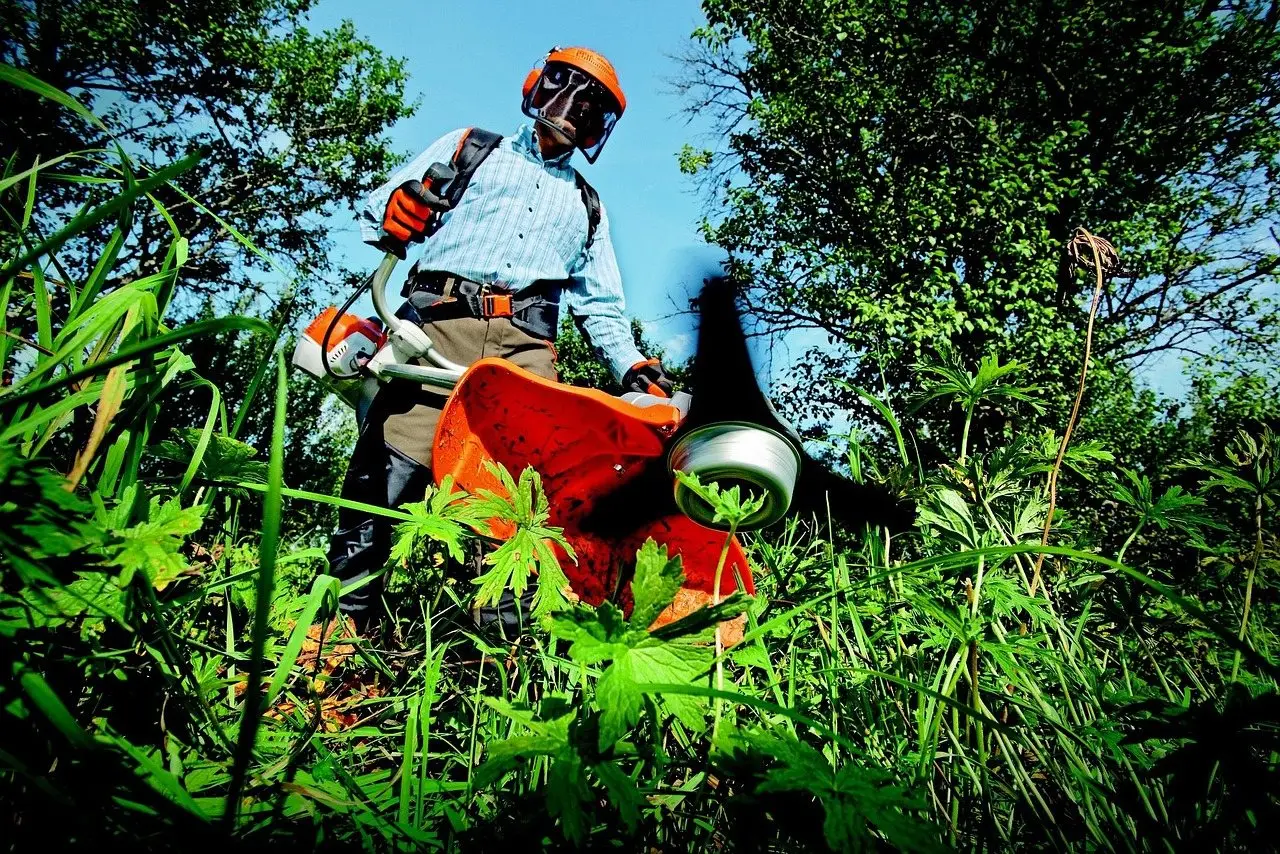
A blade catching a stem or stone on the wrong part of its arc throws the machine sideways, fast. That is the reason for the handlebar and the harness, and using one without both is the common factor in serious accidents with these machines.
Electric against petrol
| cordless | petrol | |
|---|---|---|
| Starting | Instant | Pull start, mixing fuel |
| Noise | Much quieter | Loud; restricted hours |
| Sustained work | 15–30 min per battery on blade | All day with fuel |
| Heaviest growth | Capable at 80 V | Still ahead |
| Maintenance | Almost none | Filters, plugs, carb |
| Best for | Domestic clearing a few times a year | Professional and all-day use |
For a one-off clearance, hire a petrol machine — a day’s hire costs a fraction of a capable cordless kit that would then sit for years.
How we picked
Four cordless configurations assessed on sustained cutting power, run time per battery, whether the manufacturer approves metal blades, and the harness and handle arrangement · Picks last checked October 2026.
- Manufacturer approval for a metal blade
- This is the dividing line between a trimmer and a brush cutter. A machine not rated for a blade has the wrong shaft, clutch and guard, and fitting one anyway is both unsafe and a warranty void.
- Straight shaft and bike handlebar
- A curved shaft puts the cutting head near your feet and has no harness mount. Blade work requires a straight shaft, a wide handlebar and a harness, without exception.
- Voltage and sustained output
- Peak figures mean little. 56 V to 80 V platforms hold power through a cut where 18 V to 40 V machines bog down in anything woody.
- Battery capacity against run time
- Blade work in brush drains a battery two to three times faster than trimming grass. Plan on two batteries, not one, for any session over half an hour.
Our picks
| # | Pick | Best for | Where to buy |
|---|---|---|---|
| 1 | 80 V straight-shaft brush cutter with blade | Best overall | Check price for 80 V straight-shaft brush cutter with blade → |
| 2 | 56 V convertible split-shaft machine | Best all-rounder | Check price for 56 V convertible split-shaft machine → |
| 3 | 40 V straight-shaft trimmer, heavy line | Best for long grass | Check price for 40 V straight-shaft trimmer, heavy line → |
| 4 | Spare high-capacity battery | Worth buying with the tool | Check price for Spare high-capacity battery → |
Best overall
80 V straight-shaft brush cutter with blade
- Platform
- 80 V
- Shaft
- Straight, blade-approved
- Handle
- Bike handlebar with harness
What we liked
- Holds power through woody stems where lower-voltage machines stall
- Straight shaft, handlebar and harness are the correct arrangement for blade work
- Quiet enough to use early morning without annoying neighbours
Worth knowing
- Expensive, especially the batteries
- Heavy, and the harness is essential rather than optional
Best all-rounder
56 V convertible split-shaft machine
- Platform
- 56 V
- Heads
- Trimmer and blade
- Shaft
- Straight, split boom
What we liked
- One machine covers lawn edging and brush clearing, which suits most properties
- Split boom stores in a smaller space and takes other attachments
- Enough torque for light scrub and dense weeds
Worth knowing
- Less capable than a dedicated 80 V machine on saplings
- Check blade approval on the specific model, not the range
Best for long grass
40 V straight-shaft trimmer, heavy line
- Platform
- 40 V
- Head
- Line only
- Shaft
- Straight
What we liked
- Light enough for an hour of edging and long grass without a harness
- Much cheaper than a blade-rated machine
- Heavy-gauge line handles nettles, bracken and soft weeds well
Worth knowing
- Not for woody growth, and usually not blade-approved
- Bogs down in dense wet grass
Worth buying with the tool
Spare high-capacity battery
- Use
- Second battery for continuous work
- Charge
- Fast charger recommended
What we liked
- Blade work drains a battery two to three times faster than trimming
- One charging while one works is the only way to clear a large area in a session
- Batteries outlive the tool and carry over to the next one on the platform
Worth knowing
- Often a third of the cost of the whole kit
- Adds weight to carry around the property
Which should you buy?
| If you… | Buy | Because |
|---|---|---|
| Clearing brambles and saplings on a domestic property | 56–80 V straight-shaft machine, blade-approved, with harness | Enough sustained torque for woody stems, and the harness and handlebar make an hour's work possible rather than exhausting. |
| Long grass, nettles and rough edges only | 40–56 V straight-shaft trimmer with heavy line | Line handles green growth perfectly well and the lighter machine is far more pleasant for an hour of edging. |
| A one-off clearance of an overgrown plot | Hire a petrol brush cutter | A day's hire costs a fraction of a capable cordless machine that would then sit unused for years. |
| You already own a battery platform | The blade-approved bare tool on that platform | Batteries are most of the cost. Check it is genuinely blade-rated rather than a trimmer with an adapter available. |
When not to buy at all
Skip a brush cutter entirely if the job is grass and soft weeds — a string trimmer is lighter, cheaper, quieter and safer, and a blade adds nothing on green growth.
Common questions
Can a cordless brush cutter really clear brush?
How do I know if a machine is actually rated for a metal blade?
What blade should I fit?
How long does a battery last on blade work?
Electric or petrol?
What safety kit is needed?
Backyard Weekly
Know what to plant, week by week
Join the weekly email for seasonal jobs, fixes for what is going wrong, and gear worth buying.
Not ready to subscribe? The planting calendar is free and needs no email.
By subscribing you agree to our privacy policy. Grow In Backyard will never sell your address.
Keep reading

Brush Cutter vs String Trimmer: Which One You Need
A string trimmer cuts grass and soft weeds. A brush cutter takes a metal blade through saplings and brambles. Where the line actually falls.
How to Cut Tall Grass Without a Mower, in Stages
Knee-high grass takes two or three passes with a trimmer, scythe or brush cutter, clearing the cuttings between each. The order that works.
How to Cut Grass Without a Mower: Five Working Methods
A string trimmer, scythe, shears, sickle or grazing animals will all cut grass. Which suits which job, and how to get an even finish by hand.
Best Leaf Blower — 4 Picks, and What CFM Really Means
The best leaf blower is chosen on CFM, not MPH. 4 picks compared by plot size, with hearing protection noted. See which fits your garden.