
Why Do Squirrels Look at You? It Is Threat Assessment
A squirrel staring at you is deciding whether you are a predator. What the freeze, the head tilt and the half-turn mean, and what breaks the stare.
 By
On this page
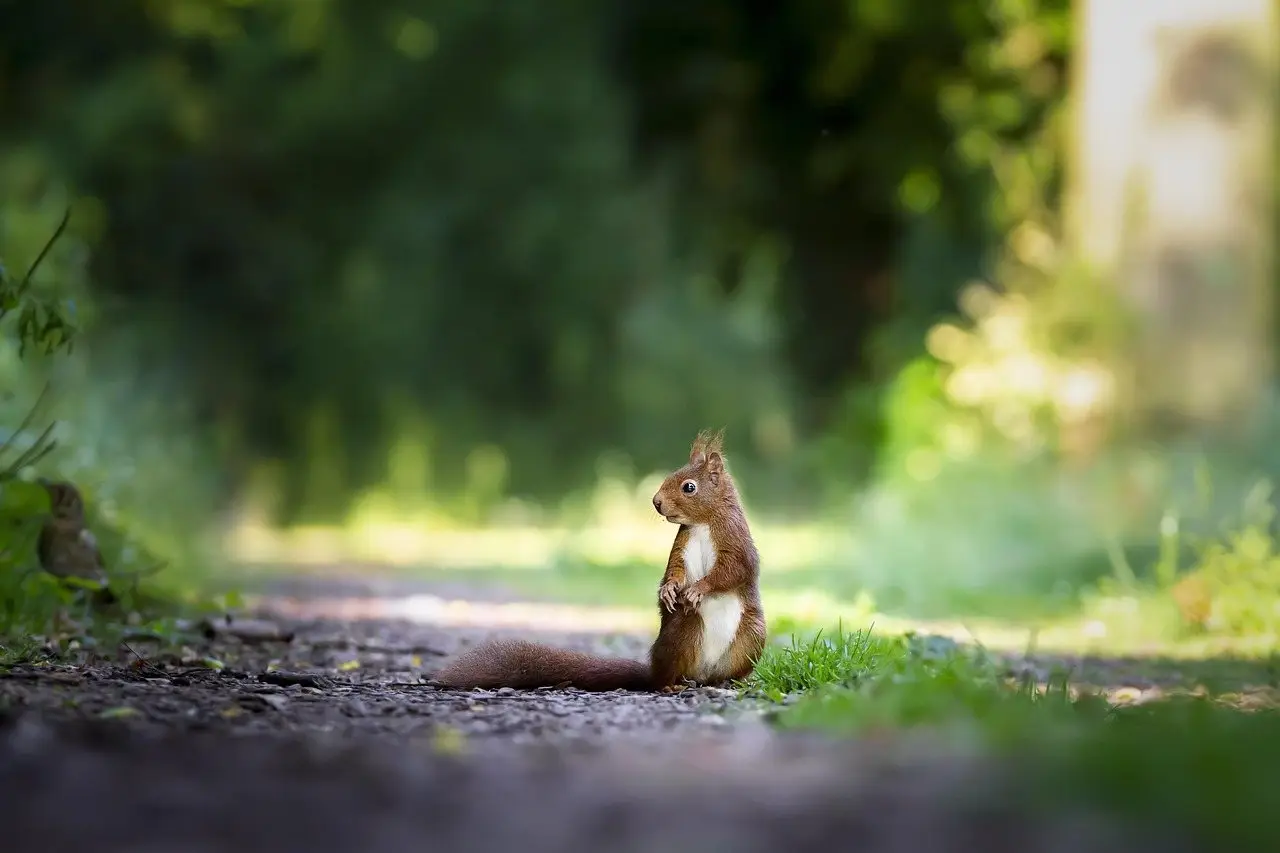
A squirrel looking at you is running a threat assessment. It is not curiosity in the way we mean it, and it is not affection. It is the pause between noticing a large animal and deciding what to do about it.
Why turning to face you means something
A squirrel’s eyes are set high and far apart, giving a field of view approaching 360 degrees. It can watch you without moving its head at all, and most of the time that is exactly what it does.
So the moment it turns square on and holds still, something has changed. It has moved from background monitoring to foreground assessment, and the usual trigger is one of:
- You stopped moving — a person walking past on a path is scenery; a person who halts is a decision to make
- You turned toward it
- You looked directly at it. Squirrels respond to gaze direction specifically
- You came within its flight distance, which in a garden is a few metres and in a busy park can be under one
The sequence, and what each part is for
| behaviour | what it is doing |
|---|---|
| Peripheral watching while feeding | low-cost monitoring |
| Freeze, face on, still | assessment; also near-invisibility to aerial predators |
| Head tilts and small side-steps | building depth perception by motion parallax |
| Tail flicking, foot stamping | alarm signalling — to you and to other squirrels |
| Half-turn toward a trunk | preparing the escape route |
| Spiral up the far side of the tree | the actual escape |
If it gets to tail flicking, you have been classified as a threat rather than a question. The flick is a signal, not a nervous tic: it tells a predator it has been seen, which makes ambush pointless, and it tells other squirrels something is up.
How to make it stop
Look slightly away and stay still. Sitting down helps more than anything else, because it changes your outline from a tall approaching shape to a low stationary one. Most squirrels resume feeding within a minute.
The head tilt
The eye placement that gives a squirrel its wide field of view costs it binocular overlap, so depth is harder to judge from a fixed head. The fix is movement: shifting the head from side to side makes near objects slide against far ones, and the brain reads distance from the difference.
You will see the same motion before a jump between branches, and before a drop to the ground. When it is aimed at you, it is measuring how far away you are.
Fed squirrels are a different animal
A park squirrel that approaches, sits up and stares has learned that people produce food. It is not assessing a threat; it is waiting. The posture looks similar and means close to the opposite.
The giveaway is what happens next: a wary squirrel keeps a trunk between you and it, a habituated one closes the distance.
Worth knowing either way: a squirrel that has lost its fear of people is a bite risk, approaches strangers, and spends its autumn near a back step rather than caching. Watching one is free and changes nothing about it.
Common questions
Why does a squirrel stare at me?
Is a staring squirrel being friendly?
What does it mean when a squirrel freezes and stares?
Why does a squirrel tilt its head at me?
Should I stare back at a squirrel?
Do squirrels recognise individual people?
Backyard Weekly
Know what to plant, week by week
Join the weekly email for seasonal jobs, fixes for what is going wrong, and gear worth buying.
Not ready to subscribe? The planting calendar is free and needs no email.
By subscribing you agree to our privacy policy. Grow In Backyard will never sell your address.
Keep reading
Why Are Squirrels Afraid of Humans? And Why City Ones Aren't
Squirrels read us as a predator by size and gaze. Why urban squirrels lose the fear in a few generations, and what the flight distance actually tracks.
Why Are Squirrels So Twitchy? Everything Is Trying to Eat Them
Freezing, tail-flicking and sudden turns are one system doing one job. What each signal means, and what it says about the predators in your yard.
Do Squirrels Have Good Eyesight? Sharp, Wide, and Colour-Blind
Squirrel vision is excellent for spotting movement and judging a jump, but they see only two colours. What that means for feeders and deterrents.
Why Do Squirrels Raise Their Paw? Scent, Pause and Balance
A squirrel freezing with one forepaw lifted is mid-assessment, not waving. What the posture means, how it differs from an injured foot, and when to worry.