
How to Get Rid of a Skunk Under a Deck Without Being Sprayed
Skunks under a deck leave on their own if you make the space unpleasant. The one-way door method, the timing that avoids trapping kits, and warning signs.
 By

On this page
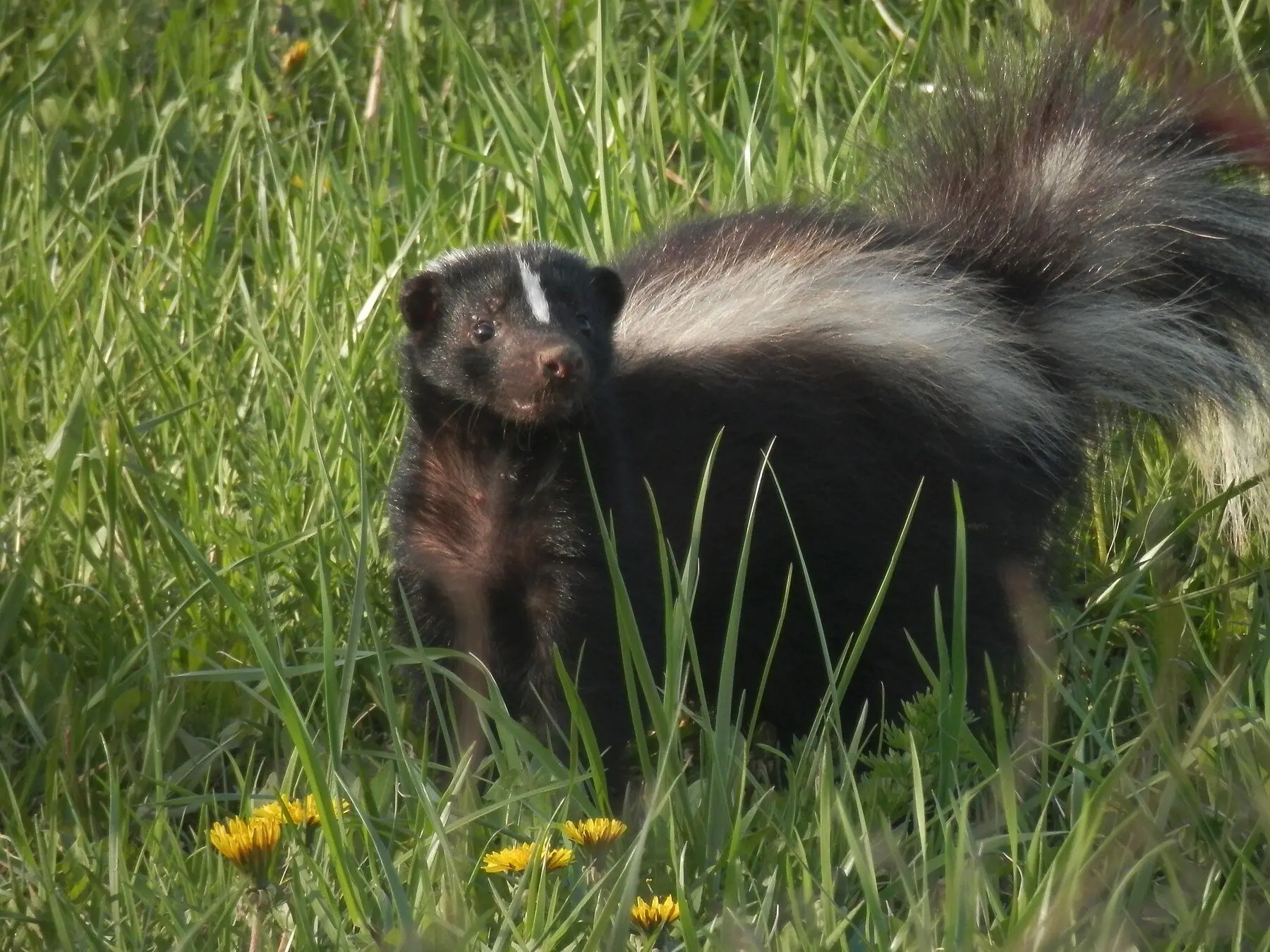
A skunk under a deck is an eviction problem, not a removal problem. Make the space dark, quiet and undisturbed — which is what it wanted — into none of those things, and it leaves by itself.
Confirm it is a skunk
| Sign | Animal |
|---|---|
| Faint musk smell, even with no spraying | Skunk |
| 3–4 in entry hole, dug, close to a wall | Skunk |
| Cone-shaped divots in the lawn overnight | Skunk (grubbing) |
| Five-toed prints, front feet with long claws | Skunk |
| Larger hole, hand-like prints, tipped bins | Raccoon |
| Clean shallow scrape, pellet droppings | Rabbit |
| Large mounds, very large hole | Groundhog |
A faint background musk with no spraying event is the clearest skunk signal there is. They leave it on everything.
Check for kits first
April to August, assume there are young
Kits are born in May and June across most of North America and stay in the den around two months.
Block an entrance in that window and you seal them in to die under your deck, and the mother digs new holes trying to reach them. Both outcomes are worse than waiting.
The newspaper test, before anything else:
- Stuff every opening loosely with crumpled newspaper in the evening
- Pushed out by morning — something is still living there
- Undisturbed for two or three consecutive nights — the space is empty
Do this even if you have watched an adult leave. You are checking for the ones that cannot.
Evicting an adult
Skunks chose the spot because it is dark, quiet and undisturbed. Remove all three:
- Bright work light shone into the space, left on overnight
- A radio nearby, tuned to talk radio rather than music — human voices work better
- Ammonia-soaked rags in an open container, or a bag of used cat litter, near the entrance. Not sealed in, and not so much that the animal cannot get past it to leave
- Open the space up — clear stored wood, clutter and leaf litter from underneath
- Give it several nights. Skunks are habit animals and do not bolt on the first evening
Leave the exit clear
Every one of these makes the den unpleasant. None of them should block the way out.
An animal that cannot leave does not leave — it digs, or it stays and has kits where you cannot reach it.
Not being sprayed
Skunks warn repeatedly before spraying, and almost everyone who gets sprayed missed the warnings or surprised an animal at close range.
The sequence:
- Foot stamping — the first warning
- Raised tail
- Hissing and a short charge
- Tail fully up, body turned in a U — the last moment to be somewhere else
How not to get there:
- Move slowly. Skunks have poor eyesight and startle easily
- Approach from upwind, and keep your distance
- Never corner one, and never block its only exit while standing beside it
- Work at dusk or dawn when you can see whether it is home, not in full dark
- Keep dogs inside. Dogs get sprayed far more often than people do
The permanent fix
| Right | Wrong | |
|---|---|---|
| Material | ½ in galvanised hardware cloth | Chicken wire, lattice alone |
| Depth | Buried 12 in | Sat on the surface |
| Bottom | Bent outward 12 in in an L | Straight down |
| Top | Fixed to the deck framing | Left with a gap |
| Coverage | Whole perimeter | The visible hole only |
The outward apron is what does the work. A skunk digs at the barrier, hits horizontal mesh, and stops.
Leave one opening with a one-way door if there is any doubt at all, and close it after a week of no activity. It removes the guesswork entirely.
Removing the reason
Skunks came for food as much as shelter:
- Grubs in the lawn. The cone-shaped overnight divots are skunks digging for them — and a grub problem you did not know you had
- Pet food left outside, and pet bowls on a porch
- Spilled birdseed under feeders
- Unsecured bins and open compost
- Fallen fruit under trees
- Gaps under sheds, porches and steps — proof those at the same time, or you have simply moved the problem
Rabies
Skunks are a rabies reservoir in North America, which is the reason for genuine caution rather than mild caution.
Report to animal control rather than approach:
- Active in broad daylight, repeatedly
- Moving unsteadily, circling, partially paralysed
- Unafraid, approaching people
- Drooling, or behaving strangely
Any bite or scratch needs immediate medical advice. Keep pets vaccinated — that vaccination is the main thing standing between wildlife rabies and a household.
Do not trap and relocate
Illegal in many states, and a poor outcome everywhere:
- Spreads disease into new populations
- A relocated skunk in unfamiliar territory usually dies
- Risks a spraying, and a trapped skunk in a cage is a difficult problem to then solve
- Catches the wrong animal regularly — cats especially
- Does nothing about the space, so the next skunk moves in
Eviction plus exclusion resolves it permanently, and costs less than the trap.
Common questions
How do I get a skunk out from under my deck?
How do I know if there are baby skunks under the deck?
How do I avoid being sprayed?
What keeps skunks from coming back under a deck?
Are skunks under a deck dangerous?
Should I trap and relocate a skunk?
Backyard Weekly
Know what to plant, week by week
Join the weekly email for seasonal jobs, fixes for what is going wrong, and gear worth buying.
Not ready to subscribe? The planting calendar is free and needs no email.
By subscribing you agree to our privacy policy. Grow In Backyard will never sell your address.
Keep reading
Rabbits Under a Deck: Evicting Them Without Trapping a Litter
A rabbit under a deck usually means a nest. How to check before you block anything, the one-way door method, and the skirting that ends it for good.

Can a Raccoon Jump? How High, How Far, and What Stops One
A raccoon jumps about 4 feet up and 4 to 5 feet across, but climbing is the real problem. What actually keeps one off a fence, a roof or a bin.
How to Get Rid of Ground Squirrels — 3 Measures
How to get rid of ground squirrels comes down to exclusion below ground. 3 measures compared on cost and effort. See which suits your beds.
Dairy Goat Breeds — 6 Compared on Yield and Butterfat
Dairy goat breeds trade volume against butterfat, and that decides taste. 6 compared on yield, richness and size. See which suits your holding.