
Do Fake Owls Work for Squirrels? For About a Week
Plastic owls deter squirrels briefly, then get ignored or perched on. Why habituation beats the decoy, and what to do if you want to keep using one.
 By
On this page
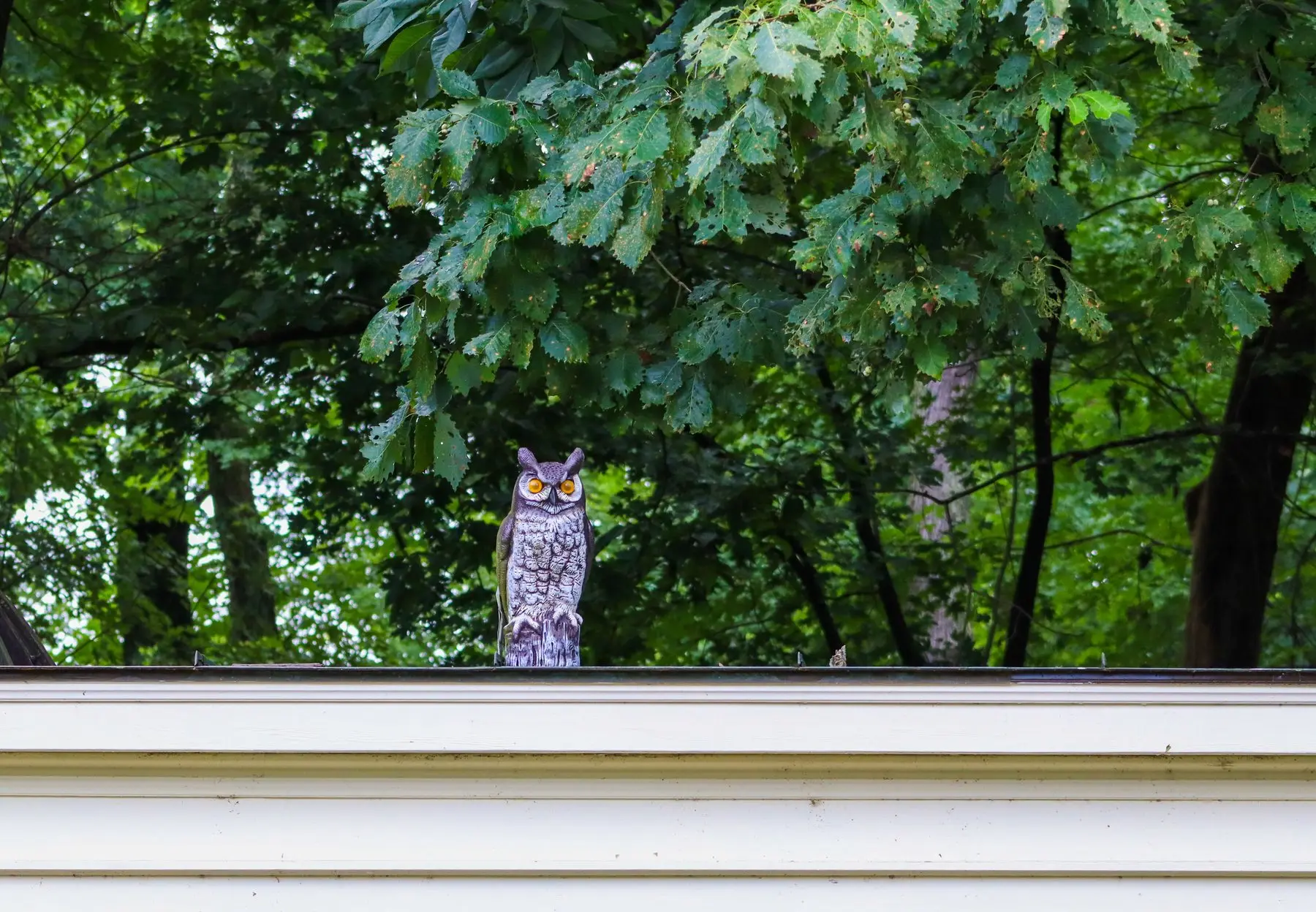
For about a week. A squirrel gives an unfamiliar owl-shaped object a wide berth at first, then notices it never moves, never hunts, never reacts — and stops caring. The usual end point is squirrels feeding underneath it.
Why it fades
A squirrel is not simply pattern-matching an owl silhouette. It is watching for behaviour.
Real owls turn their heads, shift on the perch, blink, fly. A plastic one on a fence post does none of that, and a few days of observation from a safe distance is enough to establish that nothing is going to happen.
Habituation is the general rule, not a flaw in one product
A signal that never precedes anything bad stops being a signal.
That is why decoy owls, shiny tape, ultrasonic boxes and scent repellents all follow the same curve: promising first week, useless second month. It is not that each product is badly made. It is that they all depend on the animal continuing to believe something untrue.
How long, in practice
- A few days to a couple of weeks is the usual range
- Bolder local squirrels shorten it
- A feeder they badly want shortens it a lot — the payoff outweighs the doubt sooner
- The end state is squirrels feeding directly beneath the owl, and birds perching on its head
If you want to keep using one
You can slow habituation. You cannot stop it.
- Move it every few days, to a genuinely different position — not six inches along the same rail
- Pick a model with moving parts — a head or wings that turn in the wind hold up better than a solid moulding
- Take it away for stretches. A decoy that is absent for a fortnight is unfamiliar again when it returns
The cost nobody mentions: your songbirds
If the owl is guarding a bird feeder, remember what the bird it imitates eats.
Small songbirds are the natural prey of a great horned owl, and a convincing decoy can suppress exactly the visitors you put the feeder up for. Squirrels habituate faster than the shyest birds do — so you can end up with the squirrels back and the finches still gone.
What works instead
| How it works | Holds up? | |
|---|---|---|
| Pole baffle + clearance | Geometry | Yes, permanently |
| Weight-triggered feeder | Ports close under a squirrel’s weight | Yes |
| Decoy owl | Fear | No — days |
| Shiny tape, spinners | Fear, novelty | No |
| Ultrasonic device | Sound | No evidence |
| Scent repellent | Smell | No — days, and rains off |
The numbers that matter for a baffle:
- Feeder at least four to five feet up
- A dome or cone baffle on the pole below it
- Nothing within roughly ten feet to jump from
Horizontal distance is the part people get wrong
Squirrels are powerful horizontal jumpers. A feeder perfectly baffled from below is still open if there is a fence, a branch or a wall within jumping range.
Height stops the climb. Clearance stops the leap. You need both.
Common questions
Do fake owls work for squirrels?
How long before squirrels ignore a plastic owl?
Can you make a decoy owl last longer?
Do fake owls scare birds away too?
What keeps squirrels off a bird feeder properly?
Why do deterrents based on fear always fade?
Backyard Weekly
Know what to plant, week by week
Join the weekly email for seasonal jobs, fixes for what is going wrong, and gear worth buying.
Not ready to subscribe? The planting calendar is free and needs no email.
By subscribing you agree to our privacy policy. Grow In Backyard will never sell your address.
Keep reading
Does Peppermint Oil Repel Squirrels? Briefly, At Best
Peppermint oil is sold hard as a squirrel repellent. What it actually does, why squirrels stop caring within days, and the one approach that works.
Do Squirrels Eat Pumpkin Seeds? Yes — and Your Pumpkin
Squirrels eat pumpkin seeds readily and will hollow out a porch pumpkin to get them. What is safe to offer, what is not, and how to protect the display.
Are Ducks Afraid of Owls? Yes — But Decoys Stop Working
Ducks genuinely fear great horned owls, which hunt them. A plastic owl works for days, then becomes furniture unless you keep moving it.
Do Possums Live Underground? Where Opossums Actually Den
Opossums use burrows but almost never dig them. What they take over, why they move every few days, and how to tell an opossum hole from a groundhog's.