Chicken Tractors: Mobile Coop Plans That Actually Move
A chicken tractor gives hens fresh ground daily without fencing the yard. How to size one you can move alone, and the weight mistakes that strand it.
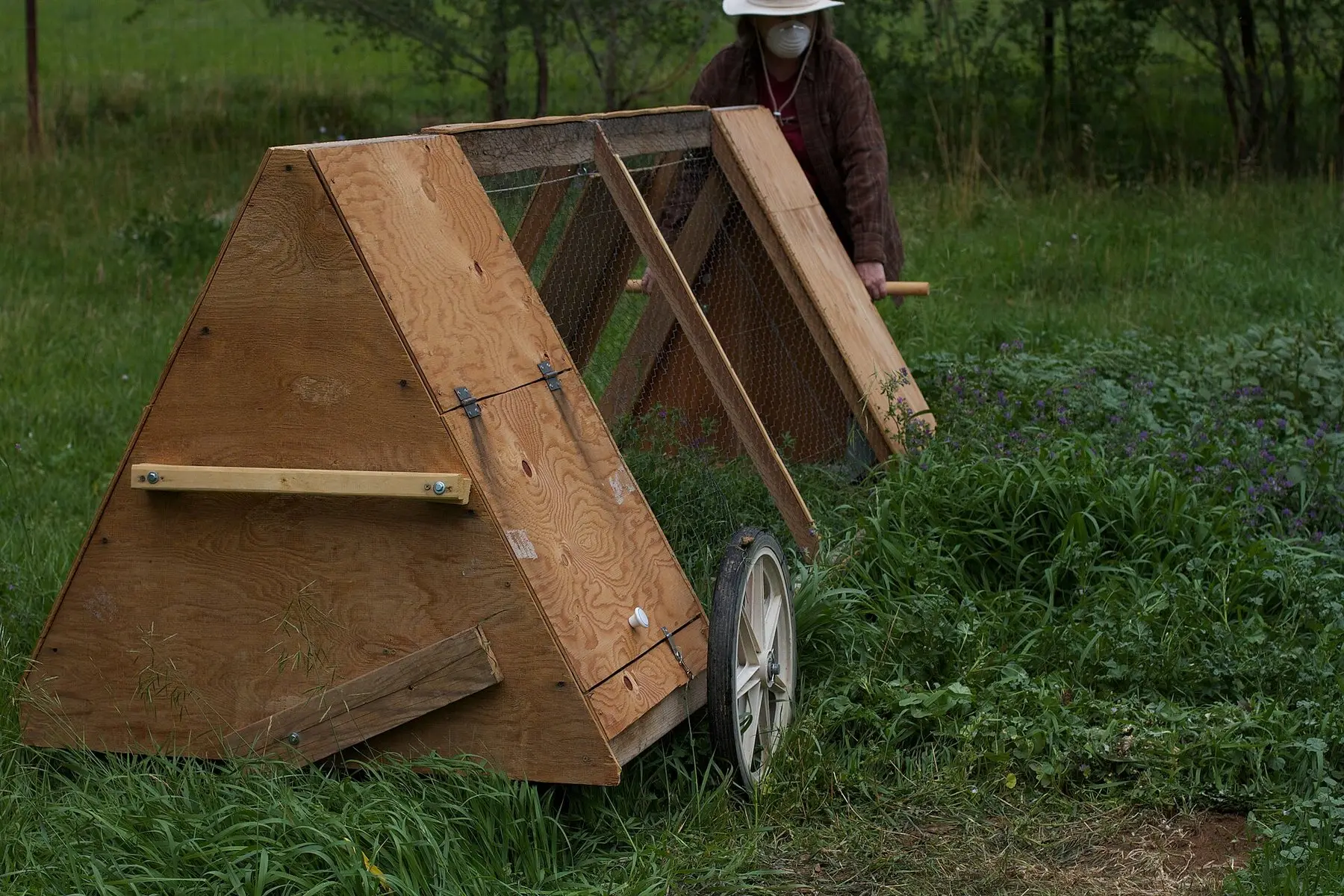
.jpg)
On this page
A chicken tractor is a floorless coop and run in one frame, dragged onto fresh grass every morning. The birds get forage and insects, the lawn gets manure spread thinly instead of concentrated, and nothing needs permanent fencing.
It works well — provided you build one you will actually move. Most tractors fail on that single point.
Weight is the whole design problem
Everything else about a tractor is ordinary carpentry. The one constraint that decides whether it succeeds is whether one person can move it in under a minute, on a wet morning, without enjoying it.
| Frame | Rough weight | Moves | Realistic outcome |
|---|---|---|---|
| 2x4, walled | 180–250 lb | Two people | Moved weekly at best; grass dies |
| 2x2 A-frame | 70–100 lb | One person | Moved daily |
| Hoop on 2x4 base | 90–120 lb | One person | Moved daily |
| 2x2 with wheels | 70–100 lb | One person, easily | Moved daily without thinking |
A tractor that does not get moved is strictly worse than a fixed run: the grass goes, the manure concentrates, and it has none of a fixed run’s predator protection. If you are unsure you will move it every day, build a fixed coop with a proper buried skirt instead.
Wheels at one end, lifted clear
Mount the wheels so they sit a half-inch above the ground when the tractor rests. Lift the front and it rolls like a wheelbarrow; drop it and the frame sits flush on the turf with no gap. Permanently ground-riding wheels leave a predator-sized opening at each corner all night.
What a tractor is genuinely better at
Fresh forage daily. Hens on rotated grass eat clover, seeds, and a lot of insects, which measurably reduces feed consumption in the growing season and improves yolk colour.
Manure management. Concentrated chicken manure burns grass — it is too high in nitrogen to sit in one place. Spread one tractor-length at a time, it is close to an ideal lawn feed.
Parasite control. Coccidia and worms need the birds to return to contaminated ground to complete their cycle. Move daily and they never do.
No permanent structure. Useful if you rent, or if your municipality treats a fixed coop as a structure requiring a permit while a movable pen is not — worth checking locally, because the distinction is common.
What it is worse at
Predator resistance. This is the real trade-off. A fixed run gets a 12-inch hardware-cloth apron pegged to the ground; a tractor cannot, because it moves. Mesh every surface, add a loose ground flap, and use two-step latches — but accept that in country with bears, coyotes, or determined foxes, a fixed coop is safer.
Winter. Once the ground freezes there is nothing to forage and the open sides stop paying for themselves.
Scale. Past about eight birds the frame gets too big and heavy for one person, and the whole model breaks down.
Uneven ground is the gap
On rough turf a rigid frame bridges hollows and leaves openings a raccoon can reach through, or a hen can walk out of. The loose hardware-cloth skirt solves it: it drapes into the dips without stopping the tractor sliding forward. Do not skip it because your lawn looks flat — it is not.
Tractor or mobile coop?
The terms get used interchangeably, and they are different things.
A chicken tractor is small, floorless, light, and combines shelter and run in one frame moved daily by hand. A mobile coop is a larger house on real wheels or a trailer, moved weekly or seasonally, with separate portable electric fencing providing the run.
For a backyard flock of four to six, the tractor is almost always the right answer. Mobile coops start to make sense past roughly fifteen birds, or where you are rotating across genuine pasture rather than a lawn.
If you are still deciding whether to keep chickens at all, start with what it actually takes.
Step by step
- Time
- P1D
- Cost
- $280
- You need
- 2x2 framing lumber for the frame, Half-inch hardware cloth, Corrugated roofing panel, Two 8–10 inch lawnmower wheels, Screws and fencing staples
- Tools
- Circular saw or mitre saw, Drill/driver, Tin snips, Staple gun
Size it to the ground, not the flock
A tractor moves onto fresh grass daily, so it needs less standing room than a fixed run — but the birds still need cover. Allow 4 square feet per bird under the sheltered section and at least 6 in the open, and cap the footprint at what one person can actually drag: about 4x8 ft for four to six hens.
Frame it in 2x2, not 2x4
This is the decision that determines whether the tractor gets moved. A 2x4 frame at 4x8 ft is heavy enough that moving it becomes a two-person job you start skipping. Ripped 2x2 is strong enough for a structure that carries no snow load and never leaves the ground.
Build an A-frame or a low hoop
Both shed wind rather than catching it, and both give headroom in the middle without the weight of vertical walls plus a separate roof. An A-frame is simpler to cut; a hoop of cattle panel over a rectangular base is faster to assemble and lighter still.
Enclose one third as the shelter
Close in one end with solid cladding for the roost and nest box; leave the rest open framing screened in hardware cloth. The closed section blocks wind and rain, and the open section is what makes the tractor worth having.
Roost low, and along the frame
Set the roost 12–18 inches up, running lengthways. Low roosts keep the centre of gravity down so the tractor does not tip when you lift one end, and the birds do not need height — they have no predators to climb away from inside a sealed tractor.
Screen everything in half-inch hardware cloth
Including the floor of the closed section if you are on ground where rats dig. A tractor has no buried skirt to protect it, so the mesh is the entire defence — staple every 4 inches and cover the edges with battens.
Fit wheels at one end only
Mount two lawnmower wheels on the back corners, positioned so they sit just clear of the ground when the tractor is at rest. Lift the front like a wheelbarrow and it rolls; set it down and the frame sits flush again with no gap for a predator to reach under.
Add a skirt of loose mesh
Staple a 6-inch flap of hardware cloth around the base so it lies loose on the ground. It closes the gap over uneven turf without stopping the tractor from sliding forward when you move it.
Move it every single day
One tractor length each morning. Daily movement is the entire point: the birds get fresh forage and insects, the manure is spread thinly enough to feed the grass rather than burn it, and parasites never complete a life cycle in one spot.
Common questions
How often should you move a chicken tractor?
How many chickens fit in a chicken tractor?
Are chicken tractors predator proof?
Do chicken tractors work in winter?
What is the difference between a chicken tractor and a mobile coop?
Backyard Weekly
Know what to plant, week by week
Free planting calendar. Join the weekly email for seasonal jobs, fixes for what is going wrong, and gear worth buying.
Set MONETIZATION.email.endpoint in src/config/site.ts to enable this form.
By subscribing you agree to our privacy policy. Grow In Backyard will never sell your address.
Keep reading
Types of Chicken Coops: Which One Actually Fits Your Yard
Fixed, tractor, walk-in, A-frame — each solves a different problem. What each style is actually for, before you commit to building or buying one.
Chicken Coop Plans: Sizing It Right Before You Build
Most coop plans get ventilation and predator-proofing wrong. The dimensions that actually matter, what to build from, and a step-by-step order of work.
Backyard Chickens: What It Actually Takes
Space, cost, time, and the rules nobody mentions. An honest account of keeping backyard chickens before you buy the coop — including why the eggs are not free.
Best Chicken Coops You Can Buy (and When Building Is Cheaper)
Prefab coops range from genuinely good to a raccoon's first target. What to check before buying one, sized by flock, and when building instead saves real money.