
Can Goldfish Live in a Pond? Yes, and Without a Pump
Goldfish overwinter outdoors and survive unfiltered ponds that are deep enough, planted and lightly stocked. What a pump actually buys you, and when you need one.
 By

On this page
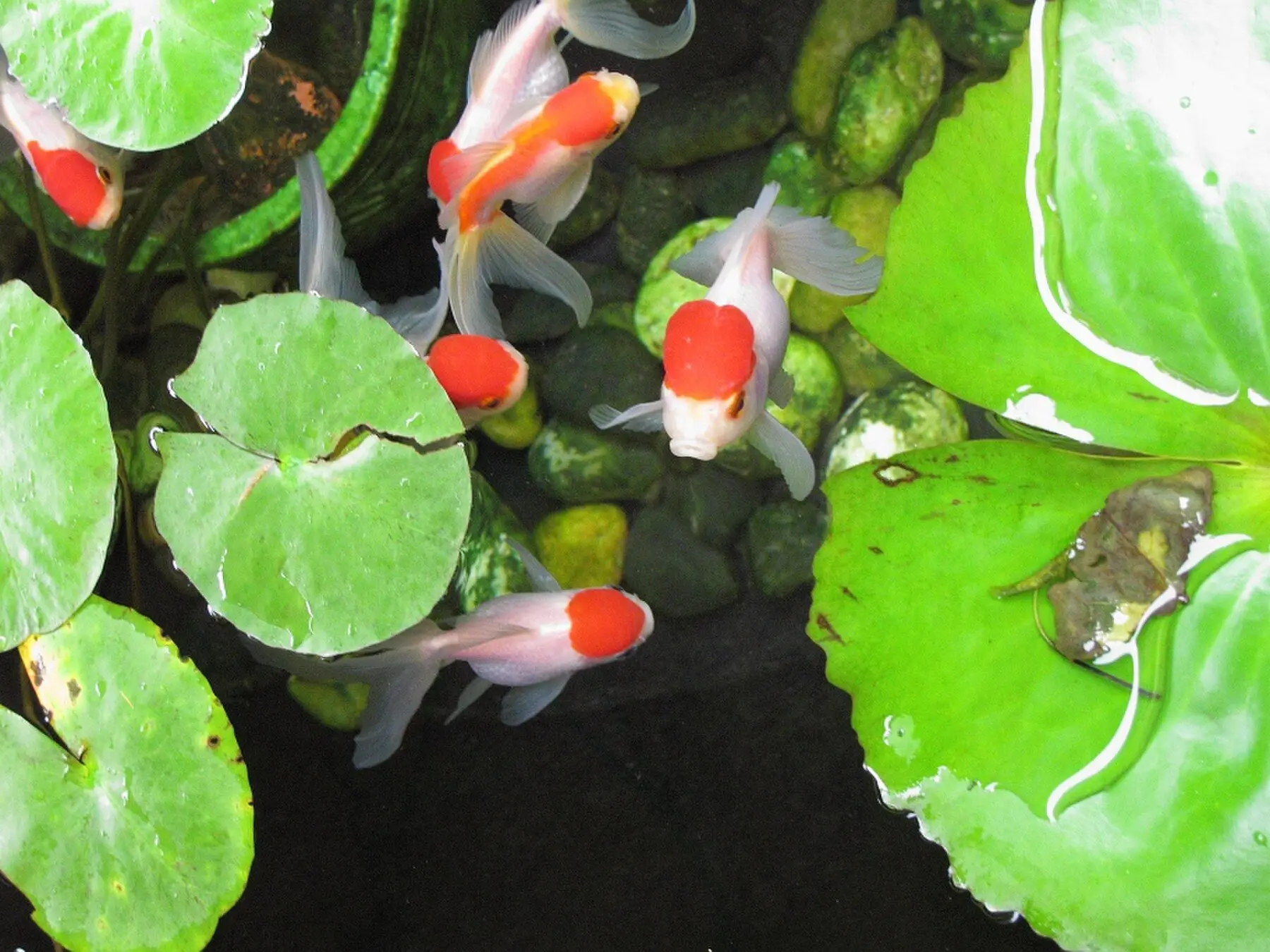
Goldfish are far better suited to a pond than to anything indoors. They are a temperate cold-water fish — a domesticated relative of the crucian carp — and a bowl is close to the worst environment you could design for one.
In a pond they grow larger, live longer, and largely look after themselves.
Without a pump
This works more often than pond shops suggest, and it works for a specific reason: plants do the filter’s job.
A filter converts fish waste — ammonia — through nitrite to nitrate via bacteria. Submerged plants take up those nitrogen compounds directly as fertilizer, and they release oxygen while they do it.
The conditions that make it work:
- Light stocking. Half what you would keep in a filtered pond. This is the one that matters most.
- Heavy planting. Submerged oxygenators — hornwort, elodea, water milfoil — plus surface cover from lilies over roughly half the pond.
- Depth. 18 inches minimum. Deeper water is more thermally stable and holds more oxygen.
- Part shade. Direct sun all day heats a small pond alarmingly, and warm water holds less oxygen.
- Minimal feeding. Every pellet you add is nitrogen the plants have to absorb.
Hot still nights are when unfiltered ponds fail
Plants produce oxygen in daylight and consume it at night. On a hot, still summer night, a heavily stocked pond can run out before morning — fish gasping at the surface at dawn is the warning sign.
A pump or a small air stone eliminates this risk for a few dollars of electricity a year. If you keep more than a token number of fish, that is what it is for.
Through winter
Goldfish overwinter outdoors across most climates. They stop eating, slow almost to a halt, and sit near the bottom.
The pond must not freeze solid, and — more importantly — a hole must stay open in the ice so gases from decomposition can escape. A floating de-icer or a bubbler does this.
Never break ice by hitting it. The shockwave carries through water and can kill fish.
Stop feeding below about 50°F. Their metabolism cannot process food, and it decays inside them.
Fancy varieties — orandas, ranchus, bubble-eyes, anything with a deformed body shape — should come indoors. They are poor swimmers and do not survive cold reliably.
What to expect
Size: 6–10 inches is normal in a pond, and considerably more for comets. The idea that goldfish “grow to the size of their tank” is half a myth — stunted growth in small tanks is a symptom of poor water quality, not a healthy adaptation.
Lifespan: 10–15 years outdoors is routine, and 20-plus happens.
Breeding: yes, readily, once the water warms. Expect the population to climb, and expect to thin it every year or two.
Colour: pond goldfish often darken or fade toward bronze in strong sunlight or where there is little shelter. It is normal and not a health problem.
The trade-off worth understanding
Goldfish eat tadpoles, newt larvae, and most aquatic invertebrates.
A pond with goldfish will not support frogs, newts or dragonflies in any real number. A pond without fish will, within a season or two, and with no work at all.
Both are good ponds. They are just different ponds, and you cannot have both in the same water.
Common questions
Can goldfish live in an outdoor pond?
Can goldfish survive in a pond without a pump?
How deep does a goldfish pond need to be?
Do goldfish need to be fed in a pond?
Will goldfish breed in a pond?
Can you put goldfish in a wildlife pond?
Backyard Weekly
Know what to plant, week by week
Join the weekly email for seasonal jobs, fixes for what is going wrong, and gear worth buying.
Not ready to subscribe? The planting calendar is free and needs no email.
By subscribing you agree to our privacy policy. Grow In Backyard will never sell your address.
Keep reading
Pond Aerator Without Electricity — 5 Solar and Wind Picks
A pond aerator without electricity runs on solar or wind, with trade-offs. 5 picks compared by pond size and site. See which matches yours.
Best Fish for a Small Pond (And How Many It Holds)
Goldfish and shubunkins suit small ponds; koi do not. Stocking limits by volume, which species survive a frozen winter, and what actually eats algae.
Can You Eat Koi? Yes — But Almost Nobody Does
Koi are ornamental common carp, entirely edible and eaten across Asia and Europe. Why the fish in your pond is still a bad dinner, and the real risks.
How to Get Rid of Frogs — 3 Fixes That Cut the Draw
How to get rid of frogs starts with the water and light drawing them in. 3 fixes compared for yards and pools. See which matches your problem.