
Backyard Fish Farming Kit — 6 Parts That Decide It Works
A backyard fish farming kit needs oxygen, filtration and heat first. We compare 6 components and the species each one suits. See which fits your climate.
 By
We may earn a commission when you buy through links on this page, at no extra cost to you.
On this page
Backyard fish farming is mostly not an equipment problem. The tanks are easy and cheap. What decides whether it works is water chemistry, oxygen, and whether the species you picked is legal and suited to your climate — and a kit does not solve any of those for you.
So the useful order is: check the law, choose the species for your temperature, then buy the equipment those two decisions imply.
Species by temperature, which is the real decision
| Fish | Growing temp | Heating needed | Hardiness | Time to plate | Notes |
|---|---|---|---|---|---|
| Tilapia | 75–85°F | Yes, most climates | Very high | 6–9 months | Restricted in many states |
| Channel catfish | 70–85°F | No | Very high | 12–18 months | Best unheated choice |
| Rainbow trout | 50–65°F | Chilling, in warm climates | Low | 9–14 months | Needs high oxygen |
| Bluegill / perch | 65–80°F | No | High | 16–24 months | Slow but very hardy |
| Common carp | 65–80°F | No | Very high | 12–18 months | Restricted in places |
| Koi, goldfish | Wide | No | Very high | n/a | Ornamental, not food |
Tilapia dominate the literature because they grow fast and forgive bad water. They also stop growing below about 70°F and die near 50°F, which in most of the United States means heating a few hundred gallons through winter — and that is normally the largest single running cost of the whole system.
Catfish in an unheated tank is the underrated answer for a temperate garden. Slower, but the electricity bill is just the air pump.
Watch out
Check your state wildlife agency before you buy anything. Tilapia possession is prohibited or permit-only in a long list of states because of invasive risk, and the rules tighten further for any system that could discharge into natural water.
The four jobs the equipment has to do
In priority order, because this is where kits get the emphasis wrong.
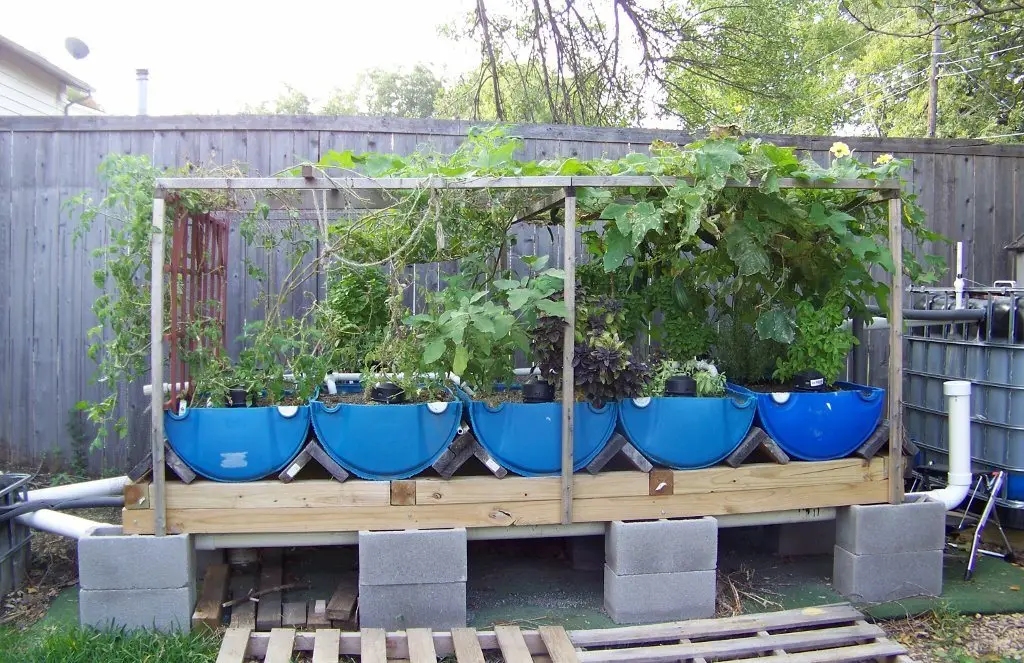
1. Oxygen. Fish at farming density consume far more oxygen per gallon than ornamental fish, and the water holds only minutes of supply without aeration. This is the failure that kills everything in an afternoon. Buy more aeration than the calculator says.
2. Ammonia. Fish excrete ammonia continuously, and it is toxic well below 1 ppm. A biofilter is a surface for nitrifying bacteria to live on, converting ammonia to nitrite and then to nitrate. In an aquaponics system the grow bed does this and the plants take up the nitrate.
3. Solids. Uneaten feed and faeces decompose, consuming oxygen and releasing more ammonia. A system with no mechanical filtration typically fails about three weeks in, when the solids load catches up with it.
4. Temperature. Only for the species that need it — see above.
Cycling, and why it cannot be skipped
A brand new system has no nitrifying bacteria. Add fish on day one and the ammonia they produce has nothing to convert it, so it accumulates until it kills them. This is the single most common way a first attempt ends.
Cycling means establishing that bacterial population before the fish arrive:
- Add a small ammonia source — a pinch of fish food, or pure ammonia solution
- Test ammonia, nitrite and nitrate every day or two with a liquid kit, not strips
- Ammonia rises, then falls as nitrite rises, then nitrite falls as nitrate rises
- When ammonia and nitrite both sit at zero and nitrate is climbing, it is cycled
Four to eight weeks. Warmer water cycles faster. Seeding with media or filter squeezings from an established system speeds it up considerably if you can get some.
Stocking density, from the bottom up
The limit is set by oxygen and filtration, not by how much water you have. A rule of thumb for a well-run recirculating system is around half a pound of fish per gallon at harvest weight — and that assumes aeration and biofiltration genuinely sized for it.
Start at a quarter of whatever figure you are aiming for. Watch ammonia and dissolved oxygen through a hot spell. Increase only once the system has proved it holds both steady.
Systems crash because people stock to the theoretical maximum on day one and then meet their first heatwave.
The economics, stated plainly
Feed is a real cost and a continuous one. Aeration runs 24 hours a day, every day. Heating a warm-water species through a northern winter can dwarf both.
Against that, you get fish — and in an aquaponics system, a decent vegetable crop from the same water, which is genuinely the part that makes the numbers less bad.
It is a good project. It is rarely a cheaper way to eat fish, and anyone selling you a kit on that basis is selling you something else.
How we picked
Equipment judged on what a recirculating system has to achieve biologically — oxygen, ammonia removal, solids removal and temperature — against published component ratings and what small-scale growers report. · Picks last checked October 2026.
- Aeration capacity, first and always
- Fish at farming density consume far more oxygen per gallon than ornamental fish. Loss of aeration kills a stocked tank in hours, not days.
- Biofiltration volume
- Fish excrete ammonia, which is toxic at low concentrations. A biofilter has to hold enough media and enough bacteria to convert it as fast as the fish produce it.
- Solids removal
- Uneaten feed and waste break down and consume oxygen while releasing ammonia. A system with no mechanical filtration fails about three weeks in.
- Heating, for the species you chose
- Tilapia stop growing below about 70°F and die near 50°F. In most of the US that is a heated system, and heating is usually the largest running cost.
- Backup power
- A pump failure overnight is a total loss. On a stocked system a battery air pump is cheap insurance, not a nicety.
Our picks
| # | Pick | Best for | Where to buy |
|---|---|---|---|
| 1 | Media-bed aquaponics kit | Best overall for a backyard | Check price for Media-bed aquaponics kit → |
| 2 | Stock tank and air pump | Best value starting point | Check price for Stock tank and air pump → |
| 3 | Linear piston air pump with air stones | The component not to economise on | Check price for Linear piston air pump with air stones → |
| 4 | Battery-backup air pump | Cheapest insurance you can buy | Check price for Battery-backup air pump → |
| 5 | Water test kit — ammonia, nitrite, nitrate, pH | The instrument the whole thing depends on | Check price for Water test kit — ammonia, nitrite, nitrate, pH → |
| 6 | Floating thermometer and tank heater | Best for warm-water species in a cool climate | Check price for Floating thermometer and tank heater → |
Best overall for a backyard
Media-bed aquaponics kit
The sensible first system. Accept a smaller fish yield in exchange for a system that largely regulates itself.
- System
- Fish tank plus gravel or clay-pebble grow bed
- Biofilter
- The grow bed itself
- Fish suited
- Tilapia, catfish, ornamental
- Also produces
- Leafy greens, herbs, tomatoes
- Needs
- Pump, aeration, heat for warm-water species
What we liked
- Grow bed is the biofilter, so one system does two jobs
- Far less equipment than separate fish and vegetable setups
- Plants take up nitrate, so water changes are minimal
- The most forgiving introduction to the chemistry
Worth knowing
- Lower fish density than a dedicated tank system
- Grow beds clog with solids and need periodic cleaning
- Kit prices are high relative to the parts
Best value starting point
Stock tank and air pump
What we would actually start with. Spend the kit money on a better air pump and a dissolved oxygen meter instead.
- Tank
- 100–300 gallon poly stock tank
- Aeration
- Linear piston or diaphragm air pump, air stones
- Biofilter
- Barrel with media, built yourself
- Fish suited
- Catfish, tilapia if heated
- Cost
- A fraction of a packaged kit
What we liked
- Cheapest way to learn the water chemistry that actually matters
- Every component repairable and replaceable separately
- Scales by adding tanks rather than replacing the system
- Stock tanks are tough and last for years
Worth knowing
- You design the filtration, and getting it wrong kills fish
- No instructions; you are reading rather than following
- Looks like what it is
The component not to economise on
Linear piston air pump with air stones
Buy more aeration than you think you need. It is the one failure that kills a whole tank in an afternoon.
- Type
- Linear piston or diaphragm, continuous duty
- Output
- Rated in litres per minute at depth
- Runs
- 24/7
- Fits
- Any tank, with weighted airline and diffusers
What we liked
- Oxygen is the limiting factor at farming density
- Continuous-duty pumps are built to run for years without stopping
- Quieter and more efficient than aquarium-grade pumps
- Multiple outlets feed several tanks
Worth knowing
- Dearer than an aquarium pump of nominally similar output
- Diaphragms are a wear part and need periodic replacement
Cheapest insurance you can buy
Battery-backup air pump
Non-negotiable on a stocked system. The question is not whether the power will fail but whether you will be awake when it does.
- Power
- Mains with automatic battery cutover
- Runs
- Hours to a day on battery
- Triggers
- Automatically on power loss
- Output
- Enough to hold a stocked tank
What we liked
- A pump failure overnight is otherwise a total loss
- Switches over without anyone being present
- Costs a tiny fraction of the fish it protects
- Also useful for transporting fish
Worth knowing
- Battery needs periodic testing and replacement
- Output is survival-level, not growth-level
The instrument the whole thing depends on
Water test kit — ammonia, nitrite, nitrate, pH
Buy it before the fish. A new system takes four to eight weeks to cycle, and stocking before it has is the commonest beginner failure.
- Measures
- Ammonia, nitrite, nitrate, pH, often KH
- Critical
- Ammonia and nitrite, both toxic at under 1 ppm
- Frequency
- Daily while cycling, weekly once stable
- Type
- Liquid reagent kit
What we liked
- Ammonia and nitrite spikes are invisible until fish die
- Tells you when a new system has finished cycling
- Liquid kits are far more accurate than test strips
- Cheap relative to a tank of fish
Worth knowing
- Reagents expire; check the date
- Colour matching is fiddly in poor light
Best for warm-water species in a cool climate
Floating thermometer and tank heater
Price the electricity before you commit to a warm-water species. In a cold climate, catfish in an unheated tank is often the better project.
- For
- Tilapia and other warm-water fish
- Target
- 75–85°F for tilapia growth
- Type
- Submersible or inline heater, sized to volume
- Running cost
- Usually the largest single cost
What we liked
- Tilapia simply do not grow below about 70°F
- Inline heaters are more efficient than submersible for large volumes
- A thermometer tells you what the heater is actually achieving
Worth knowing
- Heating a few hundred gallons year-round is expensive
- A heater failure in winter is as fatal as a pump failure
Which should you buy?
Our verdict
- Best overall:
- Media-bed aquaponics kit
- Best value:
- Stock tank, air pump and DIY biofilter
For most backyards the media-bed aquaponics kit is the right buy: the grow bed doubles as the biofilter, so one system does fish and vegetables with far less equipment than two. But the honest value answer is to start with a stock tank, a decent air pump and a barrel biofilter for a fraction of the price — the thing that decides whether backyard fish farming works for you is water chemistry, not the kit, and you learn that on cheap equipment. Also be clear-eyed about the economics: backyard fish rarely beats the supermarket on cost. It is worth doing for the control and the interest, not the savings.
| If you… | Buy | Because |
|---|---|---|
| You want food fish and you have a greenhouse or warm climate | Tilapia in a recirculating tank system | Fastest growth, tolerant of crowding and poor water, and the species nearly all backyard aquaponics is built around. Needs 75–85°F to grow. |
| Unheated, temperate climate | Channel catfish | Hardy, tolerates low oxygen better than most, grows well through a warm season and survives a cold winter in a deep enough tank or pond. |
| Cold water and good flow available | Rainbow trout | Excellent eating and fast growth in cold water, but demanding — needs high dissolved oxygen and 50–65°F, so it suits a spring-fed or flow-through setup. |
| You want plants as well as fish | A media-bed aquaponics kit | The grow bed is the biofilter, so plants and fish share one system. Lower yield of each than separate systems, far less equipment. |
| You mainly want to learn before committing | A single IBC tote or stock tank, an air pump and a simple biofilter | Cheap, repairable, and teaches you the water chemistry that decides whether a bigger system works. |
When not to buy at all
Check your state wildlife agency before buying anything. Tilapia are prohibited or permit-only in a long list of states because of their invasive potential, and stocking rules differ again for ponds with any outflow — this is the step that stops a project, and it costs nothing to check first. Then be honest about the economics: between feed, electricity for aeration, and heating for a warm-water species, backyard fish is seldom cheaper than buying fish. And skip any kit sold on a yield figure without naming the species, the temperature and the feed conversion it assumes.
Common questions
What is the best fish to raise for food in a backyard?
Is backyard fish farming actually worth it?
Do I need a permit to raise tilapia?
How long does a new fish farming system take to cycle?
How many fish can I keep in a backyard tank?
What happens if the power goes out?
Backyard Weekly
Know what to plant, week by week
Join the weekly email for seasonal jobs, fixes for what is going wrong, and gear worth buying.
Not ready to subscribe? The planting calendar is free and needs no email.
By subscribing you agree to our privacy policy. Grow In Backyard will never sell your address.
Keep reading
Best Fish for a Small Pond (And How Many It Holds)
Goldfish and shubunkins suit small ponds; koi do not. Stocking limits by volume, which species survive a frozen winter, and what actually eats algae.
How to Stock a Pond (Including for Free)
Stocking ratios that work, what it costs, and the free routes — state hatchery programs, pond transfers, and why natural colonisation is slower than claimed.
Can You Eat Perch? Yes — One of the Best Freshwater Fish
Yellow perch is mild, firm and widely considered excellent eating. The real question is the water it came from, not the species.
Pond Aerator Without Electricity — 5 Solar and Wind Picks
A pond aerator without electricity runs on solar or wind, with trade-offs. 5 picks compared by pond size and site. See which matches yours.