Coffee Grounds in the Garden: What They Actually Do
Used coffee grounds are not acidic, do not repel slugs, and should never be spread thickly. What they are genuinely good for, and how to use them.

On this page
Coffee grounds are the most over-promised material in home gardening. They are said to acidify soil, repel slugs, deter cats, feed everything, and improve any bed they touch. Most of that is wrong, and one of the claims — spreading them thickly around plants — actively causes harm.
They are still worth saving. Just for different reasons than the ones usually given.
The acidity myth
This is the claim worth killing first, because people act on it.
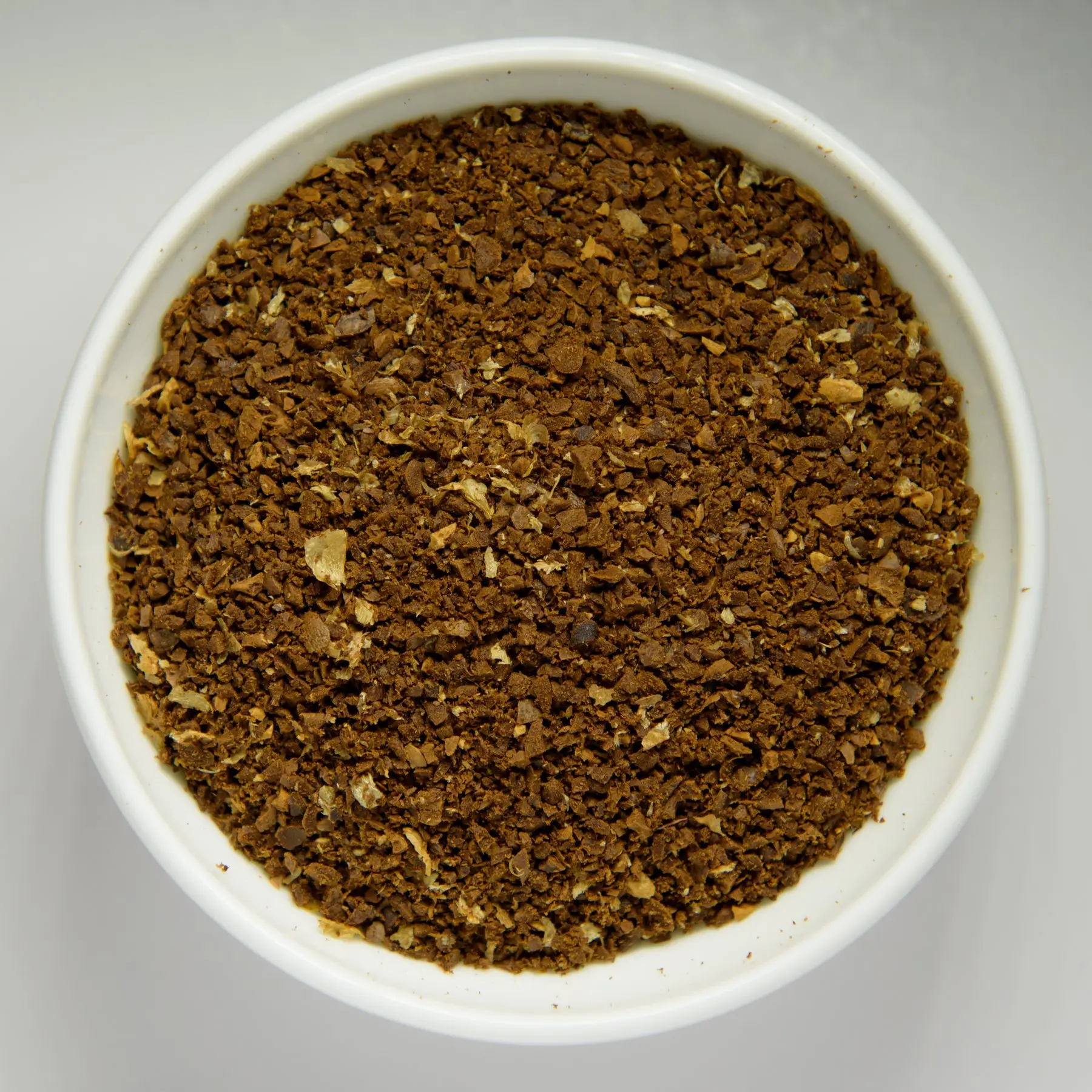
Brewed coffee is acidic, around pH 5. But the acids responsible are water-soluble, which is precisely why they end up in the drink. What is left in the filter has had most of them extracted, and used grounds typically test around pH 6.5 to 6.8 — essentially neutral, and very close to what most garden soil already is.
Even if they were acidic, the quantities involved settle it. Meaningfully lowering the pH of a bed takes a measured dose of elemental sulfur and several months of soil bacteria working on it. A household’s coffee output is nowhere near that scale.
If you actually need acidic soil
For blueberries, azaleas, or rhododendrons, coffee grounds will not get you there. That job needs elemental sulfur, dosed against a soil test and applied months ahead — see how to lower soil pH. Relying on grounds means a season lost and a plant that yellows while you wait.
The mistake that does damage
Coffee grounds are made of very fine, uniform particles. Spread in a layer on soil and allowed to dry, they lock together into a dense mat that water runs off rather than soaks through — the same behaviour dried-out peat shows.
That crust does real harm. It sheds irrigation and rain away from the root zone, and it stops air exchange at the surface. Plants mulched generously with grounds often look worse rather than better, and the gardener concludes the soil needs more of something.
If you are going to put grounds on soil directly, the rule is: a thin scatter, no more than about half an inch, raked into the surface or mixed with other mulch, never a solid layer.
What they are genuinely good for
Compost. This is the real answer. Grounds are a nitrogen-rich “green” at roughly 2 percent nitrogen, they are already finely divided so they break down fast, and heaps take them readily.
Keep them to around a fifth of the heap by volume and balance them as you would any green — roughly two to three parts browns (cardboard, dry leaves, straw, shredded paper) to one part greens. Piled in alone they go dense, wet, and anaerobic.
Worm bins. Worms work coffee grounds enthusiastically, and the grit helps their digestion. The same ceiling applies: a component of the feed, not the bulk of it.
A minor nitrogen source, once composted. After composting, the nitrogen is in a form plants can actually use, and it behaves like any other compost — good for heavy feeders, good for structure, good for soil life.
| Claim | Reality |
|---|---|
| Acidifies soil for blueberries | No — used grounds are near neutral |
| Repels slugs | Inconsistent in trials; not reliable |
| Deters cats | Briefly, while the smell lasts |
| Great mulch | No — forms a water-repellent crust |
| Good compost green | Yes — up to ~20% by volume |
| Good worm bin feed | Yes, in moderation |
| Feeds seedlings | No — suppresses germination |
Where not to use them
Around seedlings, cuttings, and seed beds. Coffee contains caffeine and other compounds that inhibit germination and early root growth — a defence the plant evolved to suppress competition. That effect is real enough to be measurable, and a propagation area is the one place to keep grounds well away from.
As a lawn top-dressing in quantity. Same crusting problem, over a larger area, where it is harder to undo.
On plants that want alkaline conditions. Not because grounds will acidify anything meaningfully, but because the effort is misdirected — they will not help.
The practical routine
Keep a lidded tub by the coffee machine. Tip the grounds and paper filters — the filters are perfectly good browns — into it, and empty it onto the compost heap every few days, covering with a handful of dry leaves or shredded card each time.
That is the whole method. Composted for a few months, the result is ordinary good compost that has cost you nothing and diverted a weekly bucket of waste from landfill. It will not change your pH, and it will not stop a slug, but it does the thing compost does.
Cafés will give you sacks of it
Most coffee shops throw away several kilos a day and are usually glad to hand it over. That is enough to matter to a compost heap in a way a household’s spoonful is not — just scale the browns up to match, or you will end up with a dense, sour heap rather than a fast one.
Common questions
Are coffee grounds good for plants?
Do coffee grounds lower soil pH?
Do coffee grounds keep slugs and cats away?
How much coffee grounds can I put in compost?
Which plants like coffee grounds?
Backyard Weekly
Know what to plant, week by week
Free planting calendar. Join the weekly email for seasonal jobs, fixes for what is going wrong, and gear worth buying.
Set MONETIZATION.email.endpoint in src/config/site.ts to enable this form.
By subscribing you agree to our privacy policy. Grow In Backyard will never sell your address.
Keep reading
How to Lower Soil pH: What Works and How Long It Takes
Elemental sulfur is the reliable way to acidify soil, and it takes months. What to use, how much, and why coffee grounds and vinegar do not work.
Chicken Manure Fertilizer: Compost It or Burn Your Plants
Fresh chicken manure is too strong to use directly and carries pathogens. How to compost it properly, the NPK you end up with, and the food-safety waiting periods.
How to Make a Compost Bin: Three Designs That Work
A heap needs about a cubic yard to heat up, air to keep going, and a lid in wet climates. Pallet, wire and bin designs, plus what actually goes in.
Wood Chips in the Garden: The Nitrogen Myth, Explained
Wood chips only rob nitrogen where they meet soil, so they are excellent as a surface mulch and a bad idea dug in. Where to use them, and which chips to avoid.