
Bird's Nest Fern Problems: Browning, Crisping and Rot
Almost every bird's nest fern problem is water in the crown, dry air, or direct sun. How to read the fronds and what each symptom actually means.
 By
On this page
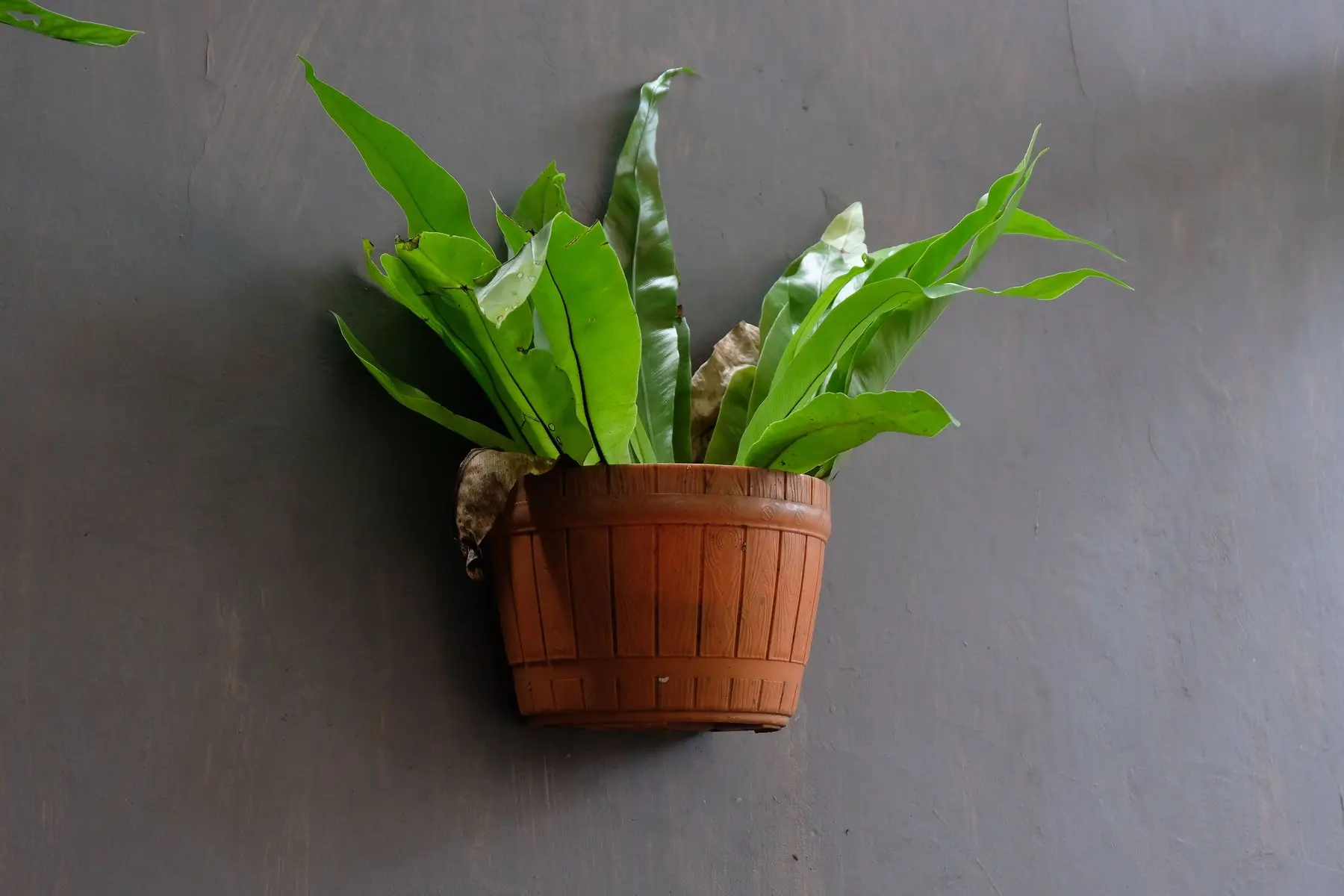
Almost every bird’s nest fern problem is one of three things: water in the crown, dry air, or direct sun. The fronds tell you which.
What the plant actually is
Asplenium nidus is an epiphyte — in the wild it grows in the fork of a tree in humid tropical forest, its roots in bark and leaf litter rather than soil, its rosette catching falling debris. Every care rule follows from that:
- Bright indirect light, never direct sun. It lives under a canopy
- High humidity. Above 50%, and it prefers more
- Free-draining compost — bark and perlite, not dense peat
- Consistently moist, never waterlogged
- A crown that stays dry
Reading the symptoms
| What you see | Cause |
|---|---|
| Crisp brown frond edges | Dry air, hard water salts, or under-watering |
| Soft brown centre, smell | Crown rot — water in the rosette |
| Whole fronds yellow, soil wet | Overwatering / root rot |
| Pale, washed-out, bleached | Too much direct light |
| Brown patches with yellow halos | Leaf spot — water left on the fronds |
| Neat brown lines underneath | Spores. Normal and healthy |
| Small brown lumps that scrape off | Scale insects |
| Fine webbing, stippling | Spider mites, from dry air |
| New fronds small or stuck | Low humidity or a damaged crown |
| Outer fronds yellowing slowly | Normal ageing |
Crown rot, the one that kills
Never water or mist into the centre
The crown is a tight nest of tissue where every new frond emerges. Water standing in it in still indoor air goes brown, soft and foul within days, and once the growing point is gone the plant cannot replace it.
Water the compost around the edge of the pot. Not the middle, ever.
If the centre is already soft:
- Stop watering entirely
- Cut away the rotten tissue with a sterile blade, back to firm green
- Dry the crown — tip the plant gently, blot with kitchen paper
- Move it somewhere with air movement but out of a draught
- Wait. If any of the growing point survived, new fronds come, slowly
Survival depends on whether the rot reached the centre. There is no treatment that reverses it.
Dry air
The most common complaint, and it appears every autumn when the heating comes on.
- Pebble tray — the pot on gravel above water, not standing in it
- Group plants together, which raises local humidity
- A humidifier is the reliable answer in a dry house
- Bathroom or kitchen suits it, given enough light
- Away from radiators, vents and draughty doors
- Misting the fronds helps a little, but keep it off the crown, and do not rely on it
Hard water does the same damage. Mineral and fertiliser salts accumulate and burn the frond margins. Use rainwater or filtered water, and flush the pot through occasionally to leach salts out.
Light and water
| Right | Wrong | |
|---|---|---|
| Light | Bright indirect — near a north or east window | Direct sun; deep shade |
| Water | When the top inch is dry, around the edge | Into the crown; on a fixed schedule |
| Frequency | ~weekly summer, 10–14 days winter | Whenever you remember |
| Compost | Peat-free mix + orchid bark or perlite | Dense wet potting soil |
| Pot | Drainage holes, snug | No drainage; far too big |
| Feed | Quarter strength, monthly in growth | Full strength; feeding in winter |
| Temp | 60–80°F, stable | Below 50°F, or a cold draught |
Empty the saucer
A pot left standing in water is the fastest route to root rot, and it is the mistake that hides behind “I water it properly”. Water thoroughly, let it drain, then tip the saucer out.
Pests
- Scale — small brown limpets on frond undersides and midribs, with sticky residue. Scrape them off, then wipe with dilute insecticidal soap. Check the label for fern safety: ferns are sensitive and burn easily
- Mealybugs — white cottony masses in the crown and leaf joins. Dab with alcohol on a cotton bud
- Spider mites — fine webbing and stippled fronds, always a dry-air problem. Raise humidity and rinse the fronds
- Fungus gnats — a wet compost symptom, not a plant disease. Let the surface dry between waterings
Avoid leaf shine products and oil-based sprays entirely. Fern fronds are thin and they scorch.
Trimming and repotting
- Cut damaged fronds at the base, not partway — a trimmed frond does not regrow a tip
- Never pull at a new frond struggling to unfurl. Raise humidity and leave it
- Repot every two or three years, in spring, into a pot only slightly larger. This fern likes being snug
- Handle by the pot, not the fronds. They bruise, and bruising shows permanently
When it looks beyond saving
If the outer fronds are dead but the centre is still firm and green, it will recover: cut everything dead away, correct the humidity and watering, and wait. New fronds from the crown are the sign.
If the crown is soft and brown, it will not. That is the one failure this plant does not come back from, and it is worth knowing early rather than nursing a dead plant for a season.
Common questions
Why are my bird's nest fern leaves turning brown at the edges?
What causes crown rot in a bird's nest fern?
Why is my bird's nest fern yellow?
What are the brown spots on the underside of the fronds?
How often should I water a bird's nest fern?
Why are my new fronds small, deformed or not unfurling?
Backyard Weekly
Know what to plant, week by week
Join the weekly email for seasonal jobs, fixes for what is going wrong, and gear worth buying.
Not ready to subscribe? The planting calendar is free and needs no email.
By subscribing you agree to our privacy policy. Grow In Backyard will never sell your address.
Keep reading
Spider Plant Care: Brown Tips, Babies and Why It Stops
Spider plants are nearly unkillable but tell you everything through their tips. Water, light, why yours has no babies, and propagating the ones it has.
How to Propagate Aloe: Pups, Not Leaf Cuttings
Aloe multiplies from offsets at the base, and leaf cuttings almost always rot. How to separate a pup, when to do it, and the callusing step.
Cast Iron Plant: The One for the Dark Corner
Aspidistra tolerates deep shade, neglect and cold that kills other houseplants. What it will not tolerate, how slowly it grows, and outdoor use.
Can You Grow Raspberries in a Pot? Yes, With One Condition
Raspberries do well in containers if the pot is big enough and you pick a compact autumn variety. Fifteen gallons is the number that decides it.