
Mulch for a Chicken Run: What Works and What Turns to Mud
Wood chips beat straw, sand and bare earth for a run that drains and composts. Depth, cost, top-ups, and the materials that are genuinely unsafe.
 By
On this page
Coarse wood chips, six to eight inches deep, over ground that drains. Everything else on this page is detail — and straw, the usual first choice, is the usual first mistake.
The materials, honestly rated
| Material | Verdict |
|---|---|
| Coarse arborist wood chips | Best. Drains, lasts months, composts, often free |
| Dry leaves | Excellent, free, seasonal. Mix with chips |
| Pine shavings | Fine in the coop, too light for a run |
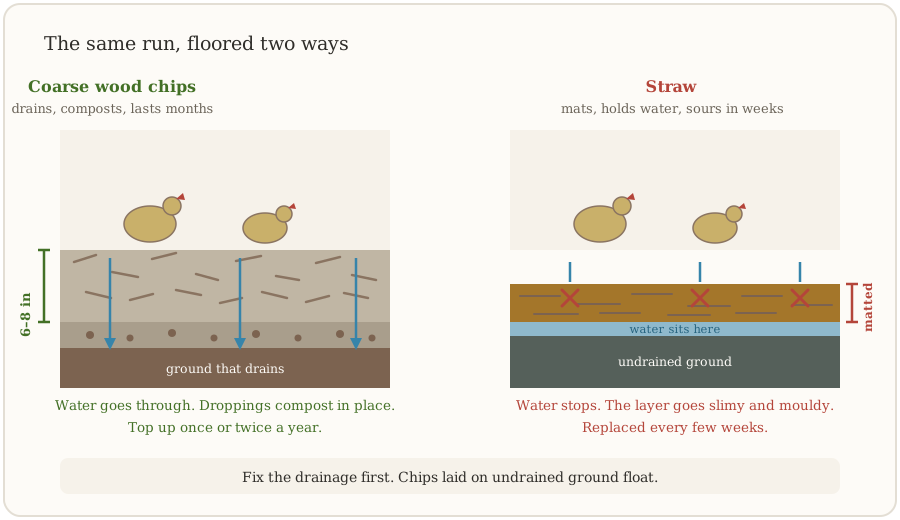
| Straw | Mats, holds water, goes mouldy. The common mistake |
| Hay | Worse than straw — more seed, more mould |
| Sand | Good in dry climates, poor in wet. Does not compost |
| Gravel | Good as a base layer under chips, harsh alone |
| Grass clippings | Mat and go slimy. Thin layers only |
| Rubber mulch | No. Not compostable, and ingestion risk |
| Cedar chips | No. Aromatic oils irritate birds’ airways |
| Treated, painted, dyed wood | No |
| Bare earth | Becomes mud, then a parasite reservoir |
Ring a local tree service
Arborist chips are the right material and they are frequently free — crews pay to dump them otherwise, and many will deliver a load to a driveway.
Ask for hardwood or mixed hardwood and pine, and specifically no cedar and no walnut.
Fix the water first
A muddy run is a drainage problem wearing a bedding problem’s clothes. Adding chips to undrained ground gives you floating chips.
- Divert roof runoff. Guttering on the coop and shed, discharging well away from the run. This alone resolves many cases
- Look at the grade. Water should run away from the run, not into it
- Trench or French drain on the uphill side if it sits below the surrounding ground
- Build the level up — gravel or hardcore base — if the run is in a hollow
- Then six to eight inches of coarse chips on top
Depth and upkeep
- Start at 6–8 inches. It compacts to roughly half over the first few months
- Top up a few inches once or twice a year, and after heavy rain
- Fill the hollows the birds scratch out, especially in dust-bathing corners
- Under four inches turns to mud in a wet week
- Fork it over occasionally if it compacts — the birds do most of this themselves
Deep litter
Letting the bedding build and compost in place rather than stripping it out.
What it gives you:
- Droppings break down instead of accumulating
- Insects and worms colonise it, and the birds forage them
- A little warmth from the composting action in winter
- Good compost at the end, rather than a disposal problem
What it needs:
- Carbon-rich material — wood chips, dry leaves
- The birds’ scratching to turn it, plus an occasional fork
- Damp, not wet. Soaking litter goes anaerobic
- Depth. Thin litter does not compost, it just sits
Ammonia means it has gone wrong
Working deep litter smells earthy, like a forest floor.
If it smells of ammonia it is too wet, too compacted, or too shallow. Ammonia damages birds’ respiratory tracts, and it is the clearest signal available that something needs changing — usually drainage, ventilation or more carbon.
Cost
| Material | Cost | Replace |
|---|---|---|
| Arborist chips | Often free | Top up, 1–2× a year |
| Bagged wood chips | $100–$200 | 1–2× a year |
| Dry leaves | Free, seasonal | Continuous |
| Straw bales | $50–$100 | Every few weeks |
| Sand | $150–$300 | Rarely, but rake weekly |
Straw looks cheapest per bale and is the most expensive over a year, because you buy it again every few weeks.
Afterwards, in the garden
Composted run litter is excellent material — chips plus manure, already partly broken down.
- Let it finish composting for several months. Fresh chicken manure is too high in nitrogen and burns plants
- For food crops, apply well-composted manure at least 120 days before harvesting anything that touches the soil
- Around trees, shrubs and ornamentals it can go on sooner
Which is the argument for wood chips in one line: the flooring problem and the compost supply turn out to be the same job.
Common questions
What is the best mulch for a chicken run?
How deep should mulch be in a chicken run?
Can I use cedar or treated wood chips?
How do I stop a chicken run turning to mud?
What is the deep litter method?
Is chicken run mulch safe to use in the garden afterwards?
Backyard Weekly
Know what to plant, week by week
Join the weekly email for seasonal jobs, fixes for what is going wrong, and gear worth buying.
Not ready to subscribe? The planting calendar is free and needs no email.
By subscribing you agree to our privacy policy. Grow In Backyard will never sell your address.
Keep reading
Rat Deterrent for Garden — 5 Fixes, Only 1 Permanent
A rat deterrent for garden use fails unless food and shelter go first. 5 measures compared, and why poison is the wrong call. See which fits yours.
Best Chicken Coops to Buy — 4 Fixes Before You Order
Knowing the best chicken coops to buy starts with what prefabs get wrong. 4 fixes compared, plus when building costs less. See which your flock needs.
Backyard Chickens: What It Actually Takes
Space, cost, time, and the rules nobody mentions. An honest account of keeping backyard chickens before you buy the coop — including why the eggs are not free.
Chicken Manure Fertilizer: Compost It or Burn Your Plants
Fresh chicken manure is too strong to use directly and carries pathogens. How to compost it properly, the NPK you end up with, and the food-safety waiting periods.