
Outdoor Metal Wall Decor: What Survives a Winter Outside
Most metal wall art is indoor stock sold for gardens. Which metals last, how to hang it without staining the wall, and where it actually works.
 By
On this page
Most metal wall art sold for gardens is mild steel with a thin paint finish — indoor stock with an outdoor photograph. It rusts from the cut edges within a few seasons.
The materials
| Material | Outdoor life | Stains the wall | Notes |
|---|---|---|---|
| Corten weathering steel | Indefinite | Yes, heavily, year 1–2 | Stable oxide layer; the real thing |
| Powder-coated aluminium | Indefinite | No | Light, no rust at all |
| Galvanised steel | Decades | No | Industrial look, very durable |
| Stainless steel | Indefinite | No | Expensive, bright finish |
| Painted mild steel | 2–5 yrs | Yes, as it fails | What most cheap art is |
| Bare mild steel, rusted look | 5–10 yrs | Yes | Keeps rusting; perforates eventually |
| Cast iron | Decades | Yes | Heavy — fixings must suit |
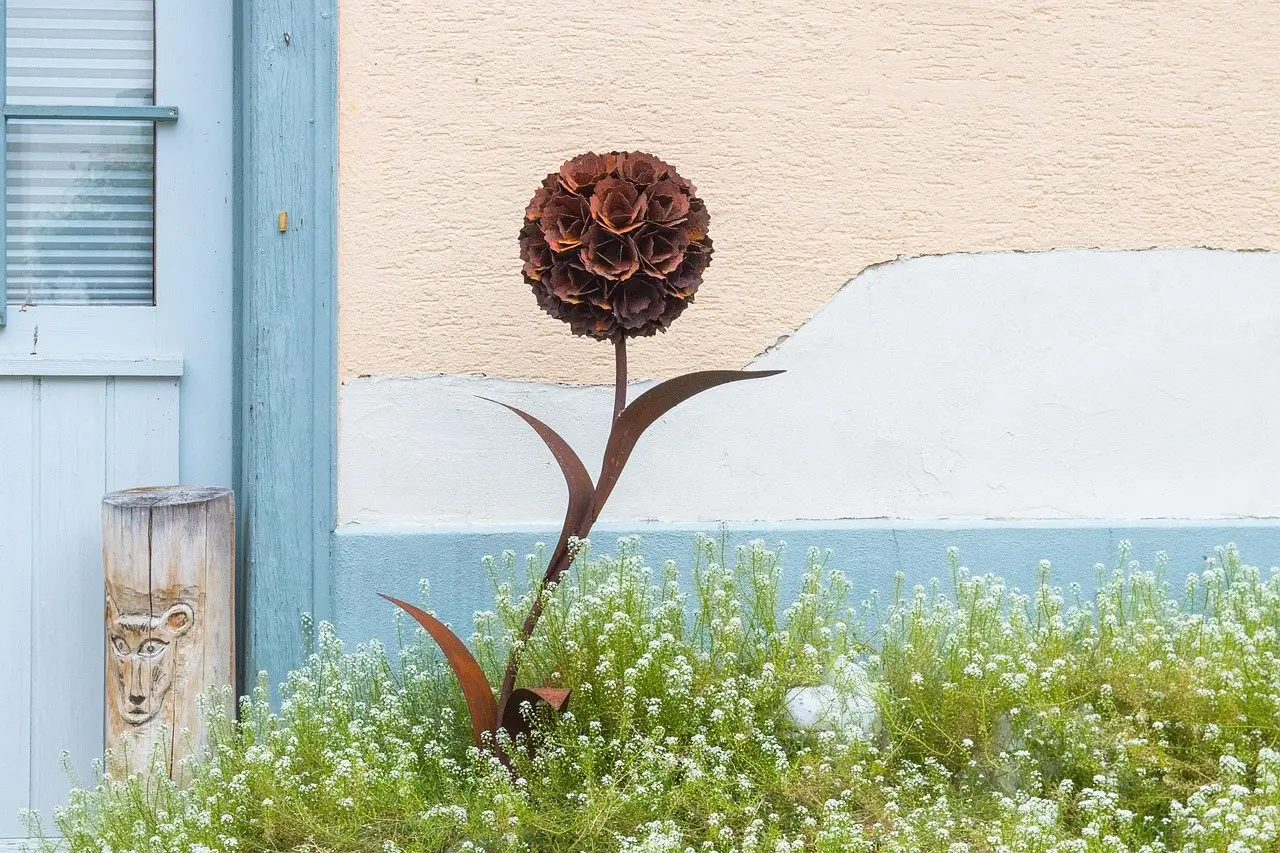
Corten and ordinary rusted steel look identical in a photograph. The price usually tells you which you are buying.
Hanging it without wrecking the wall
- Identify the substrate — solid brick, cavity wall, render on block, timber fence
- Fix into structure. Resin anchors or expanding bolts into brick or the inner leaf. Never into mortar joints alone, never into render on its own
- Stainless or galvanised fixings. Plated steel screws rust and leave their own streaks
- Use standoff spacers — 10 to 20 mm. Air circulates behind the piece, water does not sit between metal and wall, and run-off drips clear
- Check the weight. Cast iron and large steel panels are far heavier than they look
- Two fixings minimum, more for anything wide, so wind cannot rotate it
Corten will stain whatever is under it
Weathering steel sheds iron oxide heavily for its first year or two, and the run-off marks brick, render and paving permanently.
Put it on a fence, a dark wall, or on standoffs with the drip line falling on soil or planting — not on pale render above a patio. This is the single most common regret with corten in a garden.
Where it works
- A plain wall or fence that needs breaking up — the best use
- At the end of a sightline, so the eye lands on it
- Above a seating area, as the focal point the group faces
- On a shed or garage wall, which otherwise contributes nothing
- Lit at night by an uplighter, which doubles the hours it works
Where it does not
- Several small pieces scattered across a wall. Reads as clutter
- Against climbers or busy brickwork, where the outline disappears
- High on a wall, above eye level, where nobody looks
- On pale render, if it is corten or bare steel
- In a windy spot on a single fixing
Making a piece rust deliberately
For bare mild or weathering steel:
- Degrease thoroughly — fingerprints and oil show as pale patches
- Mist with a weak vinegar and salt solution
- Leave it outdoors and repeat over several days
- The colour develops over days to weeks depending on weather
- Seal with a matt exterior lacquer if you want to limit run-off, accepting it needs renewing every few years
On corten, leaving it outdoors does the whole job unaided.
Cheap alternatives that hold up
- Galvanised stock items — a feed trough, a grid panel, corrugated sheet cut to shape
- Powder-coated garden trellis used as a graphic panel rather than for plants
- An old tool or implement, cleaned and sealed
- A mirror in an outdoor-rated frame, which makes a small space read larger
The test for any of them is the same: what is the metal, and what happens to it after two winters.
Common questions
What metal lasts outdoors for wall art?
Will metal wall art stain my wall?
How do I hang heavy metal art on an outside wall?
Does rusted metal garden art keep rusting away?
Where does metal wall decor work best?
Can I make outdoor wall art rust deliberately?
Backyard Weekly
Know what to plant, week by week
Join the weekly email for seasonal jobs, fixes for what is going wrong, and gear worth buying.
Not ready to subscribe? The planting calendar is free and needs no email.
By subscribing you agree to our privacy policy. Grow In Backyard will never sell your address.
Keep reading
Garden Decor Ideas That Don't Look Cluttered in a Year
Most backyard decor gets added piece by piece until the yard looks like a garden center. A short list of what earns its place, and what to skip.
What Is Rustic Decor? Raw Materials, Visible Wear, No Polish
Rustic decor keeps materials in their natural state — unfinished wood, iron, stone — and treats age and imperfection as the point rather than a flaw.
Small Patio Decor Ideas on a Budget That Do Not Look Cheap
A small patio is won or lost on scale and lighting. What to buy, what to make, and the five mistakes that make a small space feel smaller.
Should an Outdoor Fountain Run All the Time? Usually, Yes
Moving water stays clearer and mosquito-free, and most fountain pumps are designed to run continuously. The exception is freezing weather.